

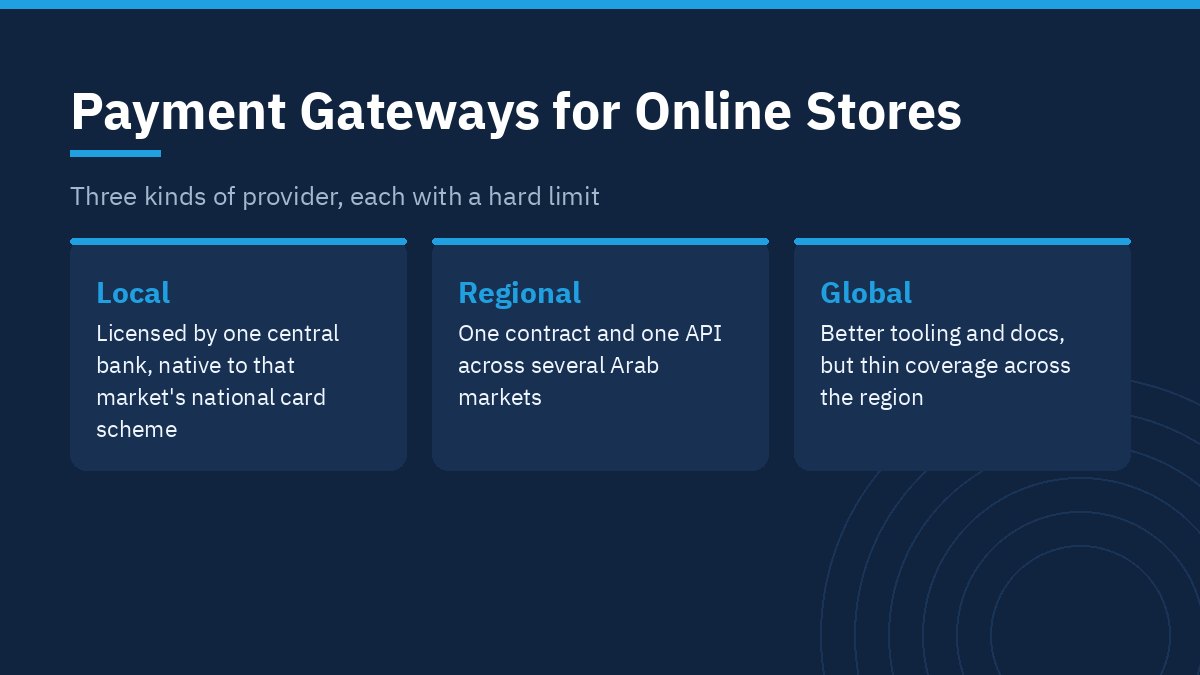
Payment gateways for online stores in Egypt and the Gulf fall into three groups: a local provider licensed in your own country, a regional provider covering several Arab markets, and a global provider that does not operate everywhere in the region. Two questions decide between them before price does. Does the provider accept your market’s national card online, and how fast does the money reach your bank account?
This guide compares payment gateways for online stores using figures published on the providers’ own pricing pages, then gives you a checklist to run before you sign. It names no single winner, because the right answer changes with your country of registration and your order volume.
What does a payment gateway actually do?
A gateway takes card details from checkout, passes them to the banking network, and returns an approval or a decline. It does not hand you money. Behind it sits an acquirer, the party that collects the funds and settles them into your account after deducting its share.
Most providers here bundle both roles into one contract, so you deal with a single company. That is convenient. It also means the headline fee already contains the scheme’s cut, the bank’s cut and the provider’s cut, and you cannot separate them.
How do local, regional and global payment gateways for online stores differ?
The three categories carry real limits, and confusing them is the most common early mistake.
- Local. Licensed by the central bank of one country and native to its national card scheme. Strongest at home, weakest across the border.
- Regional. One contract and one API across several Arab markets, which suits anyone selling into more than one country.
- Global. Better developer tooling and documentation, but thin geographic coverage in this region.
Stripe’s official global availability page shows what that limit looks like: it lists the United Arab Emirates among supported countries, and does not list Saudi Arabia or Egypt. If your entity is registered in Cairo or Riyadh, the provider you read about on an American blog may not be an option at all.
What do payment gateways for online stores actually charge?
The figures below come from the providers’ official pricing pages at the time of writing. They change, so check them yourself before you build a spreadsheet on top of them.
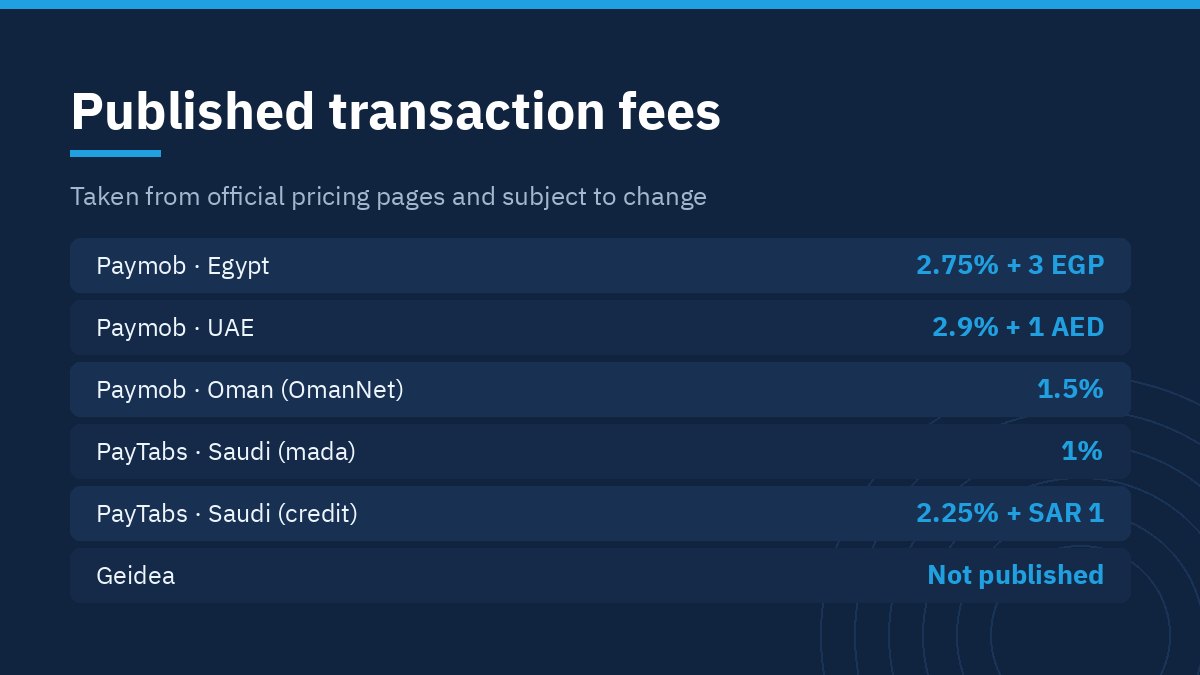
| Provider | Market | Published transaction fee | Monthly fee |
|---|---|---|---|
| Paymob | Egypt | 2.75% + 3 EGP | None, settled weekly |
| Paymob | United Arab Emirates | 2.9% + 1 AED | None, settled weekly |
| Paymob | Oman | OmanNet 1.5%, Visa and Mastercard 2.5% | None, settled weekly |
| PayTabs (Paymes plan) | Saudi Arabia | mada 1%, credit cards 2.25% + SAR 1 | SAR 49 per month |
| Geidea | Saudi Arabia and UAE | Not published, quoted on request | Not published |
| Stripe | UAE only of these three markets | Account dependent | Account dependent |
PayTabs states plainly on its own page that the Paymes prices are part of a testing phase and subject to change. Geidea publishes no public rate at all. That is not a defect on its own, but it does mean you will not know your number until after a sales call.
Why does the national card matter more than the provider’s brand?
In Saudi Arabia, mada is the national card scheme and carries a far larger share of everyday spending than international credit cards. A store that cannot take mada loses buyers at the checkout screen itself. Egypt has Meeza, launched through the banking sector. The UAE has Jaywan, run by Al Etihad Payments under the central bank, and acceptance widened through 2026 to include airlines and online retailers.
So make this your first question to any provider: do you accept my country’s national card online, not only at the point of sale? Some providers support the domestic scheme in physical stores well before they support it in ecommerce.
How do you verify a provider is licensed?
Do not rely on a badge on the provider’s homepage. Every market in the region has a regulator that publishes its own lists:
- In Saudi Arabia, the Saudi Central Bank licenses payment companies and publishes the licensed companies on its site.
- In Egypt, payment service provider licensing runs through the Central Bank of Egypt.
- In the UAE, the central bank regulates retail payment services and card schemes.
Search the legal entity name as it appears in your contract, not the trading name in the advert. They are sometimes different, and some payment gateways for online stores are resellers sitting on another company’s licence.
What should you ask payment gateways for online stores before signing?
The advertised rate is not the total cost. Ask for these in writing:
- Settlement time to your bank account, and what delays it.
- Whether there is a one-off setup or integration fee.
- Refund fees and chargeback fees.
- Daily or monthly volume caps on a new account.
- Whether the rate differs for locally issued cards versus foreign-issued cards.
- The documents needed to open the account and the expected review time.
Companies that answer clearly and quickly now are usually the ones that answer at the same speed on the day payments break.
Do you need more than one payment gateway?
If you sell in one market and you are early, one of the payment gateways for online stores is enough, and a second only adds work. Three situations justify a second provider: selling in two countries no single provider covers well, reaching a volume where half a percentage point is real money, or having lived through a long outage and wanting a tested fallback.
Several providers means a routing layer that decides which gateway takes which order. That is extra development work and belongs in the budget from day one, as our breakdown of what an online store costs to build explains.
How does your platform choice affect payment gateways for online stores?
Your platform decides which gateway installs with a ready plugin and which needs custom development. A plugin is faster and cheaper but sometimes lags behind the provider’s updates. Custom work costs more and gives full control of checkout. That trade sits inside a larger decision covered in our comparison of WooCommerce, Shopify and Salla.
Before any of it, finish the legal side. Providers ask for company documents before activating an account, which our guide to opening an online store in Egypt lays out.
What is the practical next step?
Put four things on one page: country of registration, the national card in your market, expected average order value, and monthly order count for the first six months. Then ask at least two providers for a quote against those same numbers. Comparing two written quotes beats comparing two pricing pages.
For the payment methods themselves and what buyers expect in each market, read online payments in Egypt and online payments in Saudi Arabia and the Gulf. The official register of licensed payment companies in Saudi Arabia is published on the Saudi Central Bank site.
Frequently asked questions about payment gateways for online stores
Which payment gateway is cheapest in Egypt?
There is no single answer, because the advertised rate is not the whole cost. Paymob publishes a fee of 2.75% plus 3 EGP per transaction with no monthly charge on its official pricing page. Weigh that against settlement time, refund fees and chargeback fees at each provider before deciding which is actually cheaper for you.
Do I need a commercial registration to open a gateway account?
In normal circumstances, yes. Payment providers in Egypt and the Gulf are supervised by their central banks and require documents proving the legal entity before they activate an account. Ask your provider for the document list and the expected review period early, because that period affects your launch date more than the integration work does.
Can I use Stripe in Saudi Arabia or Egypt?
Stripe’s official global availability page lists the United Arab Emirates among supported countries and does not list Saudi Arabia or Egypt at the time of writing. If your entity sits in either country, look at a local or regional provider instead, and check the availability page yourself because these lists do change.
Why are some transactions declined even when the card is valid?
Most declines come from the card issuing bank rather than the gateway. The usual causes are insufficient funds, online purchases disabled on the card, or a failed additional verification step. Ask your provider for a report of decline codes, because it shows quickly whether the problem is your configuration or your customers’ cards.
When does the money actually reach my bank account?
Settlement periods differ by provider and by market. Paymob, for example, states on its Egypt, UAE and Oman pricing pages that funds are settled weekly. Treat settlement time as a negotiable term exactly like the rate, because it decides how quickly you can buy your next batch of stock.
Need help connecting a payment gateway?
Arqam Web is a web design and development company that builds online stores and connects them to the payment gateways for online stores that fit the client’s market. If you are launching a new store, or moving an existing one to a different provider, see our pricing page or request a quote.