

The online store cost at Arqam Web starts at $885 for the Launch e-commerce package published on our pricing page, which covers a full store with cart, checkout, customer accounts and the first twenty products entered for you. The figure climbs from there with product count, shipping rules, languages and any system you need the store wired into.
This article breaks that number into its parts, shows what pushes it up, what is not worth paying for, and which recurring costs most owners leave out of the budget. If you are still deciding between a store and a brochure site, how much a website costs in Egypt covers the other half of that decision.
What are you actually paying for in an online store?
A store is not pages with photos and prices on them. It is a system that takes an order, reserves stock, collects money, hands the parcel to a courier and leaves an accounting trail behind all of it.
The difference between one quote and another is usually how many of those links the quote really covers. A cheap build gives you a good-looking front end and a working cart, and then you discover after launch that shipping is calculated by hand and stock never drops when something sells.
Any serious store has five cost blocks: design, the build plus product entry, payment integration, shipping integration, and the technical setup that lets search engines read the catalogue. Any block missing from the quote comes back later as an invoice or as daily manual work.
How much does an online store cost in Egypt and the Gulf today?
We publish our prices instead of hiding them. The Launch e-commerce package is $885 one time. It includes a custom-coded site, the domain and first year of hosting, a full store with cart and checkout, payment gateway support, customer accounts, the first twenty products entered, an admin dashboard, and delivery in five days. The informative package without a store is $490, and the gap between the two numbers is what the commerce layer itself costs.
Larger projects are quoted to scope, because a hundred-product store and a three-thousand-product store are not the same job in any respect: not data entry, not category structure, not page speed, not internal search.
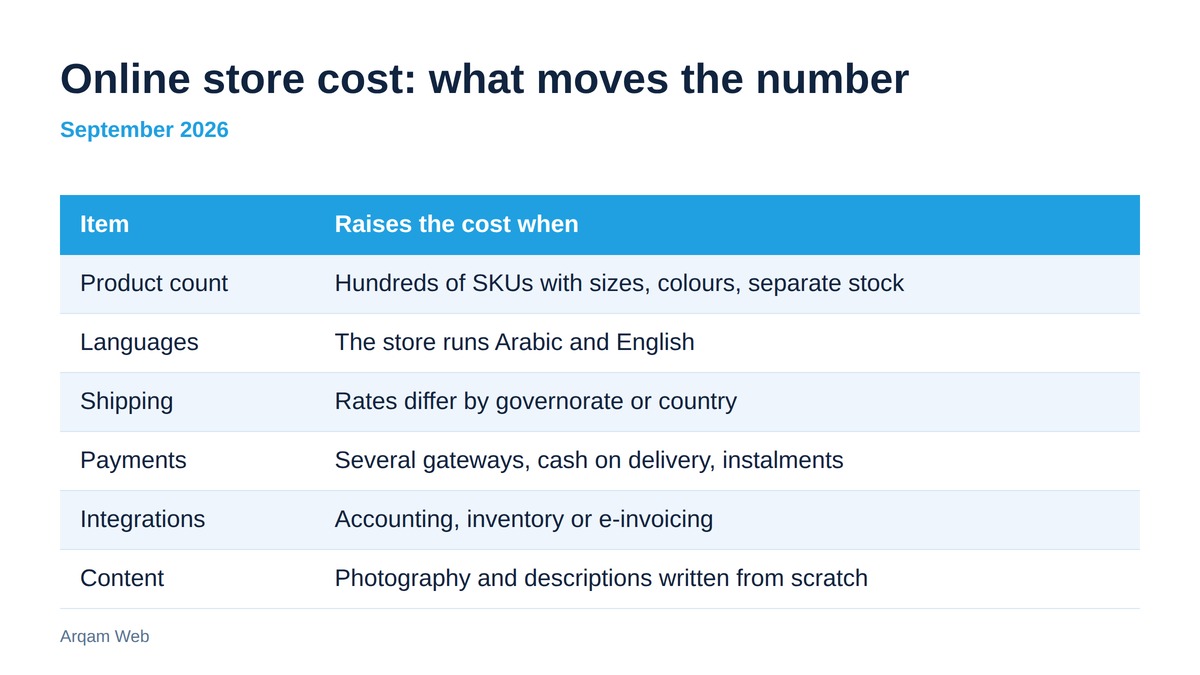
So the sharper question is never “what does an online store cost” but “what does a store with these specifications cost”. The specifications move the number, and they are in the table below.
What raises the online store cost?
These are the items that explain why two quotes for the same brief differ. Read them before you ask for a price, and decide which ones you genuinely need in your first year.
| Item | Raises the cost when | Does not when |
|---|---|---|
| Product count | You pass a few hundred SKUs, each with sizes, colours and separate stock | You have dozens of products with clean data in one file |
| Languages | The store runs Arabic and English, so every product, policy and label is written twice | One language only |
| Shipping | Rates differ by governorate or country and a courier API is wired in | Flat rate or pickup from the branch |
| Payments | Several gateways, cash on delivery and instalments | A single gateway |
| Integrations | Accounting, inventory or e-invoicing systems | Everything is managed from the store dashboard |
| Content | Product photography and descriptions are written from scratch | Images and copy are ready and approved |
The item that surprises owners most is content. Photographing a hundred products and writing a selling description for each is real work with real hours, and it is usually the largest hidden line in the online store cost.
What does the payment gateway take per sale?
This is an operating cost that never appears in a build quote, but appears in every order.
Paymob publishes its rate openly: 2.75% plus EGP 3 per transaction, with no monthly or subscription fee, and weekly settlement to your bank account. The full terms are on the Paymob pricing page.
Build that percentage into your margin before you set a retail price. On an average order of EGP 1,000, roughly EGP 30 goes to the gateway. That is comfortable on a product with a forty percent margin and painful on one with eight.
Cash on delivery carries a different cost: the return rate. It shows up on nobody’s invoice and eats more profit than any gateway fee.
What are the recurring costs after launch?
The common mistake is budgeting the build alone. A store is an operating asset, and like any operating asset it has an annual running cost.
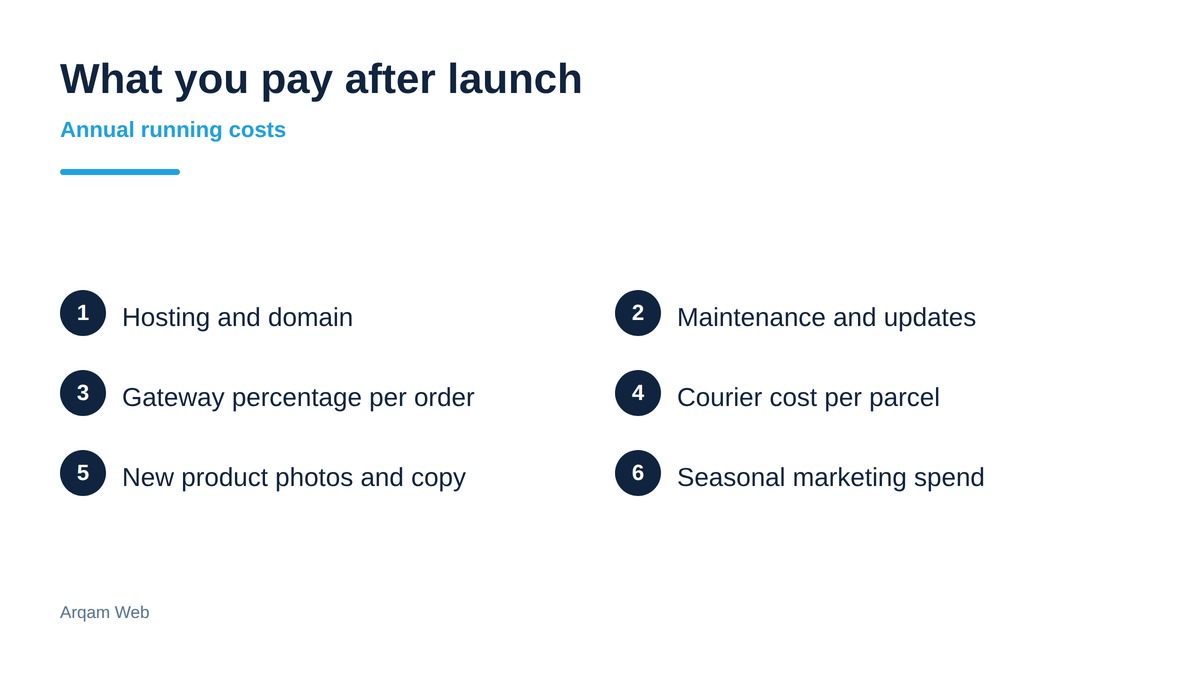
- Hosting and domain: our managed hosting starts at $15 per month billed annually, with an SSL certificate, daily backups, email on your domain and automated uptime monitoring.
- Maintenance: the care plan starts at $30 per month, covering a weekly check, plugin and theme updates, and a backup before every update.
- Payment fees: a percentage on every order, as above.
- Shipping: your courier contract, charged per parcel.
- Content and marketing: new products, new photography, seasonal offers.
A store with no annual operating budget becomes, within a year, a slow site running outdated plugins and showing products that sold out months ago.
Ready template or a store built to fit your operation?
This decision moves the number more than any other line, and there is no single right answer to it.
| Criterion | Ready template | Built to fit |
|---|---|---|
| Upfront cost | Lower | Higher |
| Time to launch | Days | Weeks |
| Speed | Carries code you never use | Carries only what you need |
| Changing it later | Limited to what the template author allowed | Open |
| Suits | Testing an idea or a small catalogue | An established business with its own processes |
The practical rule: if you are testing the market and have not yet proven the product sells, start as cheaply as you can. If you already have sales and want to move them online, saving on the build costs you every day in operations.
What happens if you take the cheapest quote?
The cheapest quote is not wrong by itself. The problem is that a low number usually has a reason, and the reason shows up after handover rather than before.
What we see most often when we take over a store built elsewhere: a paid template loaded with twenty plugins the shop never uses, slowing it down; a product page with no size or colour fields, so customers type them into the order notes; stock that never decrements, so you sell what you do not have; and pages with no meta titles at all, so the store never surfaces in search.
Fixing those four later sometimes costs more than rebuilding, because you are repairing a structure that was never meant to be modified. The lowest online store cost on paper is not always the lowest over two years.
Ask before you sign: do I own the code? Can I move the store to another host? Who holds the domain account? What happens if we stop working together?
What do we need from you before the build starts?
Having these ready shortens the timeline and lowers the price. Missing them is the number one reason projects slip.
- A product file with name, description, price, variants and quantity.
- Product photos on a consistent background, large enough to zoom.
- Your shipping policy: zones, rates and delivery times.
- A final returns and exchange policy.
- The official contact details that will appear on the site.
- A payment gateway account, or the documents needed to open one.
We help organise this material and draft the policies, but the commercial decisions inside them are yours, and nobody can make them for you.
Where not to save money
Save by deferring, not by deleting. Start with your best sellers rather than the full catalogue. Add a second language once you can see customers searching in it. Push loyalty programmes and instalments to after your first hundred orders.
Three things are not worth cutting: page speed, checkout clarity, and the product page. Google’s Core Web Vitals ask for a Largest Contentful Paint within 2.5 seconds, an Interaction to Next Paint of 200 milliseconds or less, and a Cumulative Layout Shift of 0.1 or less, measured at the 75th percentile of page loads. The official thresholds are published on web.dev.
A slow store loses the order before anyone sees it, and no ad budget buys that back.
Frequently asked questions about online store cost
How much does an online store cost for a beginner?
The Launch e-commerce package at Arqam Web is $885 one time. It covers the store, the domain, the first year of hosting, the first twenty products entered, and delivery in five working days. That figure suits anyone starting with a limited catalogue who wants to launch quickly before scaling up.
Does the price include entering my products?
The Launch package includes the first twenty products. Anything beyond that is quoted on the number of products and how ready the data is. When images, descriptions and prices sit in one organised file, entry is far faster and cheaper than starting from scattered pages or phone photos.
What will I pay monthly after launch?
The fixed lines are hosting from $15 per month and maintenance from $30 per month. On top sit the variable ones: the payment gateway percentage on every order, your shipping costs, and any marketing you decide to spend. The domain renews annually.
Do I need a commercial registration to open an online store?
Yes. Selling for money is commercial activity and needs to be registered, and the procedure differs between Egypt, Saudi Arabia and the UAE. We build the store and connect the gateway, but the paperwork goes through your accountant or a legal office, because gateways ask for those documents before they activate an account.
What is the difference between WooCommerce and a monthly subscription platform?
WooCommerce runs on your own hosting, so you own the store and its data and pay no commission on sales to a platform, in exchange for owning updates and maintenance. A subscription platform handles operations for a monthly fee and sometimes a percentage, and limits you to what it allows.
How long does a store take to build?
The Launch package is delivered in five working days, provided the content is ready. Larger stores take weeks, and in our experience the main cause of delay is not development. It is waiting for product photos and descriptions from the client.
Start from a clear number
Arqam Web is a web design and development company based in Sheikh Zayed, serving clients across Egypt and the Gulf. We build stores on WooCommerce with clean code, and we publish our prices on the site instead of asking you to get in touch to find them. Look through our work or the web design and development service to see how we build.