

WordPress or custom code? The short rule: choose WordPress when your site is content, service pages, a blog and a standard store, and choose custom code when the heart of the project is business logic that does not exist off the shelf. The difference is not quality. It is the distance between what you need and what already exists.
WordPress or custom code: what is the technical difference?
WordPress is a ready made open source content management system that you build on with a theme, plugins and code changes where needed. Custom code means writing the application from scratch on a framework such as Laravel or Node, so nothing exists that you did not ask for.
Asking WordPress or custom code is like asking whether to buy a flat in a finished building or build a house. The first is faster and cheaper and bounded by what the building allows. The second gives you everything and asks for time, money and maintenance.
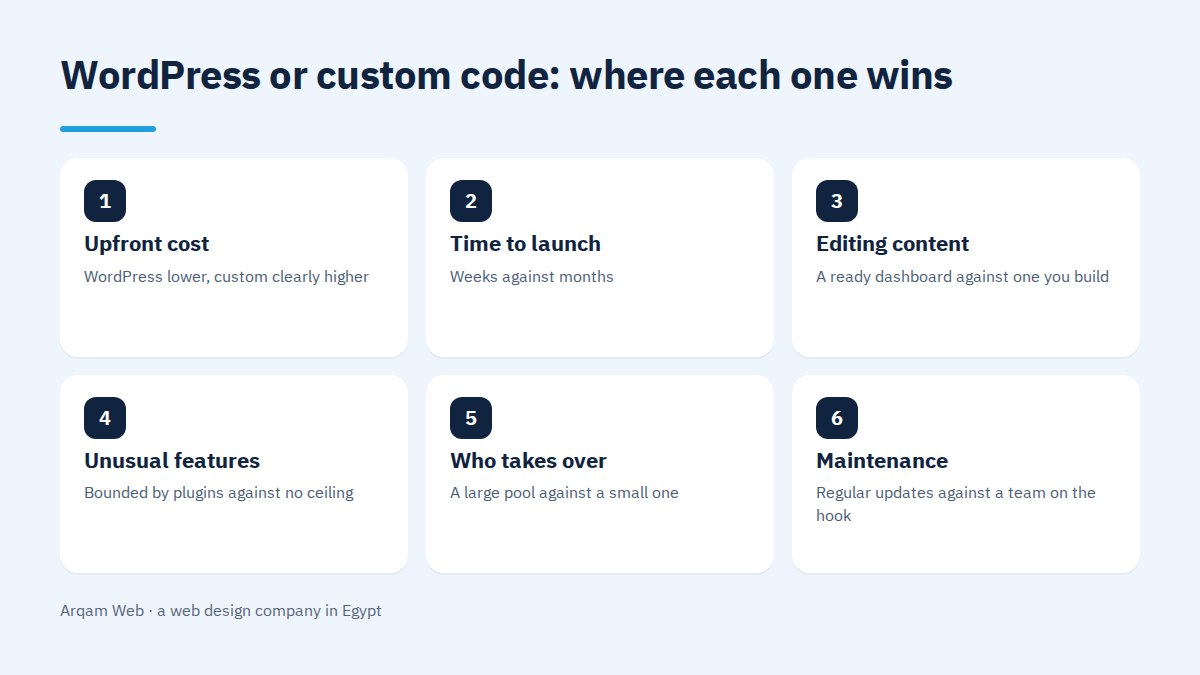
WordPress or custom code on the lines a business owner cares about
| Line | WordPress | Custom code |
|---|---|---|
| Upfront cost | Lower | Clearly higher |
| Time to launch | Weeks | Months |
| Editing content yourself | Easy from a ready dashboard | Needs an admin panel built first |
| SEO | Mature, ready tooling | Built by hand from zero |
| Unusual functionality | Bounded by available plugins | No ceiling |
| Maintenance | Regular plugin and core updates | No external updates but a team on the hook |
| Security | A common target because it is everywhere | Less targeted, more dependent on team discipline |
| Who can take over after you | A large pool of developers | A small pool who know this codebase |
Look at that last line. Plenty of businesses choose custom code and later discover that changing supplier is harder than they expected.
When is WordPress the right call?
- A company or services site. Service pages, work, a blog and a contact form.
- A standard online store. Products, categories, cart, payment and shipping through WooCommerce.
- A content led site. Anyone publishing weekly needs a comfortable editor, not a support ticket per edit.
- A fixed budget and deadline. WordPress reaches the market sooner, and that alone can settle it.
- A bilingual site. Running Arabic and English has mature, tested solutions.
Most business sites in Egypt and the Gulf sit here, which is why the answer to WordPress or custom code is WordPress in the majority of cases.
When is custom code the sounder choice?
- Distinctive business logic. Complex pricing, calculations, matching two sides of a marketplace, or an internal workflow no plugin covers.
- Very large data volumes or many concurrent users running heavy operations.
- Deep integration with internal systems such as an ERP or a bespoke inventory platform.
- The product is the software. If you sell a subscription to an application, that application is not a brochure site.
- Security or regulatory requirements that demand control of every line.
Is WordPress slow?
WordPress is not inherently slow. Slowness comes from a heavy theme, twenty plugins, uncompressed images and cheap shared hosting. A disciplined WordPress site on suitable hosting with caching and compressed images competes with any custom build, and the reverse holds too: an undisciplined custom site is slower.
The rule: speed is a result of build decisions, not of the technology name. Read website components to see what actually weighs a page down.
WordPress or custom code over five years?
A fair comparison is not the build price alone. Add the build, then annual maintenance, then the cost of a typical mid sized change, then the cost of moving to another supplier. WordPress starts lower and needs update discipline. Custom code starts higher, saves plugin fees and ties you to a team that knows the codebase.
For the numbers on the other side, see how much a website costs in Egypt and the pricing page.
Five questions that settle it in ten minutes
- Does my project contain a calculation or rule I cannot find on any similar site? If yes, custom code belongs on the table.
- Who edits the content in two months? If it is a non technical colleague, WordPress saves you an endless support queue.
- How much content will there be in a year? Publishing weekly needs a mature editor and ready SEO tooling.
- Do I have a technical team or a long term partner? Custom code with nobody to maintain it becomes a sealed box.
- What is the real launch date? If it is soon, weeks versus months settles the debate on its own.
Answer those five honestly, then ask WordPress or custom code again. The answer usually arrives without a long technical argument.
What should stay out of the decision?
Three arguments come up often and make poor foundations: the opinion of a developer selling what they happen to know, the idea that WordPress is for beginners, which is false since large publishers run on it, and the idea that custom code is automatically safer, which is also false because security is discipline rather than technology.
The middle path we build often
Many projects do not need a hard choice. We build the marketing site and content on WordPress so the client edits it directly, and build the business logic as a separate application that connects to it. You get editing freedom where the content lives and programming freedom where the logic lives.
That approach retires the WordPress or custom code question and replaces it with a sharper one: which part of my project is content and which part is logic?
Frequently asked questions
WordPress or custom code for a small business site?
WordPress, almost always. A small business site is service pages, work, a blog and a contact form, all of which exist ready and proven. Custom code here means paying several times more for flexibility you will never use.
Is WordPress secure?
It is as secure as its management is disciplined. Most breaches come from outdated plugins, weak passwords or poor hosting rather than the core itself. A site that is updated regularly with daily backups and a protection layer stands in good shape.
Can a WordPress site move to custom code later?
Yes, and the content transfers through the WordPress API. What does not transfer is the design and the plugins, which get rebuilt. That is why many businesses start on WordPress to validate the idea and rebuild once the need is clear.
What makes a WordPress site look cheap?
A stock theme used untouched, generic photography, machine translated copy and fonts that do not suit Arabic. The problem is execution, not the platform. A carefully built WordPress site is indistinguishable from a custom one.
Does an online store need custom code?
Usually not. WooCommerce covers products, categories, cart, payment, shipping and coupons. Custom code starts to make sense with complex pricing, deep integration into a bespoke inventory system, or very large data volumes.
Settle it in a short call
Describe what your site has to do and we will say plainly which road suits your case, even when it is the cheaper one, because WordPress or custom code is decided by the job the project does and not by what the builder prefers. Read types of websites beforehand so you arrive with a sharper question.
Request a quote · Message us on WhatsApp · Call us
Arqam Web
44 Central Axis, Al Saraya Mall, Lower Ground, Entrance 2, Sheikh Zayed, Giza, Egypt
Phone and WhatsApp: +20 111 872 1404 · Email: info@arqamweb.com