

Online payments in Egypt are no longer a single choice. A store here needs cards, mobile wallets and retail payment codes, alongside cash on delivery, which still carries most orders. Fee structures repeat across every provider: a percentage of the transaction, a flat charge per order, or both together. The rates themselves are negotiated.
What follows is general market information rather than financial or legal advice. Your actual numbers come from the provider you sign with and from your own accountant.
Which online payments in Egypt can your store actually offer?
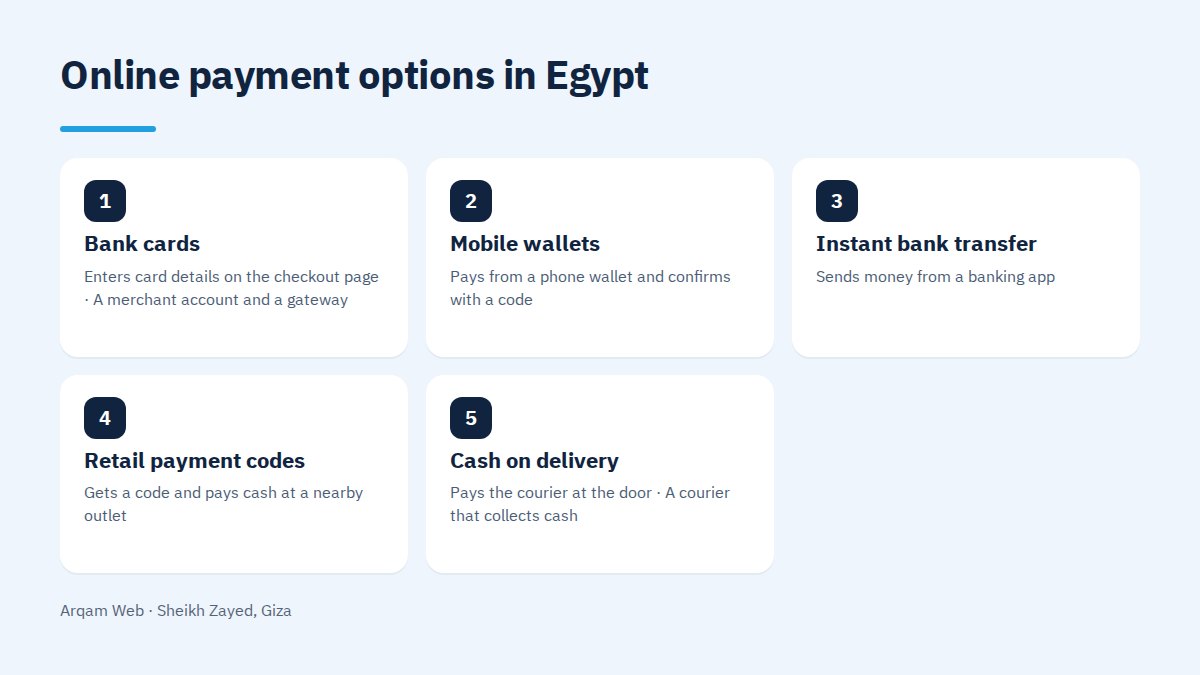
| Method | How the buyer uses it | What you need |
|---|---|---|
| Bank cards | Enters card details on the checkout page | A merchant account and a gateway |
| Mobile wallets | Pays from a phone wallet and confirms with a code | The method enabled inside the gateway |
| Instant bank transfer | Sends money from a banking app | A bank account and manual or linked confirmation |
| Retail payment codes | Gets a code and pays cash at a nearby outlet | The method enabled, plus a collection window |
| Cash on delivery | Pays the courier at the door | A courier that collects cash |
Do not switch on all the online payments in Egypt at once. Start with cards, wallets and cash on delivery, then add the rest when buyers ask for them.
What does a merchant account application need?
Documents vary between providers, and the core stays the same:
- Commercial registration and a tax card in the name of the entity receiving the money.
- A bank account in that same name, because settlement goes nowhere else.
- Identification for the owner or authorised signatory.
- A working store with a refund policy, terms of use and real contact details.
- A description of your business, your average order value and expected volume.
Providers review the business itself, not only the paperwork. Approvals usually stall over a missing refund policy or a store that does not make clear what it sells.
How are fees for online payments in Egypt built?
Four elements repeat at every provider, and what changes is the size of each one:
- A percentage of the transaction value, the main element in most contracts.
- A flat charge per successful order, whose weight shows up on small baskets far more than large ones.
- Settlement terms, meaning how and when the money reaches your bank account.
- Refund and chargeback handling, sometimes charged per case.
Setup charges, monthly charges or integration charges may sit on top. This is why comparing providers by one number means nothing. Compare the whole structure against your own average order value.
The rates are negotiated with each provider, and they move with your sales volume, your category, your average order value and your refund rate. A store selling a few large orders negotiates on different ground from one selling many small ones. Ask for the offer in writing, and reopen the conversation after a few months of trading.
Why does cash on delivery still dominate online payments in Egypt?
The reason is trust rather than technology. A buyer who does not know your store would rather see the product before paying, especially on a first order. Habit around cash adds to that, as do bad experiences with stores that never delivered.
Removing it early costs you orders rather than fees. The shorter path is to keep it, make prepayment feel easier and safer, then watch the split month by month.
What does cash on delivery really cost?
It looks free because no gateway percentage appears on the invoice. The cost shows up elsewhere:
- Refusals at the door, where you carry shipping both ways with no revenue.
- The courier’s cash collection charge, on top of the delivery fee.
- Working capital tied up between delivery and the cash reaching you.
- Your team’s time confirming orders by phone before dispatch.
- Stock held inside orders nobody has paid for yet.
Add those lines up across ten real orders of your own, then compare the result against the fee structure of online payments in Egypt on the same ten orders. A comparison on your numbers beats one in theory.
How do you reduce checkout abandonment?
Most people who abandon a basket had already decided to buy. The last step was longer or more worrying than it needed to be:
- Show shipping cost before checkout, not inside it.
- Allow buying without creating an account.
- Display accepted payment methods and the security seal where they are visible.
- Cut the fields down to what delivery genuinely requires.
- Put the return and refund policy beside the pay button rather than on a distant page.
- Keep checkout fast on mobile data, since a delay here loses an order that was already paid for in the buyer’s mind.
Read types of websites to see what a store needs compared with a brochure site before you commit to a build.
What to prepare before applying to a gateway
Prepare your documents, your policy pages, a bank account in the business name, and an estimate of average order value and monthly order count. Ask every provider for four things in writing: the full fee structure, settlement terms, refund handling, and which methods run inside the same account.
Then ask for a test account and complete a real purchase from your own phone before launch. The Boya Store project shows a store built with payment and shipping methods connected.
Which methods suit which business?
Priorities among online payments in Egypt shift by category. A store selling mid-priced products needs cards, wallets and cash on delivery. Services invoicing large amounts lean on transfers and cards with no cash collection at all. Digital products need prepayment only, because delivery is instant. To see how these choices affect the build budget, read how much a website costs in Egypt and our pricing page.
Frequently asked questions
Are online payments in Egypt safe for a small store?
Card details are entered on the gateway’s own page or a secure frame, so they never pass through your hosting and are not stored on your side. Your responsibility is a valid security certificate, an updated platform, a clear refund policy, and a record of every order. This is general information, not legal advice.
What percentage will I pay?
No general figure is honest, because rates are negotiated and they shift with sales volume, category, average order value and the method itself. Ask more than one provider for a written offer covering the percentage, the flat charge, settlement and refund handling, then compare those offers against your real orders.
When does the money reach my bank account?
Settlement timing is a contract term rather than a market rule, and it differs by method and by provider. Ask for it in writing before signing, because it affects your working capital more than a small difference in percentage does, particularly if you buy stock with cash.
Do I need commercial registration and a tax card?
Providers ask for business documents and a bank account in the same name so settlement can run, and each provider’s list differs a little. Confirm the requirements with the provider directly and with your accountant before applying. This is general information rather than legal or tax advice.
Should I switch cash on delivery off once cards work?
Not in one move. Track the share of buyers choosing each method, encourage prepayment with something concrete such as faster shipping or a small discount, then decide after a few months on your own data. Switching off early cuts orders before it cuts cost.
Work out your payment methods before the build
Send your category and your average order value, and you get the methods that fit, what to prepare before applying to a gateway, and what the store needs to connect them. We work from our office in Sheikh Zayed, Giza, and remotely across Egypt and the Gulf.
Request a quote · Message us on WhatsApp · Call us
Arqam Web
44 Central Axis, Al Saraya Mall, Lower Ground, Entrance 2, Sheikh Zayed, Giza, Egypt
Phone and WhatsApp: +20 111 872 1404 · Email: info@arqamweb.com