

To open an online store in Egypt you need more than a website. You need a short product list with real stock, a product data file, photographs, a courier agreement, at least one live payment method, written policy pages, and a support channel with a reply time you can actually keep.
The registration side, meaning commercial registration, the tax card, activity codes and VAT, is covered in a separate article. What follows is general operational planning information, not legal, tax or financial advice.
What do you prepare before you open an online store in Egypt?
Treat the launch as a packing list rather than a design step. Seven things should be finished on launch day.
- A defined product list with prices and real quantities in storage.
- A product data file ready to import, not typed by hand.
- Photographs on one background, at one size, for every product.
- A courier agreement covering the governorates you plan to sell to.
- One live payment method at minimum, alongside cash on delivery.
- Policy pages written for your operation, not copied.
- A published support channel and a reply time you can hold.
Preparing this material first makes the build faster and cheaper, because the development team receives data instead of open questions. If the shape of the site is undecided, read our page on types of websites first.
How many products should a new store launch with?
Start with the number you can photograph, describe and restock without gaps. Most people who set out to open an online store in Egypt begin with a list longer than their first month can carry, then write copy for items nobody asks about.
A small, well ordered catalogue outsells a wide half finished one, because buyers compare inside a category rather than across unrelated items. Pick products you can refill quickly, and leave heavy or fragile goods until later. For Boya Store we organised the catalogue into five categories and seven brand sections, which is why new products go in without a rebuild.
Which fields belong in the product data file?
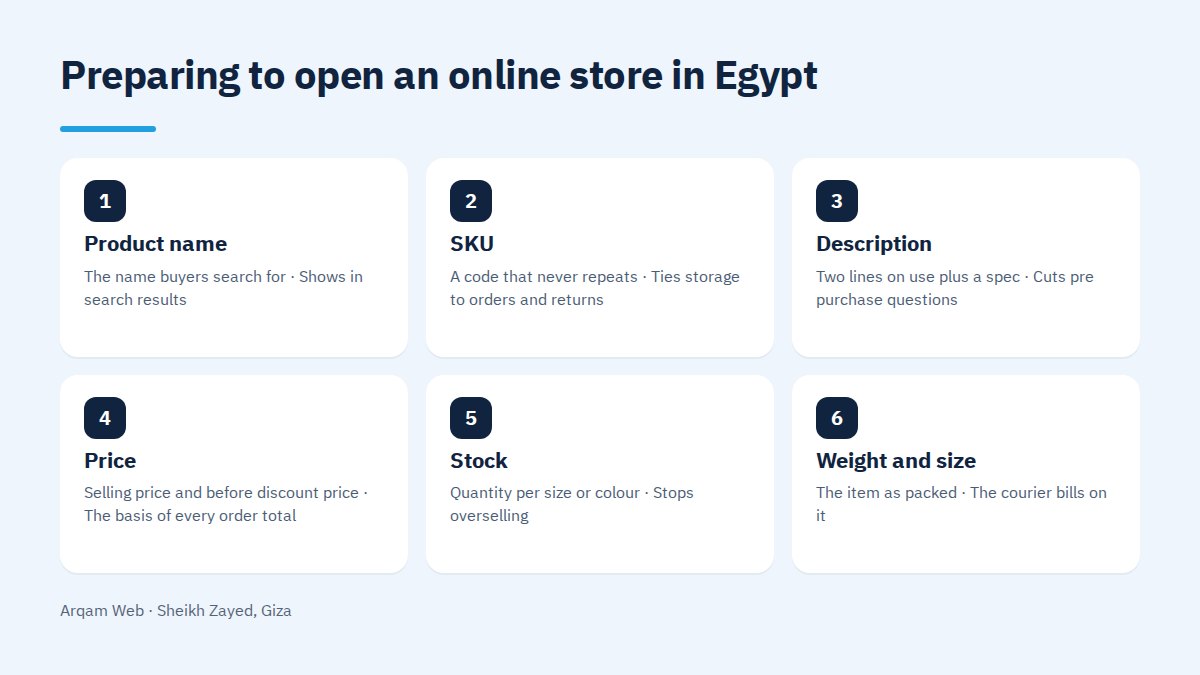
The product table is the most useful file in the project. Write it once, in one spreadsheet, with fixed columns.
| Field | What it holds | Why it matters |
|---|---|---|
| Product name | The name buyers search for | Shows in search results |
| SKU | A code that never repeats | Ties storage to orders and returns |
| Description | Two lines on use plus a spec | Cuts pre purchase questions |
| Price | Selling price and before discount price | The basis of every order total |
| Stock | Quantity per size or colour | Stops overselling |
| Weight and size | The item as packed | The courier bills on it |
| Category | Section and subsection | Sets navigation and filters |
Photography eats more time than store owners expect. One background, one lighting setup, one image size: a main shot per product, two more from other angles, and one showing scale against a familiar object. A recent phone camera is enough if held steady in natural light.
Where does stock live and who owns the number?
Before the first order, pick one place for stock and one person responsible for the count. Even when that place is a room at home, shelve products by code and record every item in and out the same day.
The most common failure is selling something that ran out, then calling the buyer to apologise for a paid order. Connect stock to the storefront so a zero quantity stops the sale.
What should you settle with a courier before launch?
Delivery is the piece most people underestimate when they open an online store in Egypt. One courier is simpler to reconcile, two protect you from weak coverage in a governorate. Start with one on real orders, and get these points in writing.
- Governorates covered and areas with special terms.
- Delivery time per area, not a general promise of a few days.
- Cash collection and when the collected money reaches you.
- Parcels refused at the door and who pays the return leg.
- Returns, and how the item is collected.
- Packing requirements for anything breakable.
- Tracking links, sent automatically or not.
Then copy those areas and delivery times onto your shipping page, and show the cost before the payment step, not inside it.
Which payment methods should you switch on first?
Three methods cover the practical floor in the Egyptian market: bank cards, mobile wallets, and cash on delivery. Dropping the last one early costs you orders. Switching everything on at once drags out the gateway review.
Ask each gateway for its fee structure in writing, its settlement period, and how refunds are handled. Payments derail many plans to open an online store in Egypt because they get left to the last week. Open that file when the build starts.
What does the store need after the buy button?
The experience after checkout produces the second order. Write the policy pages for your own operation: shipping and delivery windows, exchange and return terms with the period and condition you accept, privacy, and terms of use. A copied policy causes a dispute the moment your reality differs from it.
Then name one support channel, a reply time you can meet on working days, and who answers on holidays. Saved replies for the five most repeated questions cut support time sharply. Packaging belongs in the cost of every order too: a box, protective material, tape and a label.
How much working capital do you need to open an online store in Egypt?
Working capital is the money locked in operations before it comes back. Treat it as a list, not one figure: first stock, packing materials, photography, the build and hosting, delivery on orders shipped and not yet collected, cash collected but not yet transferred, the first advertising budget, and a reserve for returns.
What surprises new owners is the gap between paying for stock and receiving buyers’ cash. Estimate it in days and hold liquidity to cover it. For the build side, see our pricing page and the website design and development service.
Frequently asked questions
What are the practical steps to open an online store in Egypt?
Fix your first product list, prepare a data file and photographs for every item, agree areas, rates and returns with a courier, switch on at least one payment method beside cash on delivery, write your policy pages, publish a support channel, then build the store on that material.
How many products should I start with?
As many as you can photograph, describe and restock without interruption, rather than everything you might eventually sell. One category with enough depth to let a buyer compare works better than a thin spread. Widen the catalogue once you know what actually gets ordered.
Do I need a warehouse first?
Not necessarily. A tidy room with coded shelves and a daily record of items in and out is enough early on, as long as stock is connected to the storefront so sales stop at zero. Move to a warehouse once daily orders pass what one person can pack.
One courier or several?
Begin with one so you can judge performance on real orders, because running two from day one doubles your tracking and reconciliation. Add a second when you find a governorate with weak coverage, repeated delays, or trouble with cash collection. Get the terms in writing first.
Should I keep cash on delivery?
Yes, at the start, because many buyers still prefer it with a store they do not know. Run it next to cards and wallets, watch how the split moves month by month, then decide from your own order data and return costs rather than preference.
Build on data you already have
Send your product count, categories, shipping plan and preferred payment methods, and you get a written proposal covering what it takes to open an online store in Egypt properly. We work from our office in Sheikh Zayed, Giza, and remotely elsewhere.
Request a quote · Message us on WhatsApp · Call us
Arqam Web
44 Central Axis, Al Saraya Mall, Lower Ground, Entrance 2, Sheikh Zayed, Giza, Egypt
Phone and WhatsApp: +20 111 872 1404 · Email: info@arqamweb.com