

What separates online payments in the Gulf from the Egyptian market is expectation. A buyer in Riyadh or Dubai assumes they will pay on the spot, by card or phone, and cash on delivery is the exception rather than the default. That one difference reshapes your checkout page and the methods you switch on before launch.
What follows is general information about market behaviour and payment methods, not financial advice. Terms for every provider and method should be confirmed with that provider before you sign.
Why do online payments in the Gulf work differently from Egypt?
The gap is behavioural, not technical. Gulf buyers are used to a card tied to their bank account, used in shops and on the phone, and to large retailers that trained them to pay before delivery. In Egypt, cash on delivery is still what buyers ask a new store for.
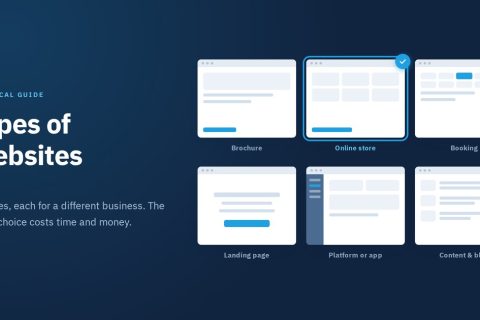
So copying an Egyptian store’s payment setup into a Gulf market weakens conversion. Domestic card networks, phone wallets and instalment options are expectations that exist before the buyer ever reaches your checkout. If you are still comparing a full store against a single sales page, read our page on types of websites.
What does a Saudi buyer expect to see?
Three methods form the floor in Saudi Arabia: mada, the domestic card network tied to bank accounts, international cards, and Apple Pay on iPhones.
Without mada, a share of buyers has no instrument they can pay you with at all. Without Apple Pay, the phone checkout falls back to typing card details on a small screen, which is where the purchase decision is usually made. Online payments in the Gulf start there, then wallets and bank transfer get added according to what you sell.
How should you handle instalments and buy now, pay later?
Buy now, pay later has become part of ordinary checkout behaviour across the Gulf. Buyers meet it as an option on the payment page rather than as a separate financing decision, and it shifts average order value because the total is split into parts.
Before switching it on, ask the provider four things in writing: who carries the risk if the buyer stops paying, when the money reaches you, how the instalment figure appears on the product page, and how a return is handled once instalments start. Higher value catalogues feel the effect more than small baskets.
How do you show a price to a buyer in another country?
A buyer reads the price in their own currency or hesitates. Three options work: the buyer’s currency, one clearly stated currency for everyone, or a local price with an approximate conversion beside it. The worst outcome is a buyer discovering the currency on their card statement after paying.
State before checkout who covers international shipping and any customs charges, and give a delivery window per country. Vagueness there reads as risk rather than detail, and it drives much of cross border cart abandonment. For the build and integration side, see how much a website costs in Egypt.
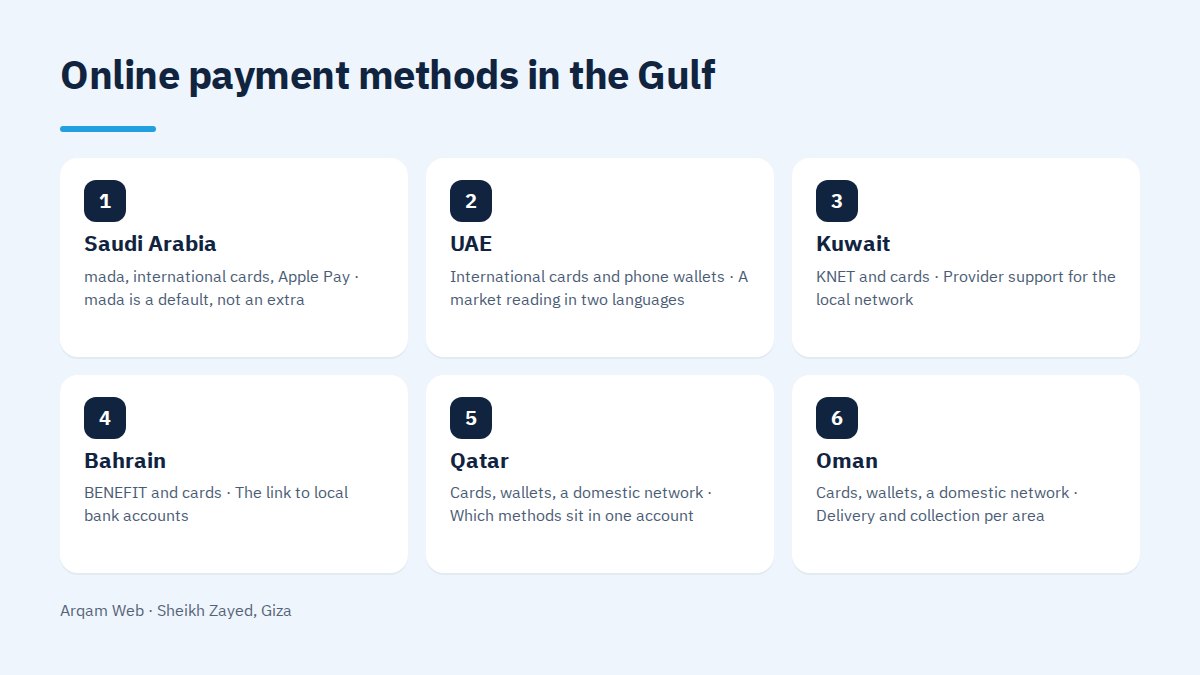
What differs between the Gulf countries?
| Country | Common methods | What to confirm |
|---|---|---|
| Saudi Arabia | mada, international cards, Apple Pay | mada is a default, not an extra |
| UAE | International cards and phone wallets | A market reading in two languages |
| Kuwait | KNET and cards | Provider support for the local network |
| Bahrain | BENEFIT and cards | The link to local bank accounts |
| Qatar | Cards, wallets, a domestic network | Which methods sit in one account |
| Oman | Cards, wallets, a domestic network | Delivery and collection per area |
The practical rule is that online payments in the Gulf are not one market. Ask your provider which methods are available in each country you sell to, and whether they can be run from a single merchant account instead of one per country.
What makes a checkout page convincing for a Gulf buyer?
The last step is where orders are lost after the buyer has already decided. Seven conditions make it work.
- Few steps between the cart and the confirmation screen.
- No forced registration, with an optional account offered after payment.
- Shipping cost and delivery window before the payment page, not inside it.
- Currency and accepted methods visible before any card details are typed.
- Arabic and English at equal quality, because the market reads both.
- Error messages a person can act on, not a numeric code.
- Speed on mobile data, since a delay here loses a paid order.
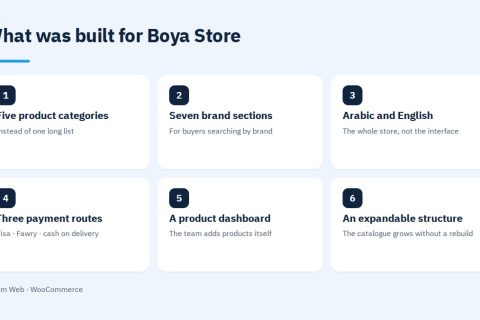
See Boya Store as an example of a store built with connected payment and delivery methods and a short checkout path.
What reassures a buyer about security?
- A secure connection with a valid certificate on every page.
- Payment inside the provider’s window or page, never an unfamiliar form.
- A bank verification step the buyer recognises and expects.
- The store’s legal name and a contact route someone actually answers.
- A statement descriptor that matches the store name.
- A written return policy visible before the pay button.
Those are the visible items. Behind them sit a maintained platform and holding as little customer data as the business needs. With online payments in the Gulf, security is a design decision as much as a technical one.
Returns and refunds in online payments in the Gulf
Buyers ask before paying, not after: how do I return this, when does the money come back, and does it go to the same card or to store credit. Answer on one page in plain language, and give the refund period as a range rather than a promise, since it depends on the bank.
Make your own return channel easier than complaining to a bank. A disputed transaction costs more in time, fees and reputation than a tidy refund handled directly. For what these choices mean for the store specification and its budget, see our pricing page.
Frequently asked questions
Which methods should I offer for online payments in the Gulf?
Start with international cards plus the domestic network in each country you sell to, and the phone wallet that is common there, such as mada and Apple Pay in Saudi Arabia. Add buy now, pay later if your average order value is high. Ask your provider which methods each country supports.
Do I really need Apple Pay?
Many buyers in Saudi Arabia and the UAE use iPhones, and having the method turns checkout into one confirmation instead of typing card details on a small screen. Ask your payment provider about enabling it and about the domain verification it requires, then test it on a real handset.
Should I price in each country’s currency?
If you sell across several Gulf countries, pricing in the buyer’s currency reduces hesitation, provided the figure stays identical from the product page through checkout and confirmation. One clearly stated currency is an acceptable alternative. What matters is that no buyer meets a different currency on their statement.
Is buy now, pay later worth offering?
It is familiar behaviour across the Gulf and worth testing, particularly on higher value products. Ask the provider in writing who carries non payment risk, when funds reach you, how the instalment figure is displayed, and how returns work once instalments have begun, then decide from your own order data.
Should I keep cash on delivery in the Gulf?
That depends on the country and your courier, since prepayment is the default expectation across most of the region. Keep it where your courier collects cash in that country and your buyers ask for it, and watch the share who choose it month by month before removing it.
Connect the right methods for your market
Send the countries you sell to, your average order value and the methods you already accept. You get a reply on what your store is missing from online payments in the Gulf and what the integration needs. We work from Sheikh Zayed, Giza, and remotely for Gulf clients.
Request a quote · Message us on WhatsApp · Call us
Arqam Web
44 Central Axis, Al Saraya Mall, Lower Ground, Entrance 2, Sheikh Zayed, Giza, Egypt
Phone and WhatsApp: +20 111 872 1404 · Email: info@arqamweb.com