

The types of websites you can build are not styling choices. Picking one is the first decision that determines whether your site earns its keep or quietly drains the budget. A business wants to sell online and ends up with a brochure site that has no cart. Another needs bookings and payments and gets a site where every request still lands in WhatsApp.
This guide is written for people with no technical background. You will get six types of websites, who each one suits, and when choosing it is a mistake. At the end there are four steps that take you to a decision before you ask anyone for a quote. Arqam Web has been building company websites for fourteen years, and this is the question we field more than any other.
The question that comes first
Before weighing up the types of websites, most people who contact us open with a technical question: will it be WordPress or custom code? That question arrives too early. The first one is: what do I need the site to do, and how does that help my business?
The difference is not academic. The first question drags you into comparing tools you cannot judge. The second gives you a clear description of the site’s job, and from that description the type follows, and from the type the build method and its cost follow. Flip the order and you pay for features nobody opens, or discover six months in that what was built cannot carry your growth.
Try finishing this sentence in one line: “The site works if a visitor arrives and does X.” If X is buying, you are looking at a store. If X is booking a slot, a booking site. If X is getting in touch after seeing your work, a brochure site is enough.
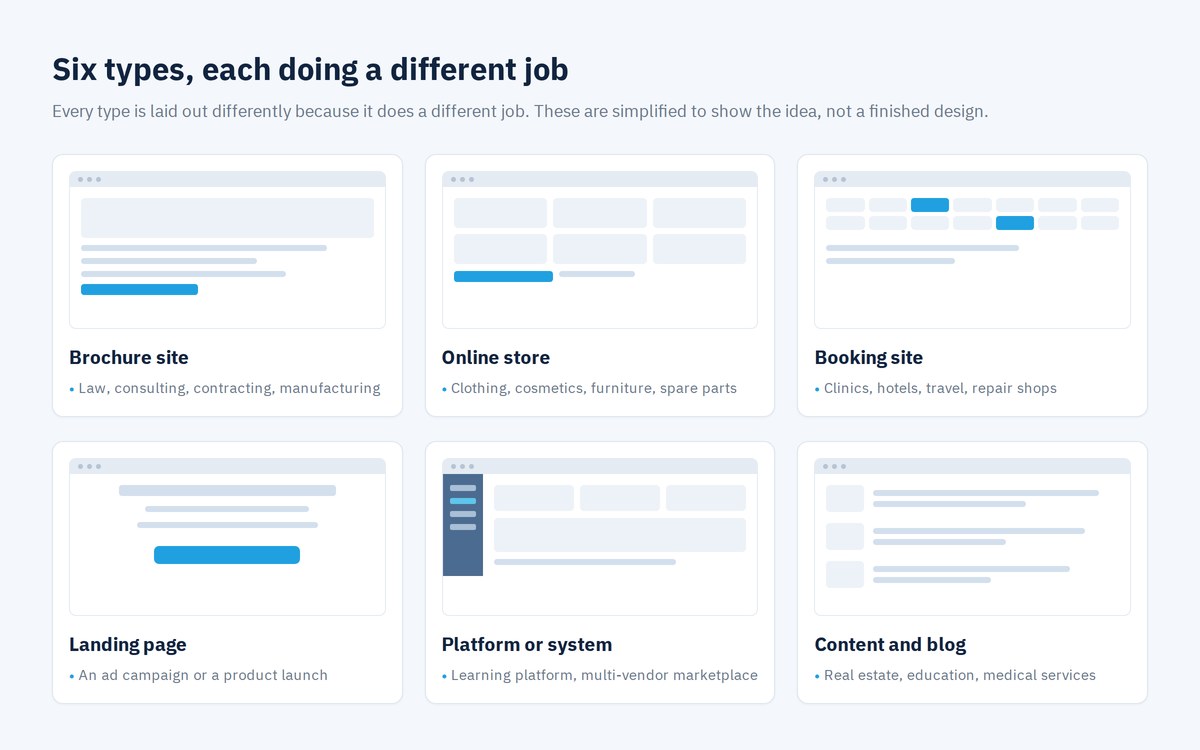
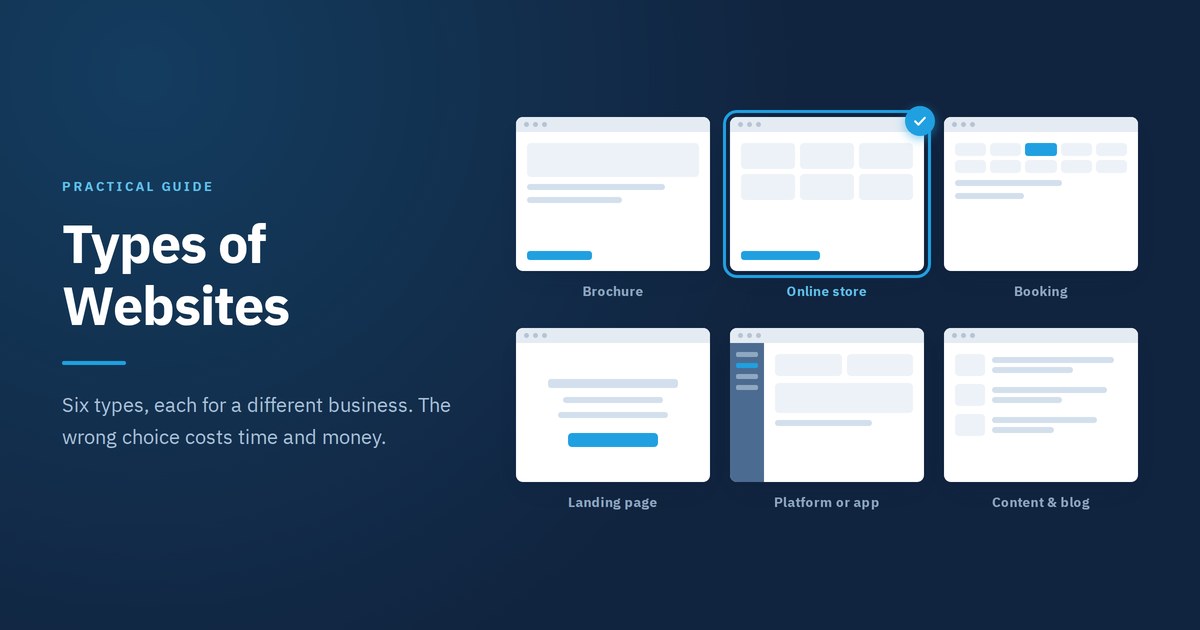
The six most common types of websites
1. The brochure site
The simplest of the types of websites and the most common. It introduces the company, its services and its past work, and ends with a way to get in touch. The page count stays small: home, about, services, work, contact.
Suits: law firms, consultancies, clinics, contractors, manufacturers, and any business where the deal closes on a call or in a meeting rather than through a buy button.
Wrong choice when: you have real products with prices and stock. Showing products as pictures on a services page means every order gets handled by hand, and you will answer “how much?” a hundred times a day.
2. The online store
The busiest of the types of websites behind the scenes. Built around a complete purchase: a product page with options and stock, a cart, payment, shipping, and an account where the customer follows the order. The visible part is small next to what runs behind it.
Suits: clothing, cosmetics, furniture, spare parts, packaged food, and any business selling countable units.
Watch out: a store is not only a technical decision. It needs decent product photography, a written returns policy, a shipping arrangement, and somebody watching orders daily. Open one without those and you get a good-looking site with no sales.
3. The booking site
The one type among the types of websites that buys back real hours. It shows what is available, whether that is appointments, rooms or trips, and lets the customer book and pay without you stepping in. It blocks double bookings on the same slot and sends confirmations and reminders on its own.
Suits: clinics, beauty centres, hotels and chalets, travel companies, gyms, and repair workshops.
Wrong choice when: your volume is small and predictable. Ten appointments a week are handled by a simple schedule and do not call for a full system in the first phase.
4. The landing page
Smallest of the types of websites. One page with one goal: capture details, deliver a download, or sell one specific product. No navigation to wander into, no side pages. It usually runs alongside an ad campaign.
Suits: a product launch, a seasonal offer, collecting interest before opening, or testing an idea before building anything larger.
Worth knowing: a landing page is not a substitute for a site. It is a campaign tool. Rely on it alone and you give up every visit that would have come from search over the following years.
5. The platform or custom system
The heaviest of the types of websites to build and to run. Not something you read, something you use. People sign in and do work inside it: submit a request, track its status, upload files, read reports, deal with other users. Customer management systems, learning platforms and multi-vendor marketplaces all sit here.
Suits: a business built on a repeated process with steps, or one serving more than one side at once, such as a seller, a buyer and an administrator.
Common mistake: choosing it at the start. Its cost, its timeline and its maintenance are far above any other type, and none of it is justified before you have proved the idea works with simpler tools.
6. The content site or blog
The last of the types of websites, and the slowest to show a result. It runs on steady publishing: articles, guides, news, answers to the questions your audience actually asks. The point is for people to find you in search before they know your name.
Suits: businesses where the customer buys after reading and researching, such as real estate, education, medical services, consulting and software.
Rarely stands alone. Usually it is a section inside a brochure site or a store, pulling in visits and pointing them at the service or product pages. There is more on that in how to benefit from your website.
Which type fits which business
Here are the six types of websites in one row each, with the signal that tells you the choice was wrong.
| Type | Main goal | Example businesses | Sign you picked wrong |
|---|---|---|---|
| Brochure | Build trust, then contact | Law, consulting, contracting, manufacturing | You process purchase requests by hand daily |
| Online store | Complete a sale | Clothing, cosmetics, furniture, spare parts | No stock and no fixed product prices |
| Booking | Reserve a slot or unit | Clinics, hotels, travel, repairs | Fewer than ten bookings a week |
| Landing page | One defined action | Ad campaign, product launch | No visits arriving from organic search |
| Platform or system | Work done inside the system | Learning platform, multi-vendor marketplace | You paid for features nobody opened |
| Content and blog | Show up in search results | Real estate, education, medical services | Plenty of visits, no enquiries |
Finding your business in more than one row of the types of websites is normal. Most projects combine two of the types of websites, a primary type and a section of another: a store with a blog, or a brochure site with simple booking. See how we handled that across our projects.
WordPress or custom code?
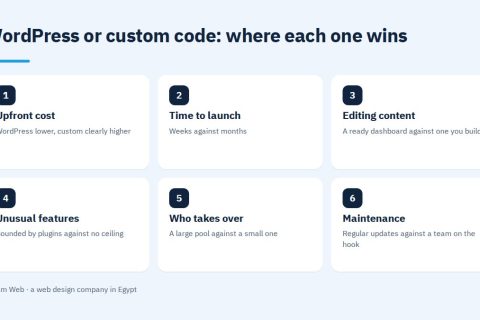
Now the question belongs, because you know which of the types of websites you need. The answer turns on how close your requirements sit to problems that are already solved.
Four of the six types of websites are solved problems: brochure sites, stores, blogs and most booking systems have been handled for years. Building them on WordPress means a shorter timeline, a lower cost, and a dashboard you run yourself without a developer. The foundation is ready and tested, so the work goes into design, content and speed.
Custom code earns its cost when the business logic itself is unusual: a relationship between several parties, calculations no existing system models, deep integration with internal software, or data volumes past what ready-made platforms carry. That is when the higher price is justified.
What never adds up is paying custom development rates for a five-page brochure site, or trying to run a complex platform on tools that were never designed for it. Both end the same way: money and months, no result. See what we do across design, development and SEO.
Four mistakes that keep repeating
These four show up in most of the projects that reach us after a failed build, and all of them trace back to comparing the types of websites on price alone.
Building smaller than you need. A business with a clear growth plan picks a limited option because it is cheaper today, then rebuilds from scratch a year later. The rebuild costs more than the gap it saved.
Building bigger than you need. A business in its first year is sold a system specified for a large organisation, and pays for dashboards, reports and permission levels nobody will ever open.
Copying a competitor without understanding their model. Your competitor may sell on annual contracts while you sell by the piece. The shape looks the same and the site’s job is completely different.
Leaving the decision to whoever builds it. The person building your site will suggest what they are good at, or what pays them most. The decision is yours, and you are entitled to hear a reason you can follow before you agree to a type.
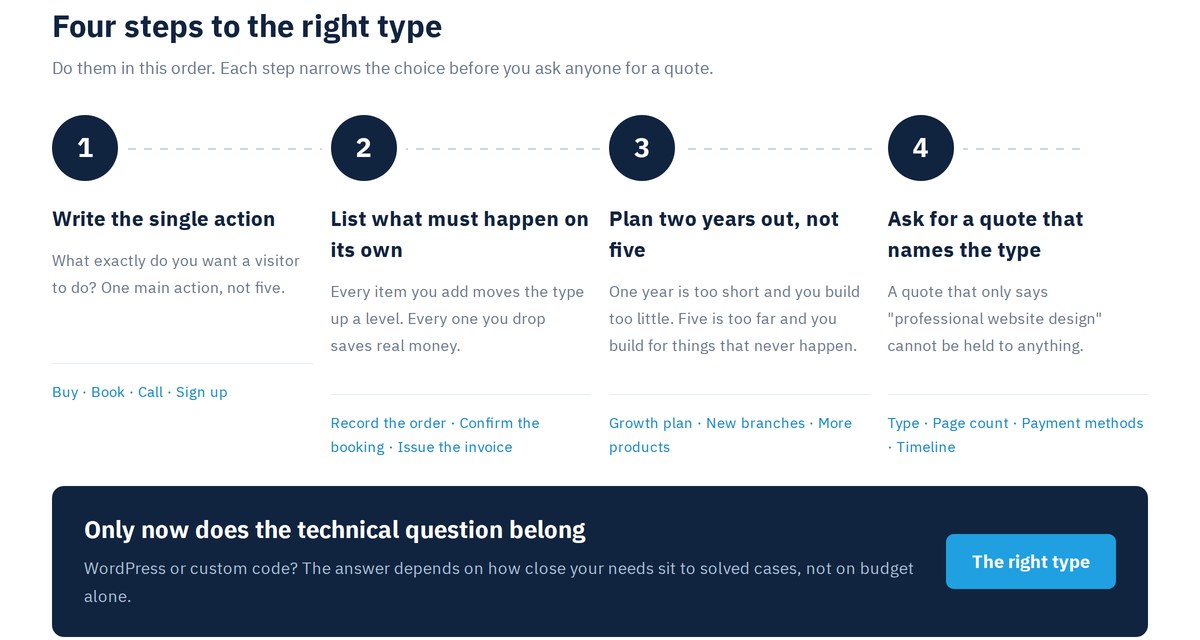
Four steps to the right type
These work across all the types of websites, whatever the size of the project or the budget.
1. Write the single action. What do you want a visitor to do? Buy, book, call, sign up, read. One main action, not five.
2. List what has to happen on its own. Should the order record itself? Should the slot get booked without a phone call? Should the invoice go out automatically? Every item here moves the type up a level, and every one you drop saves real money.
3. Plan two years out, not five. One year is too short and you build too little. Five is too far and you build for possibilities that never arrive. Two years is a sensible horizon for a decision like this.
4. Ask for a written quote that names the type. Any competent studio can tell you which of the types of websites it is quoting for. A good quote says: this is a brochure site of so many pages, or a store with this many products and these payment methods. A quote that only offers “professional website design” cannot be held to anything.
We covered the parts every site is made of, whatever its type, in website components, and what makes one site outperform a near-identical competitor in how to distinguish your site. For the fundamentals straight from the source, Google Search Central explains how search engines read any site’s content.
Made the decision and want it built?
Message us on WhatsApp ·
info@arqamweb.com ·
+20 111 872 1404 ·
Request a quote
Frequently asked questions about types of websites
What are the most common types of websites?
Six types of websites cover most projects: the brochure site that introduces a company and ends in contact, the online store where the whole purchase happens, the booking site for appointments and units, the single-goal landing page, the web platform or custom system, and the content site or blog that brings in search traffic.
Can one site combine more than one type?
Yes, and it usually does. An online store with a blog, a brochure site with simple booking, or a platform with a content section. The rule is to pick one primary type that sets the site’s structure, then add what you need from the others as sections inside it rather than separate projects.
How do I know I chose the wrong type?
The clearest signal is that a core part of the work is still manual despite having a site. Purchase requests arrive on WhatsApp, every booking needs a phone call, or you write invoices yourself. The site is not saving time, and that is the practical measure, not how the design looks.
What is the difference between a brochure site and a landing page?
A brochure site is several pages presenting the company, its services and its work. It lives for years and accumulates search traffic. A landing page is one page with one goal, usually built alongside an ad campaign and retired with it. The first is a lasting asset, the second is a temporary tool.
Is WordPress suitable for large businesses?
It is, as long as the business logic stays close to solved cases such as publishing, commerce and booking, however large the company. Custom development becomes necessary when the logic itself is unusual: multiple parties, calculations no existing system models, or deep integration with internal software.
How long does each type take to build?
It varies with the volume of content, the number of products and how much is customised. Brochure sites and landing pages are the quickest, then stores and booking sites, and platforms or custom systems take longest because they need analysis and process design before any code is written.
Contact Arqam Web
Arqam Web is a web design and development company in Sheikh Zayed, working for fourteen years across website design, search engine optimisation and brand identity. Describe your business and what you need the site to do, and we will recommend one of the types of websites and explain why before any talk of building it.
- Address: 44 Al Mehwar Al Markazy, Al Saraya Mall, Sheikh Zayed, Giza, Egypt
- Phone and WhatsApp: +20 111 872 1404
- Email: info@arqamweb.com
- Website: www.arqamweb.com
- Hours: Sunday to Thursday, 10:00 to 19:00 Cairo time
Start with a quote request or contact us directly, and you will hear back within one working day.