

The real difference is not the price. It is what happens after delivery. A freelancer suits a small site with clear edges and a tight budget. A company suits a site you sell through, one that needs a contract, a valid tax invoice, and a team that does not stop when one person is away. That is the choice, as of September 2026.
Anyone comparing a web design company vs freelancer is really comparing two different structures, not two price tags. This article sets out the criteria that measure both against the same ruler. Our website design and development page covers what we build at Arqam Web, and the pricing page breaks the cost into its parts.
Web design company vs freelancer: what is the actual difference?
A web design company is a registered entity with commercial registration and a tax ID, staffed by people who each own one discipline: design, development, content, search optimisation, then maintenance after launch. A freelancer is one person holding all of those, or passing some of them to people they know.
The difference is not quality as a personal trait. A good freelancer beats a bad agency, and that happens often.
The difference is structural. Ask one question: what keeps running if the person building your site falls ill, travels, or takes on a project bigger than yours? The answer to that is the whole difference.
Which one is actually cheaper?
The freelancer is cheaper on the first number. That is not in dispute. But the first number is not the cost.
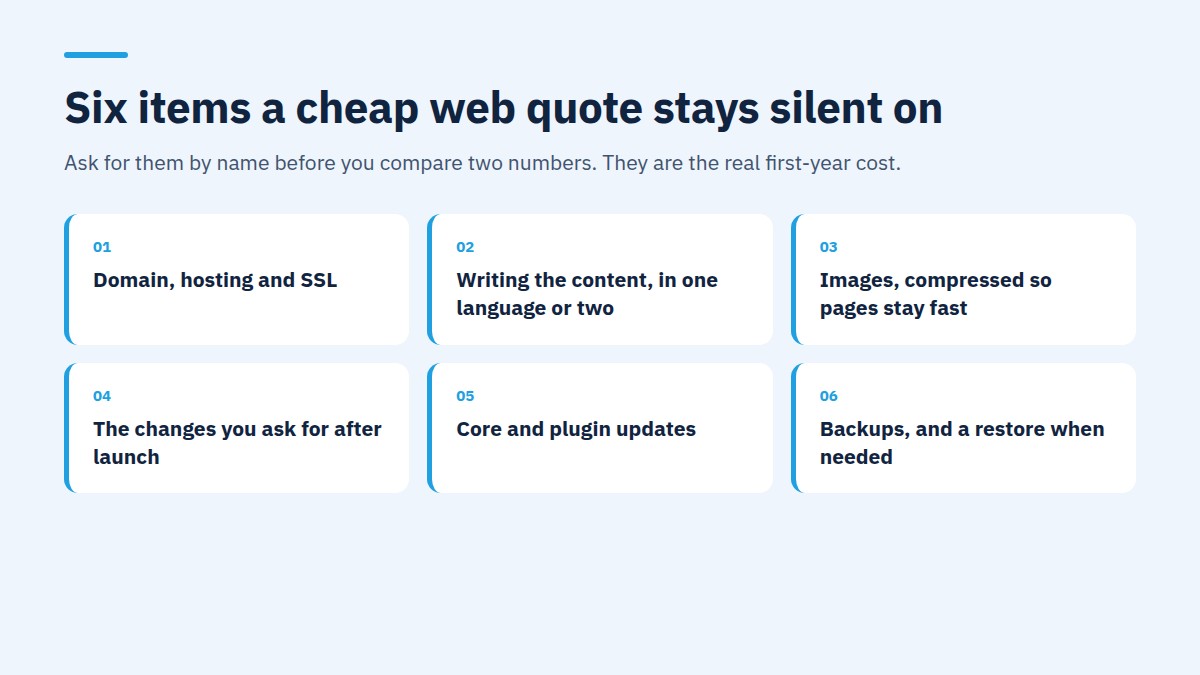
The real cost of a site you run for a full year includes items that rarely appear in an opening quote:
- Domain, hosting and an SSL certificate, renewed every year.
- Writing the content, in one language or two.
- Images, and compressing them to weights that do not slow the page.
- The changes you ask for three months after launch, not before it.
- Core and plugin updates, which are monthly rather than annual.
- Backups, and a restore on the day the site needs one.
Ask both sides about those six by name, and ask for them in writing. A quote that stays silent on them is not cheaper. It is shorter.
Who can issue you an invoice your accountant can use?
This one gets skipped, and for a registered business it is a real number on your books.
In Egypt, the Egyptian Tax Authority has stated that only electronic invoices are accepted as proof of costs and expenses in income tax returns, and for deducting or reclaiming VAT, effective 1 July 2023.
In Saudi Arabia, phase two of e-invoicing (Fatoora) began on 1 January 2023 and is being enforced in waves by revenue. The twenty-third wave covers taxpayers whose taxable turnover passed SAR 750,000 in 2022, 2023 or 2024, who must comply between 1 January and 31 March 2026.
In practice: if whoever builds your site cannot issue a compliant invoice, what you pay them may not count as a cost on your books. Plenty of freelancers are registered and invoice properly. The point is that the question belongs before the first transfer, not after it.
What skills does a single website need?
A website is not a design placed on the internet. Here is what one company site needs in order to work:
A platform someone can run after launch. W3Techs recorded on 26 September 2026 that WordPress powers 40.2% of all websites, and 58.7% of sites whose content management system is known. The platform choice decides who can edit your site a year from now.
Performance Google measures in numbers. The Core Web Vitals thresholds are published: 2.5 seconds or less for Largest Contentful Paint, 200 milliseconds or less for Interaction to Next Paint, and 0.1 or less for Cumulative Layout Shift, measured at the 75th percentile of page loads across mobile and desktop.
Arabic that reads right to left properly. Not a flipped stylesheet. Every layout, icon direction and form field built for Arabic from the first screen.
Structured data so search engines and answer engines read what is on the page rather than guessing at it.
Content written for a buyer, which is a trade of its own rather than the last step of a development project.
One person strong in all five exists. They are rare and they do not charge freelancer rates. A company splits those five across people, and that split is what the price difference buys.
Company or freelancer, item by item
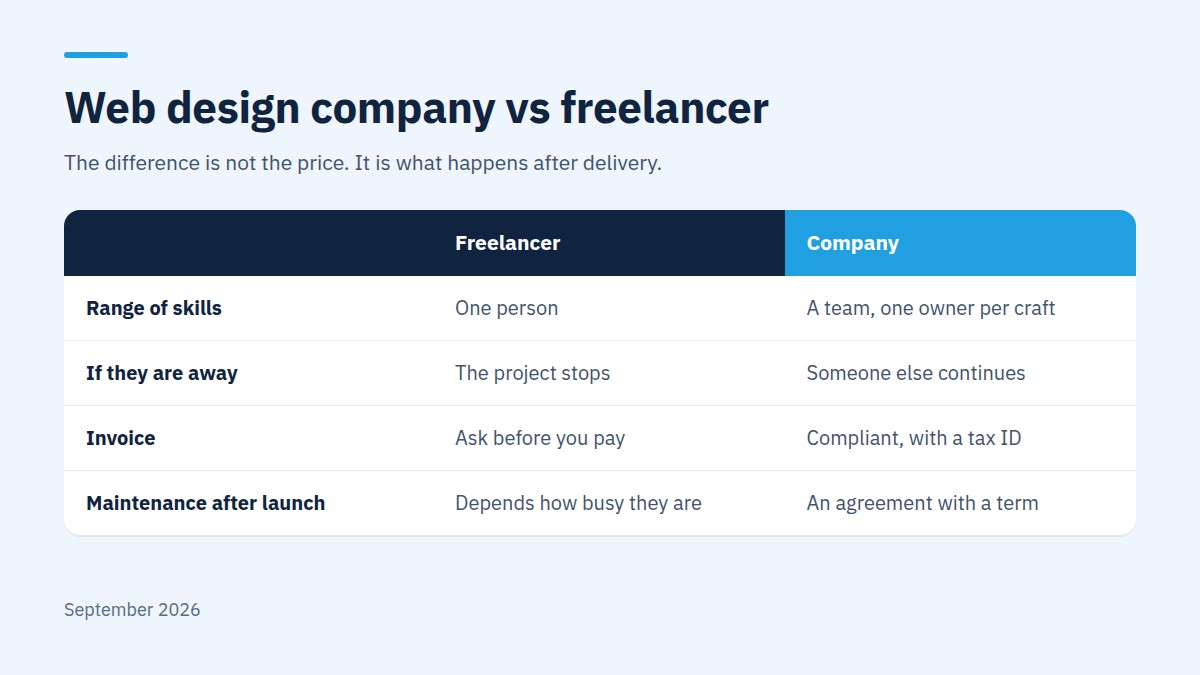
This table compresses the web design company vs freelancer comparison into ten items. One of them can settle the decision on its own, and it is the row about who owns the domain and hosting.
| Item | Freelancer | Company |
|---|---|---|
| Range of skills | One person, strong in one or two | A team, one owner per discipline |
| If they are away | The project stops | Someone else continues |
| Contract | Sometimes a WhatsApp message | Written scope and payment schedule |
| Invoice | Varies, ask before you pay | Compliant invoice with a tax ID |
| Maintenance after launch | Depends how busy they are then | A maintenance agreement with a term |
| Domain and hosting ownership | Often sits on their account | Transferred to you in writing at handover |
| Speed of starting | Faster, one person decides | Slower to start, begins with a study |
| First cost | Lower | Higher |
| Full first-year cost | Depends what the quote left out | Written into the quote |
| Project size it fits | Small site, landing page, defined task | A site that sells, a store, a bilingual site |
When is a freelancer the right call?
In cases that are clear, and not rare:
- A single landing page for a campaign, with a start and an end.
- One defined task on an existing site: fixing a bug, adding a section, changing a layout.
- A personal project or a blog your income does not rest on.
- A budget that cannot carry a company, with your eyes open about maintenance being yours.
- A freelancer you have already worked with, so you know how they behave under pressure.
When do you need a company?
- The site is where your enquiries come from, so downtime is lost sales.
- An online store taking real payments, where a bug costs money rather than time.
- A bilingual site, because Arabic and English in one site is a structural problem rather than a translation job.
- You need a compliant invoice and a contract that protects both sides.
- You want SEO and content working with the build rather than bolted on after it.
- A site you will keep extending for years, because the structure it gets today sets the price of every later addition.
How do you judge both on the same criteria?
The criteria that separate a web design company vs freelancer are the same criteria, and the common mistake is asking each side a different set of questions. Put these seven to both in the same words, then compare the answers rather than the prices:
- Show me three live sites with their URLs, and open them with me now.
- Who owns the domain and hosting accounts after handover?
- How long is the warranty, and what exactly does it cover?
- Is there a written contract setting scope, payments and dates?
- Will you issue an invoice, and under which tax ID?
- Who writes the content, and is that inside the quote?
- What happens if I need a change six months from now?
Question two alone tells you more than you expect. A site built on a hosting account someone else owns is not your site, even if you paid for all of it.
Arqam Web is a registered company based in Sheikh Zayed, Giza, working with clients across Egypt and the Gulf. If you want to see how we answer those seven, our portfolio carries the live URLs themselves.
Frequently asked questions
Is a freelancer really cheaper than a web design company?
Cheaper on the first number, not necessarily over the first year. Compare both quotes on the same items: hosting, content, images, post-launch changes, updates, backups. A quote that does not mention those items has not removed them from the cost. It has moved them to you without saying so.
Can I start with a freelancer and move to a company later?
Yes, and it happens often. From day one, insist that the domain and hosting sit on your own accounts, and that you receive a full copy of the files and database at handover. With those two conditions the move becomes a migration. Without them it becomes a rebuild.
What belongs in the contract whatever the project size?
Four things: the scope written out in pages and functions, how many rounds of revisions are included, payment dates and what each one buys, and the warranty period with what it covers. A small project needs those four exactly as much as a large one does, and usually more.
Does hiring a company automatically mean a better site?
No. A company means a steadier structure, clearer accountability, an invoice and a contract. Quality itself is measured by live work, not by the shape of the entity. Open three sites the company delivered, check their speed on a phone and how clearly the content reads, then judge.
How long does a company website take to build?
The timeline follows content readiness more than it follows development. A project whose copy and images are ready moves along its agreed schedule. One waiting on text nobody has written stalls at 90% for months. Prepare the content before you start, or agree in writing who will write it.
What if the site needs to be in Arabic and English?
That case leans strongly toward a company. A bilingual site is not translated text. It is a double structure with separate URLs, correct language tags and a layout that works in both directions. Getting it wrong at the start means rebuilding rather than fixing.