

A travel agency website is not a photo album of pretty destinations. It is a sales tool: one page per tour, a day by day itinerary, a plain list of what the price covers and what it does not, a readable cancellation policy, and a short path to a quote. Travellers compare, then trust, then book.
How do travellers actually search for a trip?
Four entry points reach your agency, and each needs a page built for it:
- By destination. “Georgia tours” or “Umrah packages”. This person already knows where, and wants to compare programmes.
- By occasion. “Honeymoon trip” or “family holiday during school break”. Here the destination is still open, so the agency that recommends well wins the enquiry.
- By budget. “Cheap trip abroad” or “luxury tour”. The number is the starting point and the destination follows it.
- By duration. “Five day trip” or “two week holiday”. Someone with fixed leave dates rules out every programme that does not fit.
A travel agency website that answers all four with one page titled “Our Tours” loses three of them. The fix is real structure: a page per destination, one per occasion, and filtering by length and budget inside the tour list.
What belongs on a tour page in a travel agency website?
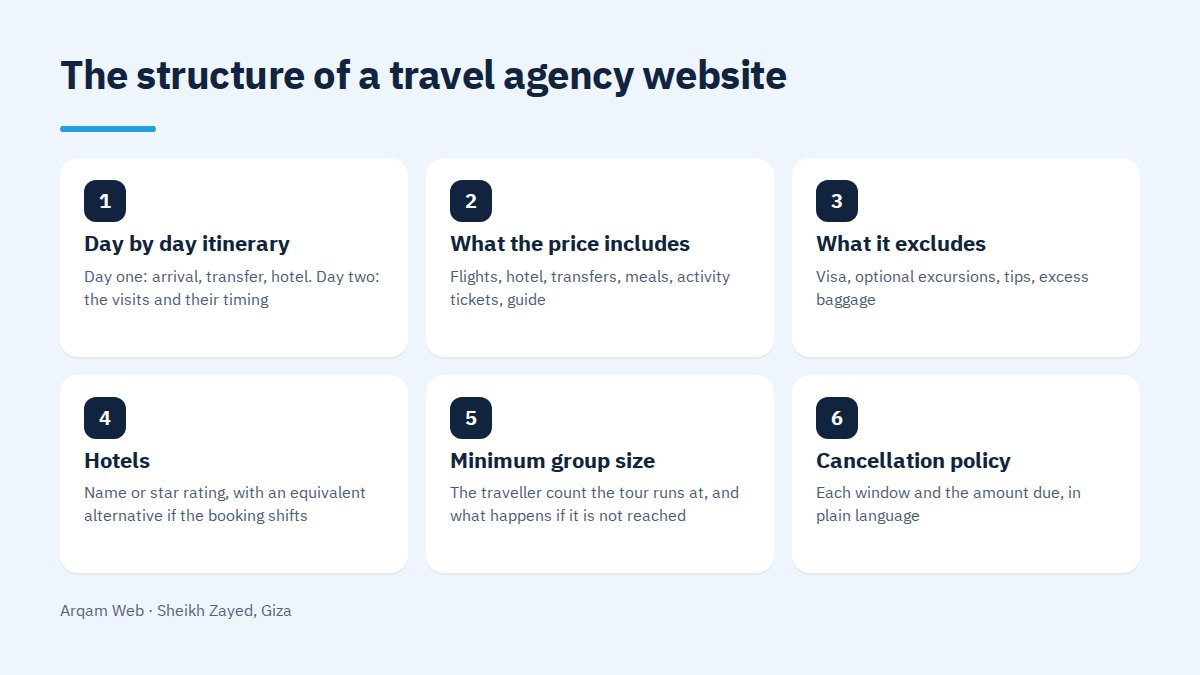
The tour page is where the sale happens or dies. This is what travellers want settled before paying:
| Element | How to write it | Why it matters |
|---|---|---|
| Day by day itinerary | Day one: arrival, transfer, hotel. Day two: the visits and their timing | Answers the first question: what will I actually be doing |
| What the price includes | Flights, hotel, transfers, meals, activity tickets, guide | Prevents the surprise that turns into a complaint after booking |
| What it excludes | Visa, optional excursions, tips, excess baggage | The exclusions list builds more trust than the inclusions list |
| Hotels | Name or star rating, with an equivalent alternative if the booking shifts | Hotel class decides it for most families |
| Minimum group size | The traveller count the tour runs at, and what happens if it is not reached | Puts the chance of postponement before payment, not after |
| Cancellation policy | Each window and the amount due, in plain language | The single most asked question right before booking |
A page carrying those six replaces a whole WhatsApp conversation, and enquiries arrive as ready requests.
Real photographs or stock images?
Stock images all look alike, and a traveller who just compared four sites spots the repeated picture at once, which costs credibility. A photo your own guide took on a real departure is less polished and more convincing, because it proves the tour ran.
The working rule: stock for generic landmarks only, and your own photography for anything specific to the trip. Keep every published image suited to your audience in Egypt and the Gulf, with modest dress throughout, because one unsuitable photo can cost you a whole family that was close to booking.
Should prices appear on a travel agency website?
Hiding price completely brings low intent enquiries and burns your sales team’s day filtering people who were never going to buy. Publishing one fixed number ties your hands against moving airline and hotel rates.
What works is a from price with an update date and the reason it varies: “from X per person sharing a twin room, varying by travel season and hotel class”. That wording filters without promising, and leaves the real pricing to the conversation.
Quote request or direct booking?
This follows what you sell, not your technical preference. A fixed departure with a known date and price can be booked directly with a deposit. A tailored programme priced by party size and dates belongs behind a quote request, because direct booking hands the traveller a number your agent must correct an hour later.
Having both paths beats choosing one: a booking button on fixed departures, and a short form for tailored requests asking destination, dates, party size and budget. Set your website goal before design so you do not end up with a long form nobody finishes.
Which language does your traveller read?
Most agencies in Egypt and the Gulf serve two audiences: a local traveller reading Arabic and an inbound or resident reading English. One mixed version loses both.
The second version is not machine translation. Inbound programmes differ in which details need explaining, and in what must be said about visas and transport. Read types of websites to see where a travel agency website sits between a brochure site and a store.
Local visibility or international reach first?
A traveller looking for a nearby office to drop off documents needs local visibility: a complete Google Business profile, the same address and phone everywhere, and a page per office if you have several.
A traveller shopping for a far destination cares little about your address and much about whether your tour page appears when that destination is searched. So a travel agency website needs both tracks: carefully written destination pages for the wider search, and a maintained map profile for the nearby one.
After the booking: the part most sites ignore
Booking is not the end. Four messages separate a well run agency from a forgettable one:
- Immediate confirmation with the booking reference, a tour summary, what was paid and what remains.
- A pre departure reminder covering required documents, the meeting time and baggage limits.
- Downloadable documents in one place: itinerary, hotel voucher, guide name and number.
- A post trip message asking for a review and photos, which is the cheapest source of the real content your pages need.
Built once, they run on every booking, and they turn a traveller into someone who recommends you.
How is a travel agency website measured?
Three monthly numbers are enough: quote requests and bookings from the site, the share that became actual travel, and which destination pages bring entrances from search. The second matters most: it tells you whether your pages attract the right audience or only browsers.
You can open the Kidana Travel project to see a travel agency website we built, and the web design and development page for how we work.
Frequently asked questions
What does a travel agency website actually need?
A page per tour holding the day by day itinerary, what the price includes and excludes, hotel class, minimum group size and the cancellation policy. Add destination and occasion pages, a clear path to a quote or booking, and real photographs from your own departures.
Should I publish prices?
Publish a from price with an update date and the reason it varies, rather than a fixed number or nothing at all. An open figure filters out casual enquiries, protects you when flight and hotel rates move, and keeps final pricing inside the conversation.
Direct booking or quote request?
Fixed departures with a known date and price should be bookable directly with a deposit. Tailored programmes priced by party size and dates suit a short request form asking destination, dates and budget instead. Offering both beats picking one and serving half your audience.
Do I need an English version?
You need one if you take inbound visitors or residents. It should be written in English rather than machine translated, because what an inbound traveller needs explained about visas, transport and daily logistics differs from what a local traveller already knows.
How long does a travel agency website take to build?
Content readiness governs the timeline more than design does. Prepare your tour list, each itinerary, the inclusion and exclusion lists, the cancellation policy and photographs from your own departures before work starts, and the schedule shortens noticeably. The longest delays we see come from waiting on written itineraries.
Start from your tour list
Send your list of programmes and your most important destinations, and you will get a proposed page structure that serves search and turns a browser into a booking request.
Request a quote · Message us on WhatsApp · Call us
Arqam Web
44 Central Axis, Al Saraya Mall, Lower Ground, Entrance 2, Sheikh Zayed, Giza, Egypt
Phone and WhatsApp: +20 111 872 1404 · Email: info@arqamweb.com