

A complete brand identity project hands over a logo in several versions, a colour and type system with exact codes, applications ready for print and social media, a written usage guide, and the editable source files with full usage rights. Anything less than that is a logo, not an identity.
What does a brand identity project actually hand over?
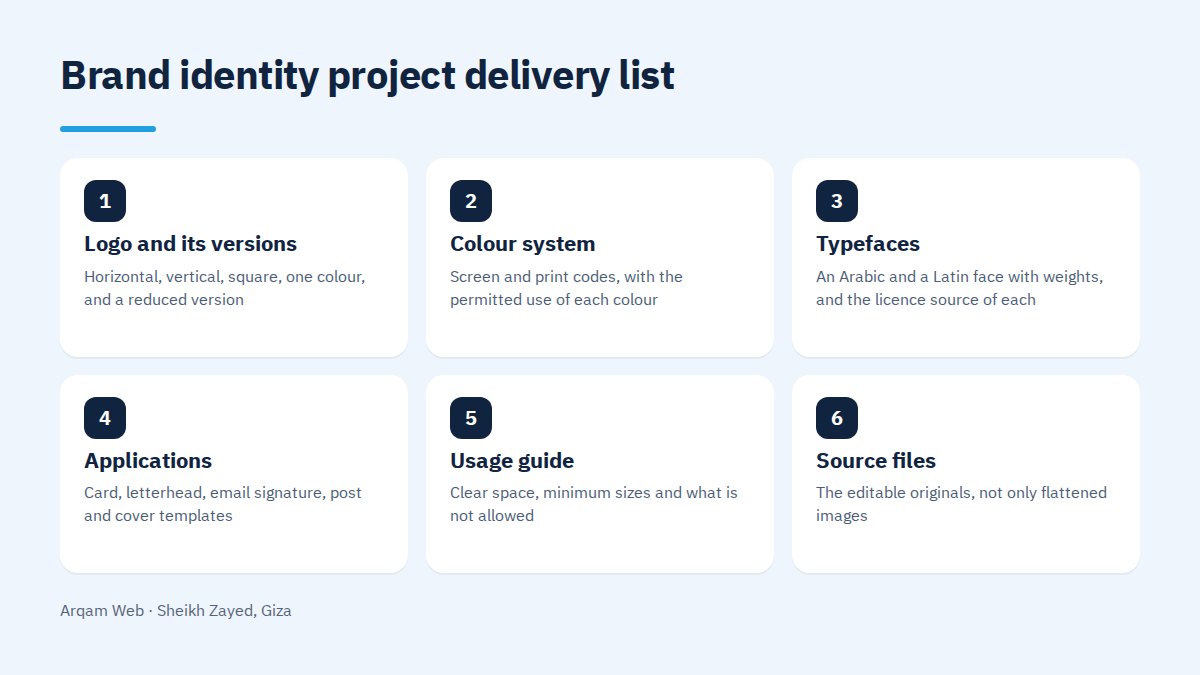
The delivery list is the real contract. Ask for it in writing, at this level of detail, before anyone starts drawing:
| Item | What you receive | Why it matters |
|---|---|---|
| Logo and its versions | Horizontal, vertical, square, one colour, and a reduced version | Every place a logo appears has a different shape to fill |
| Colour system | Screen and print codes, with the permitted use of each colour | A colour that shifts between print and screen costs you consistency |
| Typefaces | An Arabic and a Latin face with weights, and the licence source of each | An unlicensed font stops a print run or exposes you later |
| Applications | Card, letterhead, email signature, post and cover templates | An identity is seen in these, never in the presentation deck |
| Usage guide | Clear space, minimum sizes and what is not allowed | It holds the look steady with any designer or printer after you |
| Source files | The editable originals, not only flattened images | Without them every small change sends you back to one designer |
A logo is not an identity: which versions do you need?
A brand identity project delivers several lockups, because one cannot serve every place it has to sit. A shopfront sign needs a wide version, a profile picture needs a square one, and an invoice printed in black needs a single colour version that still reads.
Ask for a reduced version too. A logo built on fine detail turns into a smudge in a browser tab icon or in a small stamp on packaging, and that is where most people meet it first.
Which file formats should you receive?
The wrong format means redrawing the work at the first print request:
- The vector source as AI or EPS. This is the original everything else is cut from, and it scales with no loss.
- SVG for the website, light and sharp on any screen.
- PDF for printers, with print colour values and fonts embedded.
- PNG on a transparent background for documents and internal decks.
- Site icon in the sizes browsers and phones ask for.
One clause in a brand identity project contract prevents years of friction: source files and full usage rights transfer to you on final payment, and do not stay with the designer.
Colours and type: what makes a system usable?
A usable colour system names one primary, one secondary and the limits of each, rather than ten swatches for every designer to pick a favourite from. Each colour carries a screen code and a print code, with enough contrast between text and background to stay readable.
With type, the licence question comes before the shape question. Find out who holds the licence, whether it covers the website, the app and print, and whether Arabic and Latin weights are included. A free face licensed for commercial use is a sound choice that stays comfortable for years.
Why the usage guide decides what you bought
The guide is what keeps a brand identity project working after the person who designed it has moved on. A few pages prevent the most common damage: a logo stretched out of proportion, crowded by other elements, or dropped onto a background that swallows it.
A useful minimum: clear space around the logo, the smallest permitted size, forbidden uses shown visually, right and wrong examples on backgrounds, and the intended style of accompanying photography.
What sits outside a brand identity project?
Naming what is out of scope prevents most of the arguments that follow:
- Website design and build is a separate project that uses the identity rather than producing it. The detail sits on the web design and development page.
- Packaging artwork needs production measurements and printer specifications for each individual pack.
- Photography is its own line, even though the guide describes the style photographs should follow.
- Ad campaigns and their content are recurring monthly work, not a one time handover.
- Trademark registration is a separate legal step taken with the competent authority, and designing a logo does not grant it. This is general information rather than legal advice.
The ranges and line items for what we deliver sit on the pricing page. What varies between businesses is the number of applications, not the logo itself.
How do the stages and revisions run?
The order that produces the least rework in a brand identity project:
- Discovery. A session on the business, the audience, the competitors and what you do not want, ending in a written brief you approve.
- Visual directions. Two or three genuinely different moods, each with written reasoning rather than a verbal explanation.
- One direction developed. A single route is chosen and taken forward. Merging two produces a shape with no character.
- Applications. The agreed items produced and reviewed at real sizes, not as thumbnails in a deck.
- Guide and handover. The guide written, the files assembled in their formats, delivered in one organised folder.
Fix the number of revision rounds per stage in writing. Unlimited revisions read as generosity and end in a project that never closes and never ships.
What should be ready before work starts?
Your readiness sets the pace of a brand identity project more than the designer’s does. Four things belong in place first: a final name that will not change halfway, one person who approves, a list of where the identity will genuinely appear, and examples of what you like and dislike with written reasons.
The value of that readiness shows up in the next project. On the SportReach site, a new Saudi sports agency, the client arrived with the brand identity and logo already finished, and the logo, colours and type were set before we started. The build became execution instead of a wait for visual decisions.
For how an identity carries through to the site itself, read how to make your site distinct.
Frequently asked questions
Do I get the editable logo files?
You should, and it belongs in the contract in plain words rather than being assumed. Vector source files mean any designer or printer can work with the logo later without redrawing it. A supplier who hands over flattened images only keeps you tied to them for every small change.
How many visual directions is it reasonable to see?
Two or three with genuinely different moods beat ten that look alike. A long list pushes you into choosing by mood instead of reasoning, and burns the schedule on shuffling shapes. What matters is that each direction arrives with a written rationale for who it speaks to and why.
Can the website be built before the identity?
It can, though it usually costs more in total. A site built with no defined colour and type system gets reformatted once the identity lands, and some pages get rebuilt outright. The comfortable order is the brand identity project first, then a site built directly on it.
What is the difference between a visual identity and a brand?
The visual identity is the part you can see: logo, colours, type and photographic style. The brand is wider and takes in the name, the promise, the tone and the experience of dealing with you. An identity expresses a brand without creating one on its own.
When does an identity need updating?
When the business itself changes: a new product line, a new market in another language, or a position different from the one it was built for. Boredom with the look is not sufficient reason, and refreshing colours, type and photography often works better than replacing the logo.
Talk through the scope of your identity
Send a description of your business and the places your identity will appear, and you will get a suggested delivery list with items, formats and stages, with no obligation.
Request a quote · Message us on WhatsApp · Call us
Arqam Web
44 Central Axis, Al Saraya Mall, Lower Ground, Entrance 2, Sheikh Zayed, Giza, Egypt
Phone and WhatsApp: +20 111 872 1404 · Email: info@arqamweb.com