

Website maintenance cost is what you pay each year to keep a site updated, monitored, backed up and repaired. The items are known and can be priced on day one. They are also the items most often left out of a project budget, which is why they arrive as a surprise months after launch.
What does website maintenance cost actually cover?
Maintenance is not one line item. It is four separate jobs usually sold as one: keeping the software current, holding backups you can actually restore from, watching that the site is up and fast, and fixing what breaks. Each can be bought on its own, which is why two quotes using identical words can describe very different work, and why one website maintenance cost is rarely comparable with another.
Before any of those sits an item nobody calls maintenance even though it outranks the rest: the domain, the hosting and the certificate. Those are annual subscriptions that stop when the payment stops, taking the site with them, and they are separate from what you pay a person.
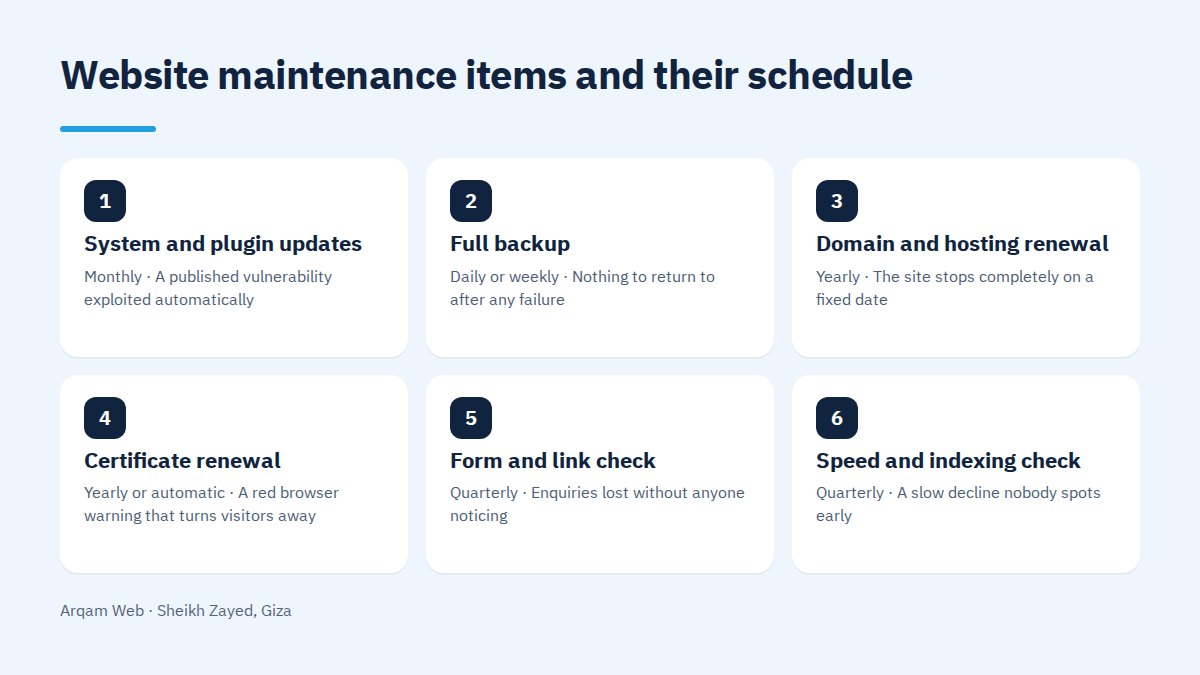
The maintenance items and what neglect does
| Item | How often | What neglect produces |
|---|---|---|
| System and plugin updates | Monthly | A published vulnerability exploited automatically |
| Full backup | Daily or weekly | Nothing to return to after any failure |
| Domain and hosting renewal | Yearly | The site stops completely on a fixed date |
| Certificate renewal | Yearly or automatic | A red browser warning that turns visitors away |
| Form and link check | Quarterly | Enquiries lost without anyone noticing |
| Speed and indexing check | Quarterly | A slow decline nobody spots early |
That table is the floor for any commercial site and the basis of an honest website maintenance cost. A shop needs a weekly check of the purchase path on top of it, because a broken contact form is an annoyance while a broken cart is lost revenue.
Where does maintenance end and development begin?
Maintenance keeps what was built working the way it was built. Development adds something that was not there. That boundary is the most argued over line in these contracts, and the fix is plain: ask for a list of what the subscription includes and a second list of what is billed separately, instead of a phrase like full technical support.
Two examples. Editing text on an existing page is maintenance; adding a service page is development. Repairing a form that stopped sending is maintenance; adding a field to it is development. This is general guidance on how such agreements are arranged, not legal advice.
Three ways to cover the work
- A monthly or annual retainer with named items and a set number of hours. Right for a business whose daily work depends on the site, and its real value is clear responsibility when something breaks.
- Hours on demand, bought in advance and drawn on when needed. Cheaper on paper, but updates slip because nobody opens the site until there is a problem.
- An internal person handling it in house. Sensible when you employ someone who understands hosting and backups, and costly when you do not.
The second route is both the most common and the most frequent cause of serious failures, and it makes the website maintenance cost look lower until a failure arrives. A site nobody opens for six months is not the site you left, and the first login reveals a pile of updates that are risky to apply together.
What pushes website maintenance cost up?
- Plugin count. Every plugin is one more update point and one more chance of a conflict.
- A purchased theme with no support, abandoned by its author, which turns every core update into a gamble.
- Customisations written inside the theme, lost on the first update and rebuilt every time after that.
- A shop with changing stock, needing eyes on prices and discontinued products, not only on code.
- No staging environment, so every update is applied to the live site in front of real visitors.
- A bilingual site, where each content change is done twice and reviewed twice.
Half of those are decided during the original build. A site built with fewer plugins and tidier code costs less to keep for years, which is why how it gets built deserves a question before what it costs. The breakdown of what a website costs in Egypt covers that relationship.
What happens when maintenance stops
On the Trio Catering project, the project page records that the site broke months later through lack of maintenance, that we restored it at no charge, and that protections were then added so the same neglect would not repeat. The instructive part is not the repair but what came before it: no fault in the build, just months with nobody watching.
That is the usual shape. A site does not fail in a day. A deferred update, a published vulnerability and an old backup stack up quietly until one morning all three apply at once. Repair after failure always costs more than the website maintenance cost that would have prevented it.
What should a maintenance quote list?
- The items covered, named one by one, with how often each is done.
- Response time for a site that is down, in hours, written into the agreement.
- What counts as extra work and how it is charged when it comes up.
When is website maintenance cost lower than you expect?
A seven page brochure site on decent hosting does not need a monthly retainer. It needs an update every couple of months, an automatic backup, and a calendar of renewal dates. That is an hour a month, and anyone selling much more should be asked what the rest buys.
Ask for the quote broken into items rather than one figure, and compare it against what your site needs rather than against the cheapest offer on the table. Our pricing page and the web design and development page set out what sits inside the scope and what does not.
Frequently asked questions
Are hosting and the domain part of the website maintenance cost?
Not necessarily, and conflating them is common. Hosting and the domain are subscriptions paid to a provider. Maintenance is payment for human work on the site. Some agreements combine both into one figure for convenience, but ask to see them separated so you know what goes to whom.
Who owns the backups?
You should hold a copy yourself, not the developer alone and not only the server. A backup sitting on the server that just failed is worth nothing. Ask for a monthly copy delivered to storage you control, and restore it once as a test.
Does a static HTML site need maintenance?
Far less, since there is no content system and no plugins to update. Renewals for the domain, hosting and certificate still apply, forms still need checking, and old content still needs revising. That is a fair reason to choose a static build for a small brochure site.
Should I pay monthly or yearly?
Yearly is usually cheaper because it gives the provider continuity, and monthly is more flexible while you are trying someone new. The billing cycle matters less than one clause: does the agreement state a response time for outages. Without one you are paying for an undefined promise.
Can a site owner do the work themselves?
Part of it, yes: pressing the update button, checking that form messages arrive, renewing subscriptions on time. The part that needs a specialist is what happens when an update breaks something, or when a vulnerability needs work at server level. How much downtime you can absorb decides it.
Ask for a maintenance estimate
Send your site address and you will get the items it genuinely needs, in order, marked by what you can handle yourself and what needs a specialist, so you can weigh the website maintenance cost against something specific.
Request a quote · Message us on WhatsApp · Call us
Arqam Web
44 Central Axis, Al Saraya Mall, Lower Ground, Entrance 2, Sheikh Zayed, Giza, Egypt
Phone and WhatsApp: +20 111 872 1404 · Email: info@arqamweb.com