

Getting cited in AI answers starts with the questions your customers already ask in their own words, then one deep page that answers each of them in a sentence that can be lifted as it stands, and a clear online identity that says who you are. The plan takes weeks of steady work.
Where do the real questions come from?
Most sites write about questions a marketing team imagined, not the ones arriving in the inbox. The real list already sits in your business, phrased by the buyer, and needs collecting rather than guessing.
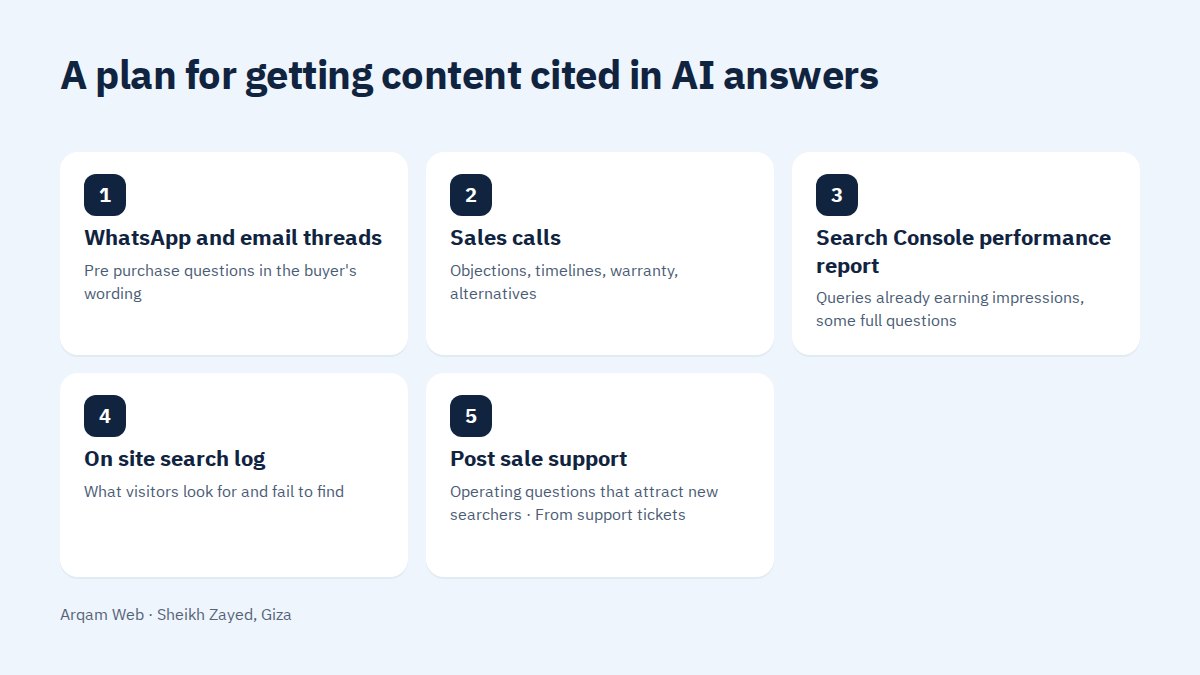
| Source | What it gives you | How to pull it |
|---|---|---|
| WhatsApp and email threads | Pre purchase questions in the buyer’s wording | The first question in each thread, last two months |
| Sales calls | Objections, timelines, warranty, alternatives | The five questions your sales team answers most |
| Search Console performance report | Queries already earning impressions, some full questions | Sort by impressions, filter the questions |
| On site search log | What visitors look for and fail to find | Review the internal search log monthly |
| Post sale support | Operating questions that attract new searchers | From support tickets |
Write each question the way it was spoken, without polishing the grammar. Customer phrasing is the entry point to getting cited in AI answers, because it resembles what people type into an answer engine.
How do you turn a question list into pages and sections?
Not every question deserves a page. Four steps keep the structure sane:
- Group near identical questions into one family. “How much does a site cost” and “what raises the price” belong together.
- Give each family one page whose title is the main question in the form people ask it.
- Turn the rest of the family into subheadings on the same page, each answer standing alone.
- Send rare questions to the FAQ block instead of a thin page.
Your pages then stop competing for one phrase, and each gets deep enough to answer its question fully.
Why one deep page beats five thin ones
Five pages covering branches of one question split a single phrase between them, so each ends up weaker. Editing a fact on one page takes minutes. Chasing it across five is a job half of which gets forgotten, and then your own figures disagree.
Placement matters more. A deep page holds the definition, the table, the steps and the questions in one document, so getting cited in AI answers stops depending on a passage assembled out of four sources. Read how to make your site stand out for building that depth.
How to build a source page worth getting cited in AI answers
A source page is not a long essay. It is an ordered page where the answer is found in seconds. Six parts do the work:
- One definition sentence at the top, answering the question with nothing in front of it.
- A table putting figures and differences into rows, each readable on its own.
- Numbered steps wherever order is mandatory, since the order is itself information.
- A question block in the customer’s wording, each answer a short complete paragraph.
- A visible update date for the reader, with a line on what changed at the last review.
- A named source beside every figure, publisher and date.
A page holding all six serves the visitor first. Getting cited in AI answers is a side effect of good order, not a separate goal with its own machine written text.
Why getting cited in AI answers needs a clear entity
Nobody quotes a source they cannot identify. A clear entity means three things: your name, address and phone match everywhere they appear; your about page carries real detail about the work and the premises; and your content has a named author with two lines of background.
Contradiction alone weakens you: an old number in a directory, an abbreviated name on an account, a different address on the contact page. Read how to benefit from your site and settle these once.
What blocks a citation even when the writing is good
Six obstacles stop good pages from getting cited in AI answers:
- Content behind a login. What cannot be read without an account cannot be quoted, so publish an open summary.
- A slow page. One that responds late gets dropped for a lighter page saying the same thing.
- Information trapped in an image or a PDF. A screenshot of a table is unreadable, so rewrite it as text.
- Text that appears only after JavaScript runs. Main content belongs in the page itself.
- Claims with no source. “Best” and “fastest” with nothing behind them get discarded.
- Figures that disagree across your pages. Three numbers for one thing cancel out.
A realistic timeline
| Stage | Rough time | What is finished by then |
|---|---|---|
| Collecting questions, grouping them into families | One week | A list ordered by commercial priority |
| Writing the first source page, rebuilding one old page | Two weeks | Two pages with all six parts |
| Fixing the entity, about page and author identity | Second month | Matching details, clear publisher |
| Monthly review, one new question family | Ongoing | Depth that accumulates without duplication |
No date can be promised for getting cited in AI answers. A new page has to be crawled and read first, and quoted material is rarely the newest thing published. The first gain has nothing to do with any platform: fewer questions reach you with no written answer ready.
The checklist before you publish
- The title question came from a real message.
- The answer is complete within fifty words and needs no preceding context.
- The page covers one question family and competes with no other of yours.
- It contains a table, numbered steps and a question block.
- Every figure sits beside a source and a date.
- The update date is visible to the reader.
- The page opens with no login and loads fast.
- Company and author details match your accounts.
Getting cited in AI answers is a standing item in how we build pages: detail on the web design and development page, scopes on the pricing page.
Frequently asked questions
How many questions should the first month cover?
Ten questions that genuinely repeat in your messages are enough. Ten real ones in customer language serve getting cited in AI answers better than fifty pulled from a keyword tool, because the first set matches what people ask and the second what the tool measures.
Should every question get its own page?
No. Group close questions into one family, give it a single page, and make the rest subheadings inside it. Small similar pages compete for the same phrase and scatter any chance that one becomes the reference page on its topic.
Is an update date in the code enough?
It should be visible to the reader on the page, with a line saying what changed at the last review. A date in the markup with no real edit behind it helps nobody, and changing one word to refresh a timestamp costs you trust in your other figures.
Can content behind a login be cited?
Material that will not open without an account is neither read nor quoted. The practical fix is an open page explaining the idea with a table and clear steps, while the login keeps what deserves registration: files, calculators and downloadable templates. The same rule applies to anything behind a data form.
Does every page need a named author?
It helps on anything carrying judgement or experience, and matters more in money, health and legal topics. A service page is fine with a clear company identity, while an analytical article gains from an author name, a short background line and a profile page.
Have your pages reviewed
Send your site address and the five questions that repeat most in customer messages, and you will get a suggested page structure with what each page is missing.
Request a quote · Message us on WhatsApp · Call us
Arqam Web
44 Central Axis, Al Saraya Mall, Lower Ground, Entrance 2, Sheikh Zayed, Giza, Egypt
Phone and WhatsApp: +20 111 872 1404 · Email: info@arqamweb.com
Google’s own reference is the AI features page in Search Central.