

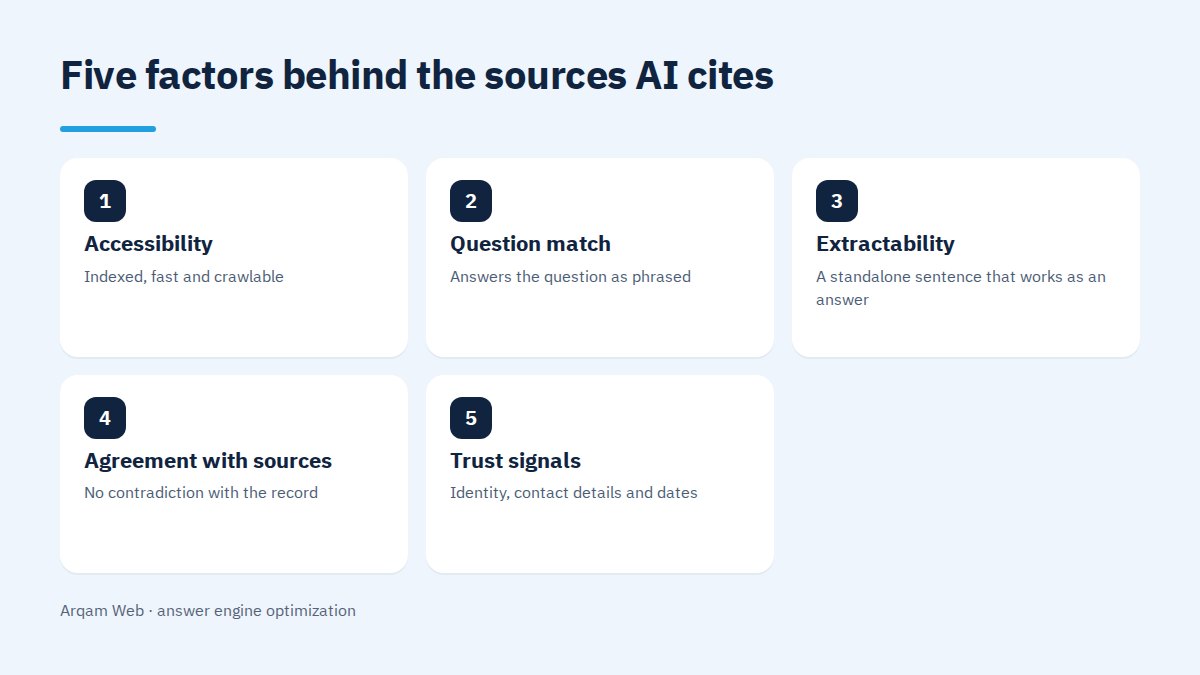
How AI picks sources it cites comes down to five practical conditions: it picks what it can reach, what matches the question closely, what a clean sentence can be lifted from, what agrees with other sources, and what carries visible trust signals. There is no secret list, and every condition is one you can meet.
What actually happens when you ask a question?
The model does not remember your site. For a question needing current information it runs a search, gathers a limited set of pages, reads parts of them, then assembles an answer and attributes each part to its source. The competition is therefore for two things: entering the read set, and being the easiest paragraph to quote.
That explains something everyone notices: a site that ranks well and is never cited. The problem is in the second step, not the first.
How AI picks sources: the five factors
| Factor | What it means | What you do |
|---|---|---|
| Accessibility | The page is indexed, fast and permitted to be crawled | Check robots.txt, the sitemap and page speed |
| Question match | The page answers the question as phrased, not a general topic | Make subheadings real questions |
| Extractability | A standalone sentence exists that works as a full answer | Open each section with a sentence that stands alone |
| Agreement with other sources | The information does not contradict the published record | Name the source and date and avoid lone claims |
| Trust signals | A known entity with contact details and a clear identity | Company details, an author, and Organization schema |
Why do good pages get skipped?
- Long paragraphs. Ten lines cannot be cut cleanly, so a two line paragraph elsewhere wins.
- The answer at the bottom. A long marketing introduction buries the information.
- Temporal vagueness. “Currently” with no date makes a fact unusable.
- Numbers with no source. An unreferenced figure is dropped or attributed elsewhere.
- Content inside images. A table saved as an image is not read.
What makes your paragraph the chosen one?
Write every section so its first sentence is a complete answer that needs nothing before it. That is the single highest impact rule. Add the detail afterwards for anyone who wants depth.
For example, instead of “many factors affect the cost and we will review them”, write “a website cost is set by page count, special features and who writes the content”. The second works as an answer. The first works as nothing.
Three content shapes that get quoted most
- The comparison table. Two rows and three columns replace a whole paragraph, and quoting from them is precise.
- The numbered list of steps. The order is itself information, which is why it transfers intact.
- A short question and answer. That structure is the closest thing to what answer engines produce anyway.
When you ask how AI picks sources, look at these three shapes: any page without them relies on flowing prose alone, which is the hardest thing to cut cleanly.
The role of structured data
Structured data does not force anyone to cite you, but it removes ambiguity about who you are and what the content is. The useful minimum for a business site: Organization with your details and address, FAQPage in articles, Article for the article, and Service for each service.
Add an llms.txt file indexing your pages with a short description each, and content signals in robots.txt that permit citation. For more, read how to distinguish your site.
Is Arabic an opportunity here?
Clearly yes. Reliable Arabic content is far thinner than English in most professional fields, so a clear, well structured Arabic source faces less competition for citation. Anyone publishing genuinely good Arabic today is building an advantage that is hard to catch up with later.
The condition is that it must be written Arabic rather than machine translated, because machine translation carries odd constructions that make any extract read badly.
How do you know you are being cited?
- Ask monthly yourself. Put your customers real questions to the answer platforms and log whether your name appeared.
- Watch referral traffic from chatgpt.com, perplexity.ai and gemini.google.com in GA4.
- Notice enquiry quality. Anyone arriving after an answer already knows the scope of your service.
Record it in a simple monthly table. Without measurement, the question of how AI picks sources stays theoretical rather than becoming a decision you can act on.
Frequently asked questions
How does AI pick the sources it cites?
It picks pages it can reach and read, that match the phrasing of the question, that a standalone sentence can be lifted from, that agree with other sources, and that carry trust signals such as a clear identity, contact details and explicit dates.
Does ranking in Google alone decide how AI picks sources?
It does not guarantee it but it helps. Ranking raises the chance of entering the read set, while the quotation itself depends on how the page is written: short paragraphs, a direct answer, and content organised into tables and lists.
Should I block AI from my site?
You can separate the two uses: allow citation inside answers and refuse use in model training through content signals in robots.txt. A full block protects you from training but removes you from answers too.
How long does it take to see a result?
Usually faster than SEO, because answer engines re-read their sources continuously. Visibility still varies between questions, so judge across a month of repeated questions rather than one attempt.
What is the single change to start with today?
Rewrite the opening paragraph of your five most important pages into a direct answer that can be quoted without prior context, and add an FAQ section with schema. Those two changes outweigh any broader technical work.
Make your site a quotable source
We review your most important pages and tell you which paragraphs are quotable and which need rewriting, then set up structured data, the index file and the content signals, working from the five factors that govern how AI picks sources.
Request a quote · Message us on WhatsApp · Call us
Arqam Web
44 Central Axis, Al Saraya Mall, Lower Ground, Entrance 2, Sheikh Zayed, Giza, Egypt
Phone and WhatsApp: +20 111 872 1404 · Email: info@arqamweb.com