

Your website goal is the answer to one question: what do you want a visitor to do once the page opens? Having a website is not a goal in itself. The goal is a specific action the visitor takes, and the design, the copy and the buttons are all built around it.
Why a website with no clear goal fails
A site that starts with design before the website goal is settled comes out handsome and full of pages, and the visitor still does not know what to do after reading. That is not a taste problem. It is a sequencing problem: the decision that belonged in the first meeting was deferred until fixing it meant a rebuild.
The tell is easy to spot. Ask the owner what they want from a visitor and the answer comes back as “to know about us”. That is not an answer, because it cannot be measured and it does not end in an action.
The five common website goals
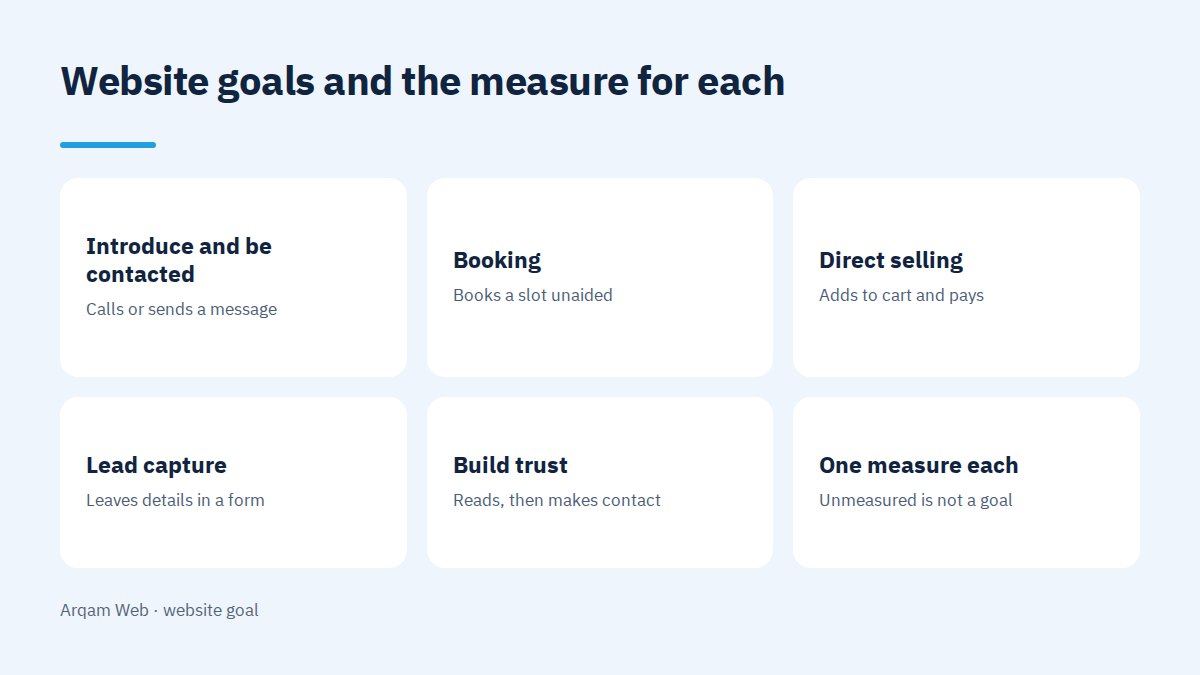
Most company sites have a website goal that falls into one of five. Each one has a different primary button, different pages serving it, and a different number that judges it:
| Goal | The action | Pages that serve it | What you measure |
|---|---|---|---|
| Introduce and be contacted | Calls or sends a message | Services · About · Contact | Messages and calls |
| Booking | Books a slot without you | Services · Calendar · Pricing | Completed bookings |
| Direct selling | Adds to cart and pays | Product · Category · Cart · Checkout | Orders and their value |
| Lead capture | Leaves details in a form | Landing page · Short form | Completed forms |
| Build trust before talking | Reads, then makes contact already convinced | Portfolio · Reviews · Case studies | Enquiry quality, not count |
That last one gets misread often. A company selling large projects does not need a hundred enquiries. It needs five from people who read, understood the scope and knew the price range before they wrote.
How the goal changes the design itself
A website goal is not a line written in the brief and then forgotten. It decides:
- The order of homepage sections. A booking site puts the booking button in the first screen. A trust-building site puts the portfolio before it asks for anything.
- How many fields the form has. Lead capture wants the fewest fields possible. Qualifying enquiries wants extra fields that filter out the casual.
- How long the copy runs. A small purchase decision needs a short page. A project costing tens of thousands needs detail that answers objections before they are raised.
- What gets cut. Every section that does not serve the goal steals attention from one that does.
One primary goal, the rest secondary
A site chasing five goals with equal weight achieves none of them. Pick one primary website goal to govern the homepage and the first screen, and let the others appear in their natural places further down.
A clinic is the clean example. The primary goal is a booking. A newsletter signup and an aftercare guide download are useful secondary goals, but neither takes the booking button’s place in the first screen.
How to settle your website goal in one session
- Write the action, not the wish. “Books a consultation” is an action. “Trusts us” is a wish.
- Name the visitor. The same service sells two different ways to a small business owner and to a procurement manager at a large company.
- Ask what stops them acting now. The price is unclear, the timeline is unknown, they doubt you have done their case before. Every blocker becomes a section on the page.
- Pick one number. If you cannot measure the website goal, it is not a goal.
- Write the whole sentence. “I want a restaurant owner in Cairo to request a quote for an online ordering site after seeing three similar builds.” That sentence is the brief.
The website goal in three published projects
The difference between one site and another shows up in the structure long before it shows up in the colours. Three examples you can open:
- Home of Tax, an accounting and tax firm. The goal is a qualified enquiry, so each service sits on its own page and the contact form is reachable from every one of them.
- Forsan Pools, a pool company. The goal is wide local coverage, so the site was built with 183 service pages, each one targeting a service in a city.
- Boya Store, a paint retailer. The goal is direct selling, so categories, the product page and the cart are the spine, and everything else supports them.
Three projects, three completely different structures, because the website goal was different in each.
Common mistakes that cost a site its goal
- The homepage opens with company history before saying what the company does.
- Five services crammed into one page, so none of them ranks and the visitor cannot find theirs.
- A bare “Contact us” button when the visitor wants a price or a date.
- A long form asking for data the company does not need at first contact.
- No measurement at all, so nobody knows which page works.
Before you commission anything, read types of websites to see which type serves your goal, and how to get value from your website for what happens after launch.
Frequently asked questions
What is a website goal?
It is the specific action you want a visitor to take: call, book, buy, leave their details, or read enough to make contact already convinced. A real goal can be expressed as a number you track. If you cannot measure it, it is a wish rather than a goal.
Can a website have more than one goal?
Yes, but in order. One primary goal governs the homepage and the first screen, and secondary goals appear in their natural places inside the pages. A site that gives five goals the same space splits the visitor’s attention and delivers none of them.
When should the goal be decided?
Before design and before any code, in the scoping session. Changing the goal after the design is approved means reordering pages, copy and buttons, which costs far more than an hour of discussion at the start.
How do I know my website goal is unclear?
Three signs: you cannot describe what you want from a visitor in one sentence containing a verb, the homepage shows everything at equal weight, and there is no single number you check monthly to know whether the site is working.
Is the goal different for a company site and an online store?
The action differs, the principle does not. A store aims at a completed order and is measured by orders and cart completion rate. A service company usually aims at a qualified enquiry and is measured by how many and how good. Either way: one specific action and one number behind it.
Start from the goal
Book a scoping session with Arqam Web and you leave with a written document naming the website goal, the action and the measure, even if you decide not to go ahead with us.
Request a quote · Message us on WhatsApp · Call us
Arqam Web
44 Central Axis, Al Saraya Mall, Lower Ground, Entrance 2, Sheikh Zayed, Giza, Egypt
Phone and WhatsApp: +20 111 872 1404 · Email: info@arqamweb.com
For the measurement side, Google Analytics documentation on events and conversions explains how the action you chose gets recorded as a conversion.