

A manufacturer website does not sell from a basket. It qualifies a professional buyer before he sends a quote request. Three things carry it: a page for every product with its specification, supply detail a procurement manager can trust, and a request path that reaches your sales desk with enough to price on.
Who actually opens a manufacturer website?
The visitor is not a consumer. He is an engineer after a specification, a procurement manager collecting three offers, a contractor on a tight programme, or an importer hunting a new source. Each reads for a number, not for a line of marketing.
The CID Group project page describes the client as a manufacturer that makes and exports Egyptian marble, limestone and granite to contractors, developers and importers. Three buyer types open the same site with different questions, so one page about the company cannot do the job.
One page per product, or a single PDF catalogue?
A PDF is excellent in a meeting and useless in search. It does not appear in results for a product specification, it cannot take a new size without being resent, and it never tells you who read it. A manufacturer website does all three, and the file stays downloadable beside the product page.
The Egyptian Marble Supplier project page puts the logic in one sentence: this is a trade where the buyer searches by the name of a stone, and a site that lists its whole range on one page gives search nothing to land on and an answer engine nothing to quote. So the catalogue was built with a page per stone, and sixty one stone pages now sit under nine sections on that project page.
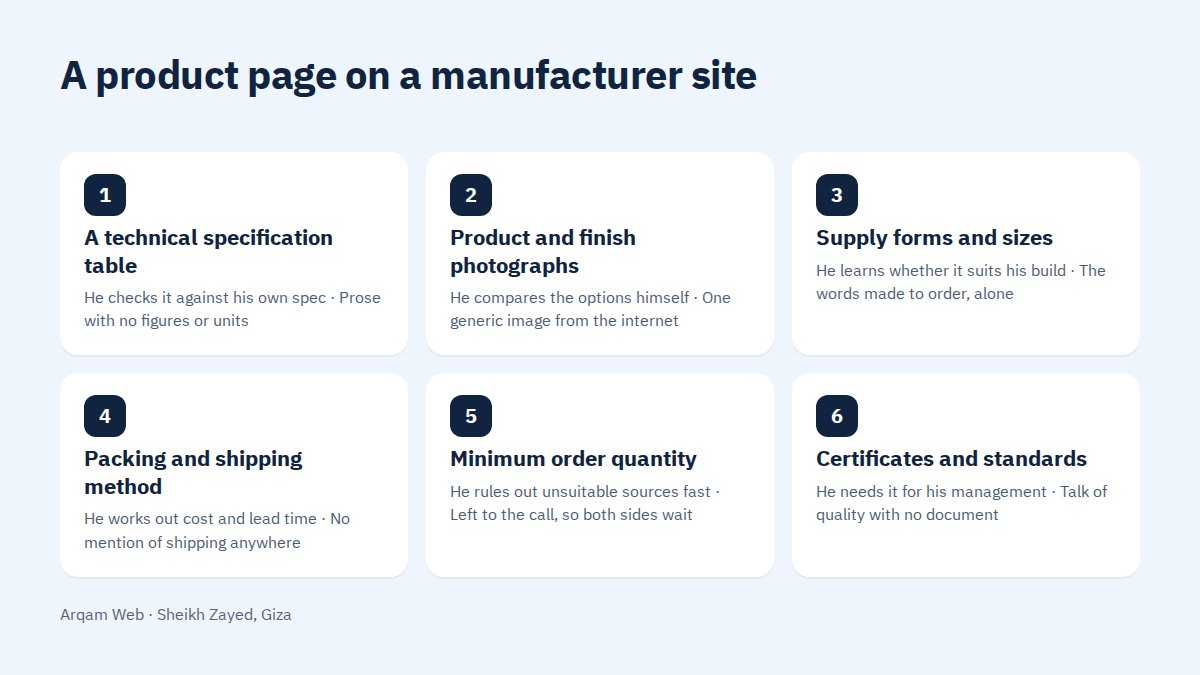
What belongs on a product page on a manufacturer website?
| Element | Why the buyer wants it | Sign it is missing |
|---|---|---|
| A technical specification table | He checks it against his own spec | Prose with no figures or units |
| Product and finish photographs | He compares the options himself | One generic image from the internet |
| Supply forms and sizes | He learns whether it suits his build | The words made to order, alone |
| Packing and shipping method | He works out cost and lead time | No mention of shipping anywhere |
| Minimum order quantity | He rules out unsuitable sources fast | Left to the call, so both sides wait |
| Certificates and standards | He needs it for his management | Talk of quality with no document |
| A quote button on the page | He asks from where he is reading | One link to a contact page |
Some factories hold the minimum order back for the negotiation. The absence should be a decision, not an oversight.
How do you lead a visitor to a quote request?
A request that arrives from a manufacturer website without detail costs your sales desk two calls before work can start. The order we use:
- Put the request button beside the product, not inside a distant contact page.
- Ask for product, quantity and destination, since pricing cannot start with less.
- Keep company and job title optional so nobody abandons a long form.
- Add WhatsApp next to the form, because buyers in Egypt and the Gulf usually start there.
- Say what happens after sending: who replies, with what, and how soon.
- Store the page name with every request so you learn which products generate enquiries.
On the Solafet Alsharq site, a Saudi hospitality supplier, what was built was a quote path, not a general contact form. The difference is not wording: a path asks for what pricing needs, a form asks for a message.
Why does the platform set a ceiling on a manufacturer website?
The CID Group project page says the site ran on Wix, that the closed platform capped what could be done on speed and technical SEO, and that it spoke only English while much of its market searches in something else. One line on that page settles it: the platform, not the product, was setting the ceiling.
What followed was a full migration from Wix to WordPress, with a faster and fully responsive build, search built around buyer language, content structured for AI answers, and room to add products and markets. That last item is what lets a manufacturer website survive years without a rebuild. Read types of websites before picking a platform.
When does a factory need a catalogue in the buyer’s language?
The rule is plain. If your buyer searches in his own language, a page that does not exist in that language does not exist for him. On CID Group the catalogue was published in Spanish, French, Italian and German alongside English, because that market searches in those languages.
The decision costs money and does not start with every language at once. Begin with the market that matters most after your own, measure the requests, then add the second. Machine translation alone will not carry a technical specification, because one wrong unit of measure costs an order.
How does a factory with an offline reputation prove it exists online?
Many factories trade on a strong reputation among their own customers and are barely known outside it. The Solafet Alsharq project page describes the position exactly: a Saudi hospitality supplier known only to the people who already knew it, with work for major Saudi hotel groups almost none of which was visible outside the existing relationships. What answers that:
- Supply lines separated clearly. That site was built with three supply lines kept apart, not blended into one list.
- A page for the sectors served, so a visitor finds his own sector named.
- The client list on a page of its own, because to a professional buyer the logos are the argument.
- Recurring questions answered in advance. Six were published with their answers rather than left for the call.
- An Arabic site reading right to left throughout, a foundation in our market and not an addition.
Solafet is a supplier rather than a factory, but the buying behaviour on a manufacturer website is the same: find my sector, find the evidence, find the way to ask.
Frequently asked questions
Should product prices go on a manufacturer website?
Most do not, because price moves with quantity, specification, shipping and destination. Publish what sets the price instead: supply forms, sizes, minimum order and shipping terms. A buyer wants to know whether you are in his range before asking for a figure, and our ranges sit on the pricing page.
How many products should the catalogue launch with?
Enter the products you sell most of, complete with specifications and photographs, then add the rest in stages. An incomplete product page does more harm than good, and twenty finished pages beat a hundred where half carry no specification and no real image.
Which photographs do you need from inside the factory?
Products on a neutral background, the finishes side by side for comparison, and the production line, the packing and the loading. Those last ones do what words cannot: they prove the factory is real. Shoot them properly rather than buying stock images.
Who updates the catalogue after handover?
Your own team, agreed before the build starts. The dashboard has to let a non technical person add a product with its specification and photographs in minutes. If every edit needs a developer, updating stops within months and the site drifts back.
What makes a factory site take longer to build?
Gathering content, not development. Specifications, photographs, packing detail and product names in English all come from you, and a delay there stops the project. Prepare a sheet of your products with their specifications and images before work starts, and the timeline shortens.
Let us review your catalogue
Send your product list or site address, and you will get a proposed structure for the product pages and the quote path that suits your factory, at no cost.
Request a quote · Message us on WhatsApp · Call us
Arqam Web
44 Central Axis, Al Saraya Mall, Lower Ground, Entrance 2, Sheikh Zayed, Giza, Egypt
Phone and WhatsApp: +20 111 872 1404 · Email: info@arqamweb.com