

The Trio Catering case study covers a website built for a catering company that sells to procurement managers at companies, hospitals, schools and factories. The site carries nine service pages in three families, a company story holding the ISO 22000:2018 certificate, a gallery of forty photographs, and three forms doing three different jobs.
Who buys contract catering, and why that reorders the site
The buyer is named on the project page: procurement managers at companies, hospitals, schools and factories. That person is not browsing. They are collecting offers to compare, and they want to know within a minute what the company supplies and what each line covers.
The sites Trio would be compared against introduced their own companies at length and answered a buyer’s questions badly. That observation set the order of every page: answer first, and put the company introduction where it belongs. The Trio Catering case study begins there, in a note about competitor sites rather than a design idea.
What the Trio Catering case study started from
The client arrived with a request, not a written brief. The first meeting did the work a brief would have, and produced what was needed to start: the service list, the grouping, and the questions each page had to answer.
The practical difference is that the specification came out of a conversation, not a form filled in alone.
Nine services, grouped in three families
The services were not listed as one long menu. They were grouped into three families a buyer recognises immediately:
- Corporate work, the contracted catering sold to companies and institutions.
- The Trio food carts, a family with a completely different commercial logic.
- The café run inside a client’s premises, an ongoing operation rather than an event ending in a day.
- Nine service pages spread across those three families, each service holding a page of its own.
Grouping into families helps two audiences. A buyer knows which family applies on sight, and search engines find a distinct page per service, not a paragraph in a general one.
One service page, repeated nine times
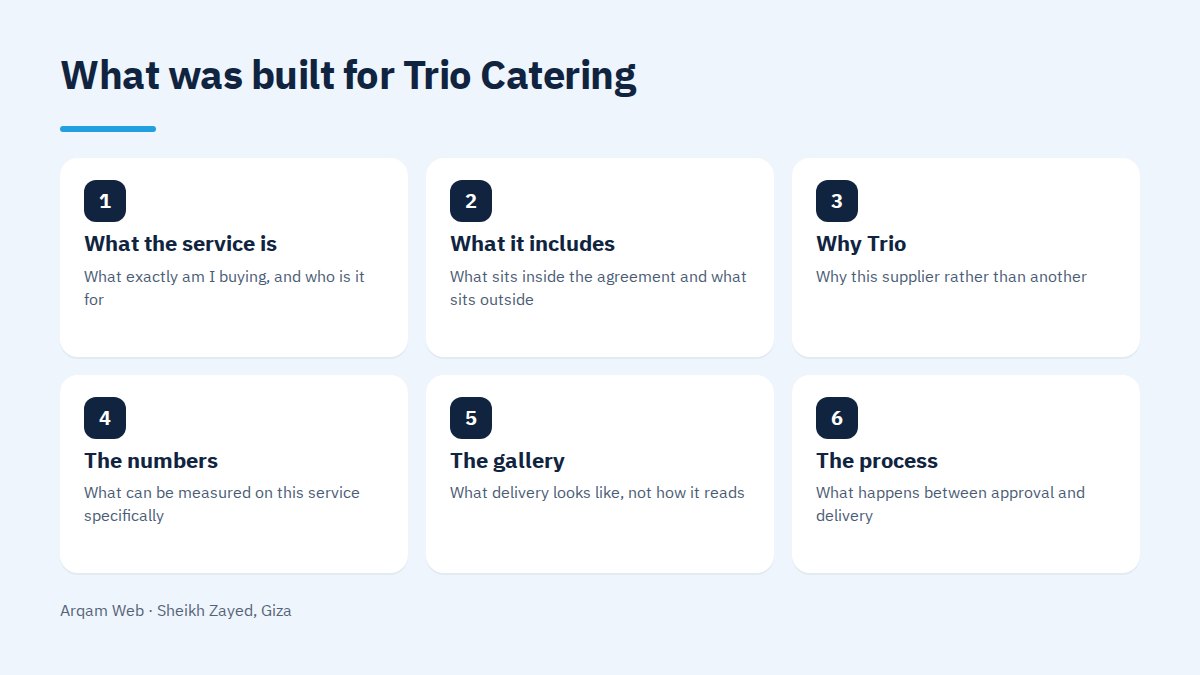
All nine service pages run the same sequence: what the service is, what it includes, why Trio, the numbers, a gallery, the process. Each part answers a question in the order a buyer asks it:
| Part of the page | The question it answers |
|---|---|
| What the service is | What exactly am I buying, and who is it for |
| What it includes | What sits inside the agreement and what sits outside |
| Why Trio | Why this supplier rather than another |
| The numbers | What can be measured on this service specifically |
| The gallery | What delivery looks like, not how it reads |
| The process | What happens between approval and delivery |
Every service also publishes its own steps rather than reusing one generic diagram nine times. Repetition in structure helps. Repetition in content makes nine pages read as one, and the Trio Catering case study keeps the two apart.
The company story, with the certificate on it
The company story page carries the ISO 22000:2018 certificate as an image anyone can read. In catering, a certificate is not decoration. A procurement manager at a hospital or a school will often ask about it before price, so publishing it removes a step from their checking.
The gallery holds forty photographs. Pictures do work that copy cannot here: they show what setup and service look like instead of describing it, and they are the part of the Trio Catering case study people ask about most. Read types of websites to see where a service site of this size sits among the rest.
Three forms doing three different jobs
The three forms are not one contact form pasted three times. Booking asks for event type, guest count, date and budget range. Careers takes the position applied for, years of experience, a cover letter and a CV upload. Contact stays short.
Alongside them, WhatsApp, phone and email sit in the header of every page, with the working days and hours beside them. Someone who prefers to call is never pushed into a form.
How the decision ran before the quotation, and after launch
- A meeting before the proposal. The first meeting did the work the missing brief would have.
- Options before a price. Several directions were presented rather than one defended, and management chose before the quotation.
- Design signed off before code. Amendments were implemented and the design was shown again until it was approved outright.
- The build. Nine service pages on one sequence, then the story, the gallery and the forms.
- After delivery. The site went through a spell with no maintenance, so it was fixed at no charge, with additions that reduce what an un-updated site can break.
That order is half of what the Trio Catering case study is about. Letting the client choose a direction before a price exists changes the project, because nobody defends a decision they took no part in making.
What the Trio Catering case study means for your own project
- Start from the buyer’s question rather than your own company description.
- Settle one service page structure, then repeat it across every service.
- Publish the real steps for each service instead of one diagram for all of them.
- Make every form ask for what that particular job needs and nothing else.
- Agree maintenance in writing before launch, not after the first failure.
For a larger site built on the same reasoning, look at Forsan Pools, a pool service company in Riyadh with 183 pool service pages, where the search structure was decided before the design rather than retrofitted after it. The full detail of this project sits on the Trio Catering project page.
Frequently asked questions
What is the summary of the Trio Catering case study?
A website for a catering company selling to procurement managers at companies, hospitals, schools and factories. It holds nine service pages in three families, corporate work, the food carts and the café run inside a client’s premises, plus a company story carrying the ISO 22000:2018 certificate, a gallery of forty photographs and three forms with three different jobs.
Who was the site actually built for?
Procurement managers at companies, hospitals, schools and factories, as the project page states. That buyer compares offers, so they need a page that says what a service includes and excludes before it talks about the company. The ordering of the whole site follows from that one fact.
Why nine service pages instead of one page listing everything?
Each service answers a different buying situation and gets searched for in different words. A combined page forces a reader to scan until they find their line, and leaves a search engine without a clear page per service. Nine pages on one structure solves both, and it is the decision the Trio Catering case study turns on.
What does publishing the ISO 22000:2018 certificate achieve?
Showing it as an image a visitor can read for themselves removes an entire round of checking. Instead of asking for the certificate and waiting for it by email, the buyer sees it on the company story page. This is a general point about content order, not advice on certification or audit requirements.
What does the free repair mean in practice?
The site went through a period without upkeep, and it was restored at no charge to the client. What mattered more came after: additions that reduce what an un-updated site can break. The repair handled the incident, the additions its cause.
Build your service site on the same method
Send your list of services and how you group them, and you will get a proposed page structure and a written offer with itemised lines. The rest of our work is on the projects page, and what we handle is on the web design and development page.
Request a quote · Message us on WhatsApp · Call us
Arqam Web
44 Central Axis, Al Saraya Mall, Lower Ground, Entrance 2, Sheikh Zayed, Giza, Egypt
Phone and WhatsApp: +20 111 872 1404 · Email: info@arqamweb.com