

Your website platform migration cost is set by three things before anything else: how much content moves and how clean its data is, how many features have no ready equivalent on the new platform, and whether a redesign is bundled in. Moving the files is the cheapest line item. Everything around it is what you pay for.
What drives website platform migration cost?
Page count on its own tells you little. A thirty page site with tidy data can cost less than a hundred product store whose attributes were named three ways over five years. Every exception that needs a human decision instead of a rule pushes the website platform migration cost up.
The invisible work is field mapping: deciding what each old field becomes on the new platform. On Boya Store, one of Egypt’s larger paint retailers, carrying well known international brands, we went through the product data the company already held and how it was organised, and the platform decision came after that. Doing it the other way round means paying for the same work twice.
Which line items should the quote break out?
A quote worth comparing separates the work below instead of giving you one website platform migration cost figure. A supplier who cannot itemise it has not scoped it.
- Content inventory. Counting pages, products and media, then deciding what moves, merges or gets dropped.
- Data cleanup. Standardising attribute names, units and categories first, because migration copies mess rather than fixing it.
- Building the new structure. Content types, fields, taxonomies and templates on the destination platform.
- The move itself. Usually half scripted and half manual: a script for the repetitive bulk, hands for the exceptions.
- Features with no equivalent. A price calculator, wholesale tiers, an accounting or courier integration.
- Redirects. A map from every old address to the correct new one, not a blanket redirect to the home page.
- Testing. Forms, the purchase path, payment and outgoing email, on a real phone rather than a desktop browser alone.
- The watch period after cutover. A month of checking 404s, page speed and pages dropping out of the index.
What inflates the bill for no return?
- Moving everything. An archive of hundreds of pages nobody visits gets migrated at full price and then ignored. Cut or merge before you pay.
- A redesign in the same project. Migration and redesign are two projects. Combining them raises the price and makes any later problem harder to trace to a cause.
- No decision maker on the client side. Every open question about a category name or a field turns into billable waiting.
- Features added mid build. A request that arrives after the move has started costs more than the same request made during the inventory.
How does the cost change by type of move?
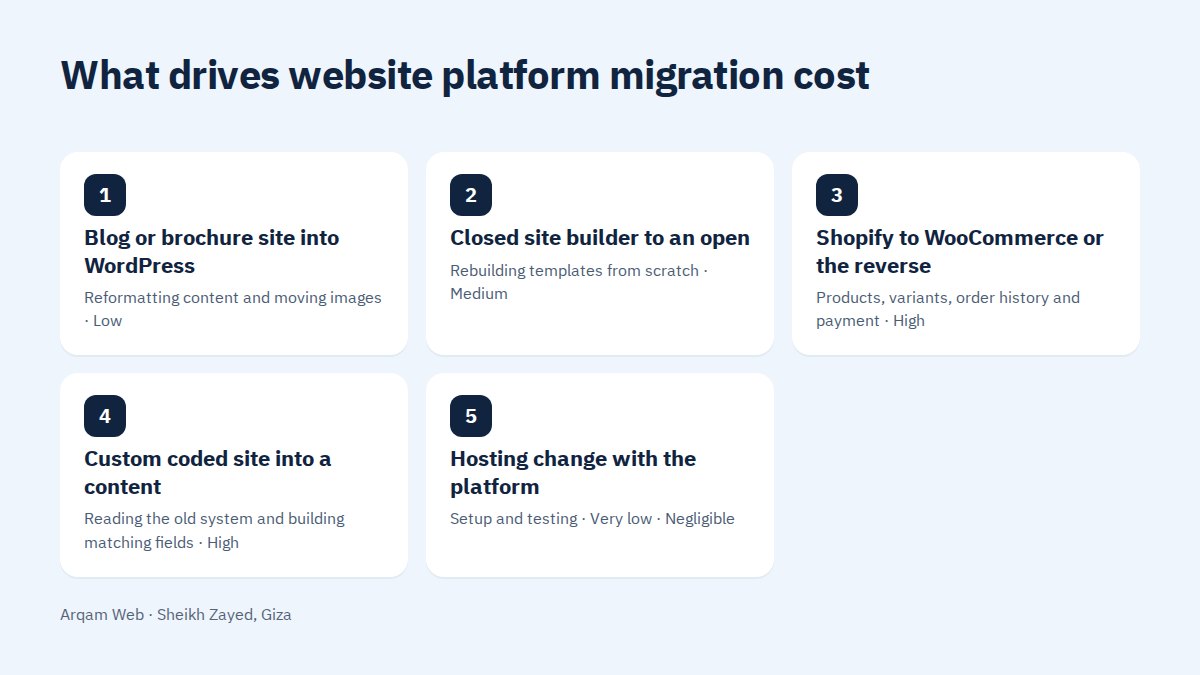
Migrations are not one job with one price. The table sets out the pattern behind most website platform migration cost estimates.
| Type of move | Biggest cost driver | Effect on price | SEO risk |
|---|---|---|---|
| Blog or brochure site into WordPress | Reformatting content and moving images | Low | Low if addresses are preserved |
| Closed site builder to an open platform | Rebuilding templates from scratch | Medium | Medium, address structure usually changes |
| Shopify to WooCommerce or the reverse | Products, variants, order history and payment | High | High, product and category paths change |
| Custom coded site into a content management system | Reading the old system and building matching fields | High | Medium, needs an exact redirect map |
| Hosting change with the platform unchanged | Setup and testing | Very low | Negligible |
How do you protect search traffic during a move?
Almost every traffic drop after a migration traces back to one cause: old addresses now returning an error page. The fix is not difficult, it is tedious, which is why it gets skipped. Export every address from the old site, map each one to its new counterpart in a redirect file, then test a sample yourself after cutover.
Watch the indexing report in Search Console weekly for a month afterwards. Pages falling out of the index appear there before traffic moves. Keep the old site running on an internal address until that month is over, so a missing page can be recovered rather than rewritten.
Can a site move platforms without downtime?
In most cases yes. The normal method is to build the new site completely on a staging address closed to search engines, test it there, then switch the domain during a quiet hour and apply the redirect file at the same moment.
Active stores are the one case that usually needs a short pause, because orders placed during the switch can fall between two systems. Closing checkout for a pre announced hour is cheaper than one lost order, and the pause adds nothing to the website platform migration cost.
When is migrating the wrong decision?
Moving platforms does not fix every problem. If the complaint is speed, hosting or uncompressed images are more often the cause than the platform itself. If the complaint is weak sales, a migration changes neither your offer nor your content.
The working rule: move when the current platform blocks something specific you need and cannot add, or when its annual cost has passed what it returns. Read types of websites and how much a website costs in Egypt before deciding, and the pricing page for how we contract.
How do you compare two website platform migration cost quotes?
Put both on the same eight line items above and look for what is missing rather than what is cheap. A quote with no redirect mapping and no watch period is not a lower website platform migration cost, it is a smaller job with the risky parts left for you.
Ask each supplier one question: what happens if a page is missing after cutover, and who fixes it. The answer separates a fixed price for delivery from a fixed price for a working site.
Frequently asked questions
How long does a platform migration take?
A small brochure site with tidy data usually finishes in days. A mid sized store with variants and integrations takes weeks, and most of that time goes on data cleanup and testing rather than the transfer. The schedule depends more on how fast the client answers category questions than on anything technical.
Can order and customer history move across?
Orders and customer records transfer on most platforms. Passwords do not, because they are stored hashed, so customers have to reset them. Loyalty point balances and active coupons often need manual work. Ask about these three items specifically before you sign anything.
Will migrating hurt Google rankings?
A careful move causes limited movement for a few weeks and then settles. Lasting damage comes from broken addresses with no redirects, from deleting content that was bringing visitors, or from leaving the staging site open to indexing so it competes with the live one.
Who owns the site after the move?
Ask in the contract that the domain, hosting account, code and database are all registered in your own name, and that a complete backup is handed to you on completion. This is general information about how to set up an agreement, not legal advice.
Are off the shelf migration plugins enough?
They handle the repetitive bulk: page text, images and products that share one structure. They do not handle custom fields, internal links inside body text, or integrations. Relying on them alone produces a site that looks migrated while half of it is quietly broken.
Ask for a migration estimate
Send your current site address and the platform you are considering. You will get a first inventory of what would move, what should be dropped, and which items need manual work, before any commitment.
That inventory is also the honest way to find out whether the website platform migration cost is worth paying at all, or whether your problem sits somewhere else.
Request a quote · Message us on WhatsApp · Call us
Arqam Web
44 Central Axis, Al Saraya Mall, Lower Ground, Entrance 2, Sheikh Zayed, Giza, Egypt
Phone and WhatsApp: +20 111 872 1404 · Email: info@arqamweb.com