

An event and sports agency website needs three things before anything else: a record of work that proves the events really happened, separate service pages a buyer can compare against each other, and an enquiry form that asks for event type, guest count, date and budget range. Most sites in this field start at the opposite end and explain the company instead.
What makes an event and sports agency website different?
The buyer here is buying confidence in delivery, not a description of a service. Somebody hiring an organiser for a conference, a training camp or an opening night asks one question first: have you done this before? A page answering with real photographs and named events ends half the conversation.
- The decision is shared. A marketing manager, a procurement manager and sometimes the owner each arrive with a different question.
- Demand is seasonal. Enquiries pile up before a season, and a site that cannot take them then loses the year.
- The portfolio changes fast. Every new event has to reach the site in days, not in an annual refresh.
- Photographs are the product. Nobody judges the quality of a gala from prose. Visitors read the images first.
Which pages does the site actually need?
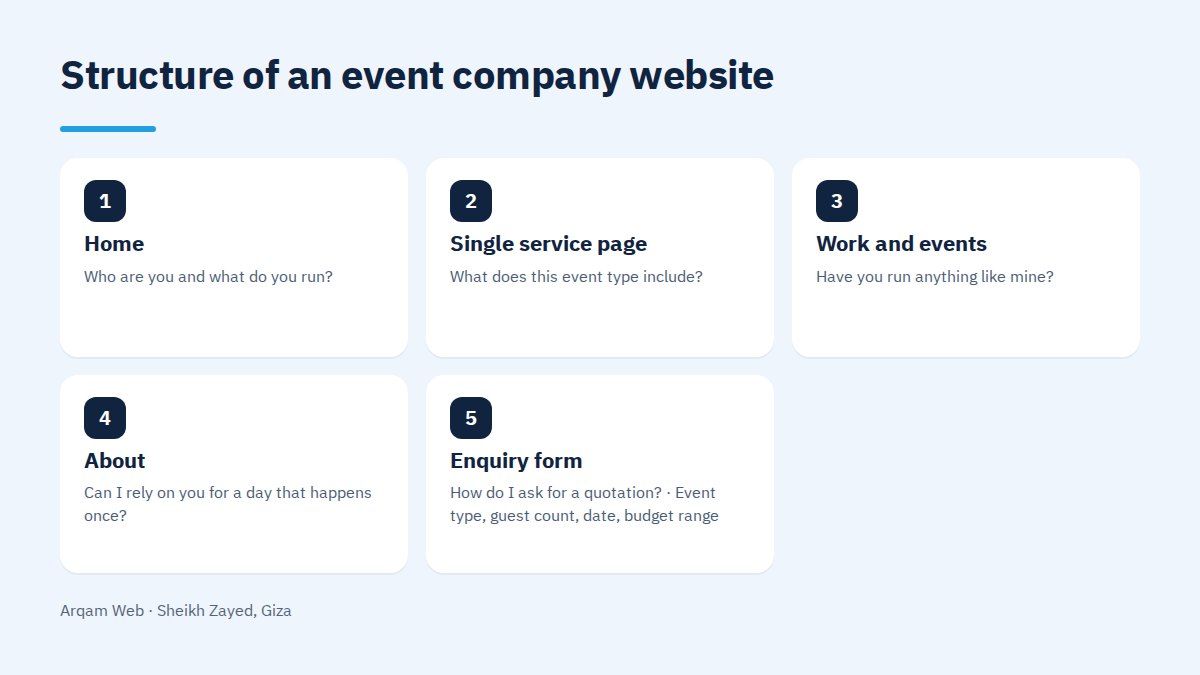
The page list for an event and sports agency website is shorter than expected, and every item answers one question:
| Page | Question it answers | What belongs on it |
|---|---|---|
| Home | Who are you and what do you run? | Service cards, recent events with photographs, one route to an enquiry |
| Single service page | What does this event type include? | What it is, what it covers, the steps, images, buyer questions |
| Work and events | Have you run anything like mine? | One record per event: name, location, photographs |
| About | Can I rely on you for a day that happens once? | The team, certificates, sectors served |
| Enquiry form | How do I ask for a quotation? | Event type, guest count, date, budget range |
What it does not need: a mission and vision page at the top of the menu, or a slider of photographs belonging to no event.
How should the portfolio work on an event and sports agency website?
On the SportReach project, a new Saudi sports agency, the project page lists the client’s fields as sports marketing, event organisation, club and team management, sports PR, consulting, talent management, sponsorship, and training. The site carried eight services and nine pieces of the agency’s work, in Arabic with full right-to-left layout.
The work section names specific events: training camps in Spain, Bosnia and Qassim, an inter-company championship, the Al-Nassr club festival, academy coverage, the Olympiad and two named tournaments. The project page states the reasoning plainly: a new agency’s credibility is the events it has actually run. That is the standard an event and sports agency website is held to.
Does every service need its own page?
Yes, and to one repeated shape. On the Trio Catering project, a catering company that sells to procurement managers at companies, hospitals, schools and factories, there are nine service pages in three families built to one page shape. Each page runs the same sequence: what the service is, what it includes, why Trio, the numbers, a gallery, the process, and the questions buyers ask.
The reason given on the project page is that somebody comparing two of Trio’s services is comparing like with like. Three of the nine carry the client’s own “Under Development” label, and it stays visible on the site rather than being hidden.
What photographs does an event and sports agency website need?
A new company has no archive, and that is a real problem rather than a detail. On the SportReach project there were no photographs and no content library. The project page puts it directly: every image on this site exists because we produced it, and an image was produced for each of the eight services.
The choice is between real photography of one event and stock images that look nothing like your work. The first costs more once and less every time after, because the photographs stay yours.
Building the site in Arabic without it reading as a translation
The SportReach site was built for Arabic from the first layout rather than mirrored afterwards. The difference shows in small irritating places: slider arrow direction, where an icon sits beside text, and the order of table columns.
Design the Arabic version first when your main audience is Arabic speaking, then build English on top of it. Check types of websites before design begins so the shape is settled early.
Which forms collect the enquiries?
One generic form that takes a name and a message gives the sales team nothing. The Trio Catering project runs three forms doing three different jobs: booking asks for event type, guest count, date and budget range; careers takes the position applied for, years of experience, a cover letter and a CV upload; contact stays short. The project page notes that one generic form would have collected none of that.
The order we build the enquiry form on an event and sports agency website:
- Start from the call. What the sales team asks in the first two minutes is your field list.
- Ask for the date first. An event in ten days and one in seven months are different requests.
- Ask for a range, not a figure. A range gets answered. An open box gets skipped.
- Make guest count required. Without it nobody can price anything.
- Put WhatsApp and the phone in the header. A good share of enquiries come from somebody in a hurry.
One detail on the Trio page is worth copying: WhatsApp, phone and email sit in the header of every page, with the working hours beside them.
Keeping the site current after the first season
On the SportReach project, services and achievements are both content types, so the work section fills up by data entry as the agency runs more events. The project page puts it as nine events today, more next season.
Adding a record is not a project. Commissioning a page is. The build detail sits on the web design and development page.
Frequently asked questions
What should appear first on an event company site?
The most recent event you delivered, with a real photograph, a name and a location. Visitors want proof rather than a promise, and the fastest proof is work that resembles what they are planning. Clear service cards come next, then one route to an enquiry.
Do I need a separate page for every event I have run?
Not a hand-built page, but you do need a separate record per event inside one content type. A new event is then added by data entry in minutes, and the site is still accurate two seasons later without going back to the developer.
How do I handle a service that is not ready yet?
Publish it and label its state. On the Trio Catering project three of nine services carry the client’s own “Under Development” label, and it stays visible rather than hidden. That beats a page that looks finished until the buyer finds out otherwise on the first call.
Do you work with agencies in the Gulf?
Yes, and the work is delivered remotely from our office in Sheikh Zayed, Giza, because we have no office in any other city. Everything runs through video calls, WhatsApp and shared files, and the SportReach project is a Saudi sports agency built that way.
What does an event and sports agency website cost?
The cost follows the number of service pages, the size of the portfolio, and whether photography has to be produced from nothing. That last gap is wide. Ranges sit on the pricing page, and a firm figure comes after a short scoping call.
Talk to us about your events site
Send the type of events you organise and how many service lines you run, and you will get a proposed structure plus a list of what to photograph first, with no obligation.
Request a quote · Message us on WhatsApp · Call us
Arqam Web
44 Central Axis, Al Saraya Mall, Lower Ground, Entrance 2, Sheikh Zayed, Giza, Egypt
Phone and WhatsApp: +20 111 872 1404 · Email: info@arqamweb.com