

You need a CDN when the distance between your visitors and your server is what slows the site down. A content delivery network keeps copies of your files on machines close to the people asking for them. It shortens travel time. It will not make a heavy theme light or a slow query quick.
What a content delivery network actually is
Picture a trader with one warehouse in Cairo. Every order from Riyadh or Doha waits for a shipment. Put a copy of the best sellers in a small depot near each market and the same order arrives in hours, not days.
That is the whole idea, applied to images, fonts, stylesheets and scripts. The original stays on your server, copies sit at points of presence worldwide, and each visitor is served from the nearest. Only the delivery route changes.
What it fixes, and what it cannot touch
The gain is in round trip time: how long a request takes to reach a server and come back. Distance and routing decide it, and extra memory on the origin changes nothing. Round trip time tells you whether you need a CDN.
Plenty of slow sites are slow for reasons unrelated to distance. A theme loading dozens of files. Photographs at camera resolution. Plugins on every page. Queries with no index. A network in front of that hides the problem for a week, then the numbers drift back.
Fix what you can measure on your own server first, then shorten the distance. Read website components to find which part carries the weight.
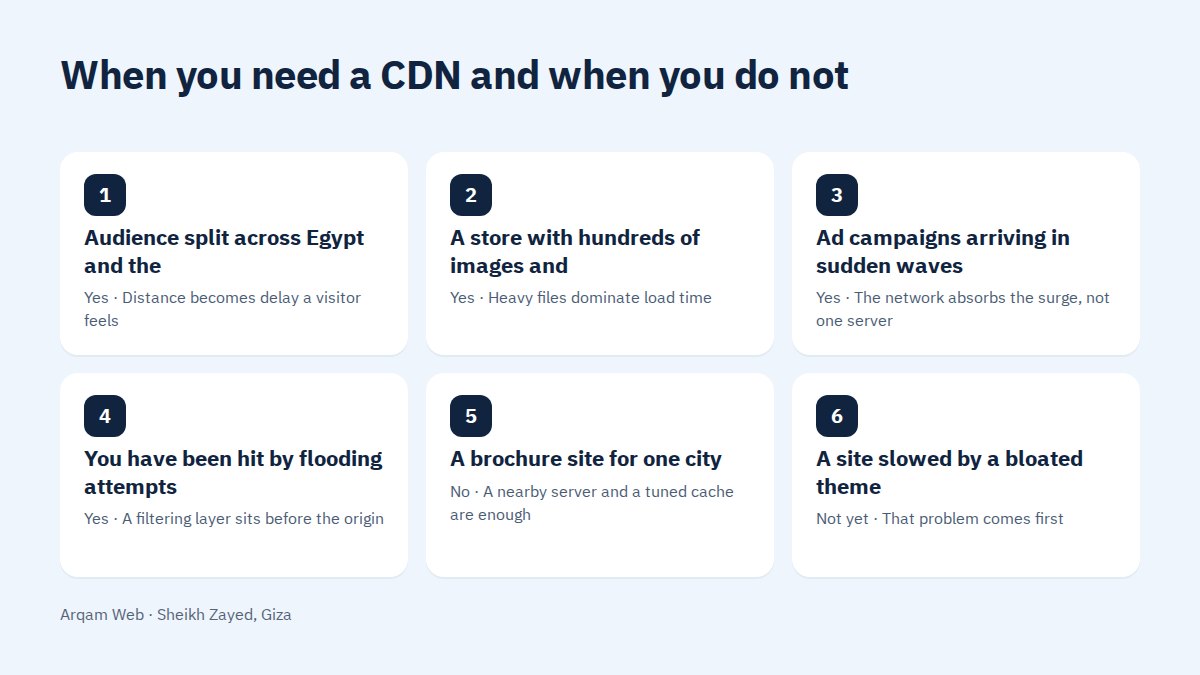
So when do you need a CDN and when do you not?
| Situation | Need one? | Why |
|---|---|---|
| Audience split across Egypt and the Gulf | Yes | Distance becomes delay a visitor feels |
| A store with hundreds of images and video | Yes | Heavy files dominate load time |
| Ad campaigns arriving in sudden waves | Yes | The network absorbs the surge, not one server |
| You have been hit by flooding attempts | Yes | A filtering layer sits before the origin |
| A brochure site for one city | No | A nearby server and a tuned cache are enough |
| A site slowed by a bloated theme | Not yet | That problem comes first |
| Content rebuilt per user on every view | Partly | Static files only, never the pages |
The last row causes the most confusion. Sites that need a CDN for static files still have to exclude pages assembled per visitor.
How is this different from caching on the site?
Site caching saves assembly work: the finished page sits on your server instead of being rebuilt for every visitor. A delivery network saves distance: the file comes from somewhere nearer. One cuts server response time, the other cuts travel time.
They work together rather than replacing each other. A site relying only on the network builds each page from nothing, then delivers it quickly. A site relying only on its cache has the page ready instantly, then ships it a very long way.
What else comes with it besides speed?
Most networks bundle services you would otherwise buy separately:
- A managed security certificate, issued and renewed with nobody remembering to.
- Image handling on request, resized and reformatted for the device asking.
- A web application firewall blocking known attack patterns before they reach your code.
- Bot filtering to cut aimless crawling that eats resources for nothing.
- Modern compression, reducing what actually travels over the wire.
Count those in, because speed is often the smallest reason you need a CDN. For what this layer involves, see the pricing page.
What breaks when it is set up badly?
Failures here rarely look like slowness. They look like behaviour nobody can explain:
- Stale content. You edited a page and an edge location still hands out the old copy.
- A cached cart page. A visitor sees another person’s items, or an empty cart after adding one.
- Real visitors blocked. Aggressive rules turn away a customer, or a search engine crawler, and pages quietly drop out of the index.
- Forms that refuse to submit. A stored page carries an expired security token.
- Misleading analytics. Requests are attributed to the network, so visitor data disappears from server logs.
Each has a setting that prevents it, and none are settled by guesswork. Test the buying path, the login pages and every form right after the switch.
How do you measure the benefit before and after?
Measurement turns an opinion into a number of your own. Four steps, in order:
- Record a baseline first: time to first byte and full load time for three pages.
- Test from two locations at least, one standing in for your most distant market.
- Repeat the same tests afterwards, same tools, same hour of the day.
- Watch real visitor data for a fortnight, since only that shows the difference on actual devices.
Then check the commercial number. If orders or enquiries have not moved, the technical gain never reached the result. Read how to benefit from your site.
Does it replace decent hosting?
No. The network serves stored copies, and any request without one travels back to your origin. A slow server stays slow for all of those, usually the dynamic pages and everything tied to a logged in user. You may need a CDN and better hosting both.
The right order is hosting close to your largest market, then a tuned cache, then a content delivery network for the rest. Reversed, it hides a problem rather than solving one. For what we handle here, see the web design and development page.
Deciding whether you need a CDN in half an hour
Open your analytics and look at the country split. If a real share of visits comes from outside your server’s country, the network is a strong candidate. Then look at page weight: if images and video account for most of it, the gain doubles. If the audience is in one city and the server in the same country, buy a lighter page instead.
Frequently asked questions
What is a content delivery network in simple words?
Servers spread across many locations that hold copies of your files and hand them to each visitor from the nearest point. The original stays put while the copies shorten the distance, so waiting time falls. The gain is largest with an audience in several countries.
Do you need a CDN for a small local site?
Usually not, if your audience sits in one country and your server is in that country or near it. The distance saving is small, so compressing images, lightening the theme and tuning the cache matter more. Revisit it the moment you sell into another market.
Will it break my online store?
Not if the buying path is excluded from storage. Cart, checkout and account pages must reach the server on every request, while product pages, category pages and static files are stored. Store failures come from an incomplete exclusion list, not the network.
Does it improve my search rankings?
It improves speed, and speed is one factor among many in how a page is assessed. Do not expect a jump in position from the switch alone. A faster site loses fewer visitors before the page loads, but content and search intent matter more.
How do I know it is really working?
Open developer tools and read the response headers on static files, where you will find the serving location and whether a stored copy was used. Compare those against the baseline you recorded, and run one test from a distant country rather than your own desk.
Start from your audience data
Send the country split for your traffic and your hosting address, and you will get a straight answer on whether you need a CDN next or something else deserves the budget.
Request a quote · Message us on WhatsApp · Call us
Arqam Web
44 Central Axis, Al Saraya Mall, Lower Ground, Entrance 2, Sheikh Zayed, Giza, Egypt
Phone and WhatsApp: +20 111 872 1404 · Email: info@arqamweb.com
A fuller explanation sits on the content delivery networks page on web.dev.