

An accounting firm website works when it catches a business owner at the moment of pressure: a filing date approaching, a year closing, a new e-invoicing rule. That means a page per service, a page per type of client, and content tied to the calendar rather than to the firm itself.
Why do clients search by season rather than by service?
Nobody wakes up wanting to buy bookkeeping. They search because a date is coming, a letter arrived, or a counterparty asked for documents they do not have. The words they type name the event, not the profession: closing the books, preparing a return, registering for value added tax, electronic invoicing.
The calendar is therefore the spine of an accounting firm website. A firm publishing weeks ahead of a season reaches a reader who is actively looking. A firm publishing after the date is writing for itself.
One line belongs on every page of this kind: the content is general information and not tax or legal advice, and an individual case needs its own review.
What does an accounting firm website need on its service pages?
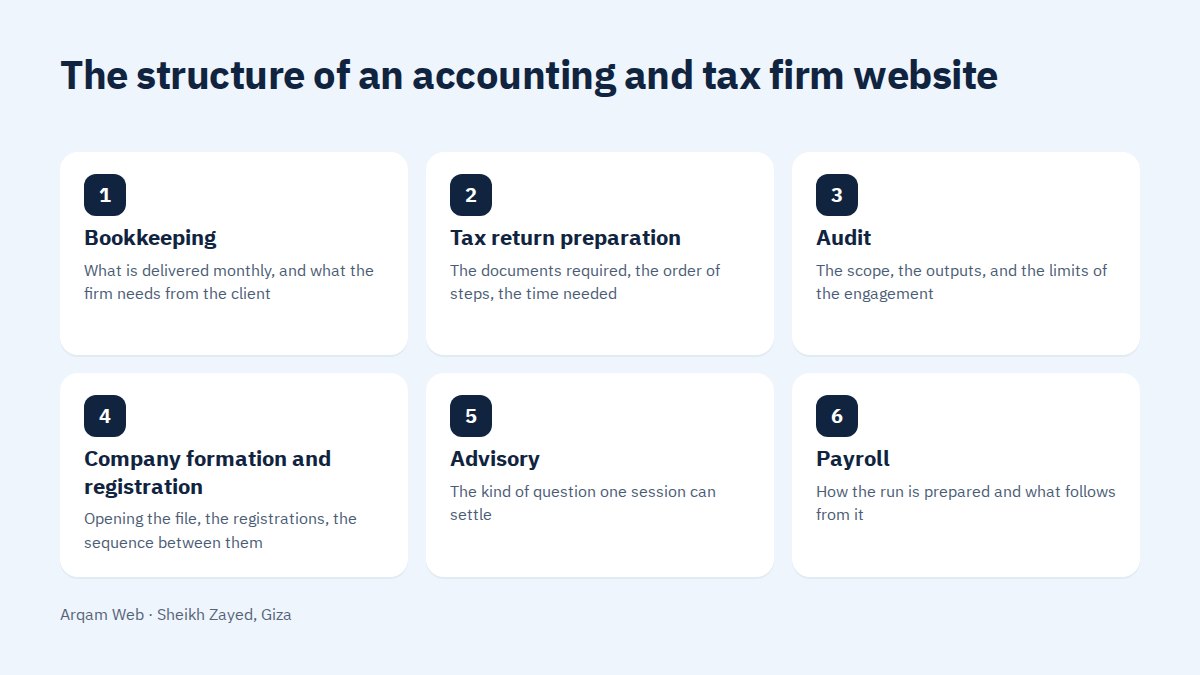
A single services page listing twelve items at a line each ranks for none of them. Each service earns its own page.
| Service | What the page answers | Who is searching for it |
|---|---|---|
| Bookkeeping | What is delivered monthly, and what the firm needs from the client | A company with no internal accountant |
| Tax return preparation | The documents required, the order of steps, the time needed | Someone whose date is close |
| Audit | The scope, the outputs, and the limits of the engagement | A company a lender or partner asked |
| Company formation and registration | Opening the file, the registrations, the sequence between them | A founder starting from nothing |
| Advisory | The kind of question one session can settle | Someone needing a decision before a move |
| Payroll | How the run is prepared and what follows from it | A company growing its team |
The Home of Tax site, built for an accounting and tax firm, follows this logic: every service is a page in its own right, so each has an entry point from search. Read types of websites for the shape that suits your practice.
A page for each kind of client, not only for each service
The same service behaves differently depending on who buys it, and a visitor wants to read their own situation rather than infer it. Four pages cover most of the market.
- The startup. Needs its books arranged from day one, and needs to know what is expected before a funding round.
- The online store. High transaction count at low value, a payment gateway to reconcile against the ledger, and refunds to handle.
- The supply company. Contracts, purchase orders, progress claims and late collection, with a cash cycle needing weekly attention.
- The independent professional. Variable income from several clients, and questions about registration and personal obligations.
These pages raise the quality of every enquiry an accounting firm website produces, because the visitor arrives having recognised themselves in the text.
The deadline page nobody on your street has built
The strongest page on an accounting firm website usually gathers compliance dates in chronological order, with a note on what to prepare before each. Readers return to it, share it, and bookmark it.
It carries one condition: upkeep. A visible review date, an update whenever an official change lands, and a link to the source. Describe the obligation and its place in the year, and leave the figures to the authority that publishes them.
Which small tools bring a visitor who is ready?
No firm needs an app for this. Three small tools are enough:
- A downloadable document checklist per service, which the client prints and works through before the first meeting.
- A deadline calendar showing what is coming, with an option to be reminded by email ahead of each date.
- A short readiness questionnaire asking about the state of the books, the software in use and the transaction volume, ending in an initial recommendation and an appointment request.
How should client documents arrive?
What reaches an accounting practice is not ordinary enquiry data: trial balances, bank statements, payroll runs, photographed identity documents. Collecting that through email attachments or a messaging app is a risk needing no explanation.
The minimum: an encrypted connection sitewide, uploads landing in a protected space with named permissions rather than a shared folder, a retention limit, and a note saying what is collected and who sees it. Put it on the intake page of the accounting firm website itself. For this client that is a reason to choose you, not legal small print.
Local visibility and seasonal visibility together
Most searches for an accountant begin locally, while the season concentrates demand into a few weeks. Doing both separates one accounting firm website from another: a complete Google Maps profile with real address and hours, the city named on service pages, and name, address and phone identical everywhere.
The seasonal half means preparing the page before the date, and checking page speed and the contact form in the quiet weeks. Read your website goal to fix the one action you want from a visitor in those weeks.
Turning a visit into a paid consultation
An open ended free call drains the firm’s time and attracts people who want a quick answer rather than an engagement. A clearer path works better: the short questionnaire, then a first session with a defined length and output, then a proposal for ongoing work. State what the session covers and what it does not, and unsuitable enquiries filter themselves out.
How is an accounting firm website measured?
Not by visits. Three monthly indicators are enough: completed enquiries, the share falling inside the services you want to grow, and how many service pages bring entries from search. The second tells you whether the structure is working.
Compare a month against the same month a year earlier, not the month before, since demand here is seasonal. For what we handle, see the web design and development page.
Frequently asked questions
What does an accounting firm website actually need?
A separate page per service, a page per type of client, a maintained deadline page, a downloadable document checklist, and a safe route for files to arrive. Those five produce most of the result, and everything after them improves a working base.
Should tax information be published on the site?
Publish it as an explanation of the obligation and the order of its steps, with a visible note that the content is general information and not tax or legal advice, and a link to the official source. Wording that promises an outcome, or rules on one case, creates exposure with no return.
Does an accounting practice need a blog?
It does, because clients search to understand their own position before they search for a firm. The priority is not volume. Cover the questions tied to each deadline, and refresh them before every season. One article updated in time beats ten that have aged.
How do a public site and a client portal fit together?
Keep them apart. The public accounting firm website attracts, explains and filters, while the portal is a closed space for existing clients to exchange documents and follow progress. Merging the two makes the site heavier and the service pages harder to keep current.
How long does the build take?
Writing the service copy drives the timeline more than design does, because every page needs review by an accountant in the firm. A practice that prepares its service list, its client types and the documents per service before work starts finishes noticeably sooner.
Start from your service list
Send the services your practice offers and the client types you want more of, and we will rearrange them into a page structure that serves search and filters enquiries.
Request a quote · Message us on WhatsApp · Call us
Arqam Web
44 Central Axis, Al Saraya Mall, Lower Ground, Entrance 2, Sheikh Zayed, Giza, Egypt
Phone and WhatsApp: +20 111 872 1404 · Email: info@arqamweb.com