

A Hajj and Umrah company website is not a holiday site with different photos. The visitor is preparing for an act of worship, so trust comes before price: who you are, what licence you hold, how far the hotel sits from the Haram, and what a package covers.
Why a Hajj and Umrah company website is a different kind of site
Nobody arrives comparing destinations or looking for entertainment. They are choosing an organisation to hand something important to, something that concerns them and their family. That changes the order of the questions: trust first, then detail, then cost.
The second difference shapes every page. Many bookings are not made by the traveller. A son books for his mother. An office manager arranges places for colleagues. A family registers three generations at once. A site written for a young person booking alone talks past most of its readers.
Who is actually reading your pages?
Four readers turn up, each needing something different:
- The adult child booking for a parent. Wants detail clear enough to read aloud, then a quick way to confirm.
- The traveller. Asks the practical questions: distance to the Haram, whether there is a lift, how transport works.
- The group organiser. A workplace, a mosque or a large family, asking about capacity and registration.
- The early researcher. Not booking today, wanting the options explained months before the season opens.
The first and third read on someone else’s behalf. They need plain wording and a visible phone number on every page of a Hajj and Umrah company website more than a long form.
What belongs on a package page
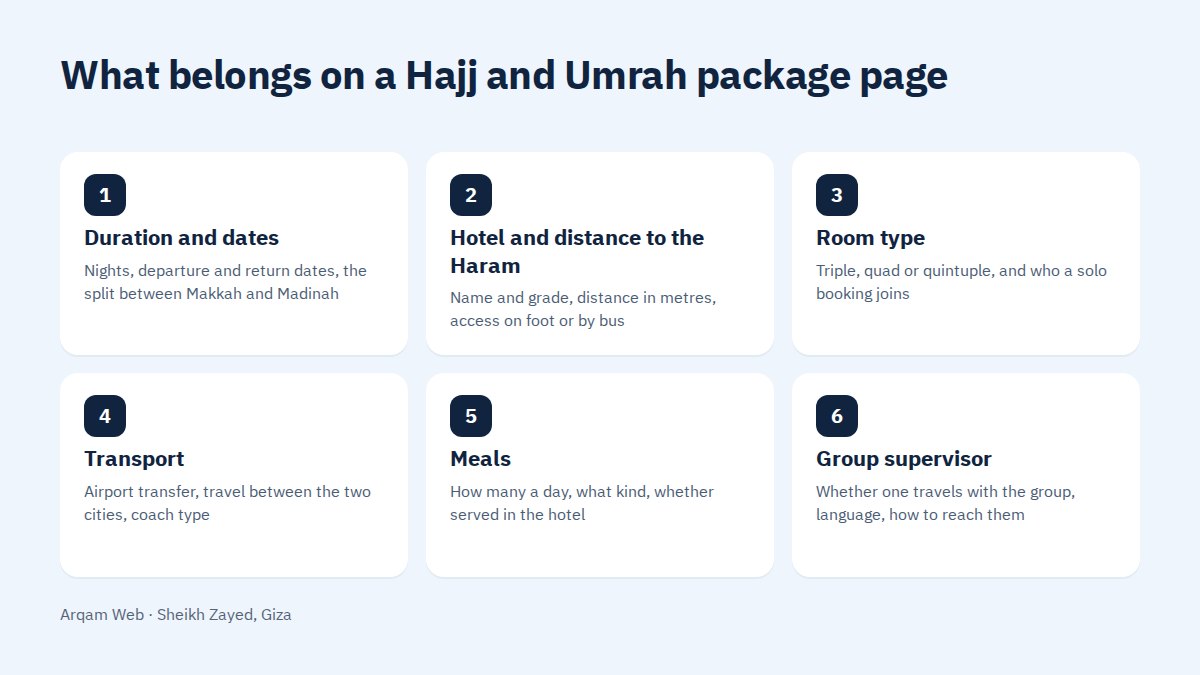
The package page is the most read page on a Hajj and Umrah company website, and anything missing becomes a call or a lost visitor:
| Item | What to state | Why they ask |
|---|---|---|
| Duration and dates | Nights, departure and return dates, the split between Makkah and Madinah | Has to fit leave |
| Hotel and distance to the Haram | Name and grade, distance in metres, access on foot or by bus | Decisive for older travellers |
| Room type | Triple, quad or quintuple, and who a solo booking joins | Decides comfort and privacy |
| Transport | Airport transfer, travel between the two cities, coach type | Usually summarised into nothing |
| Meals | How many a day, what kind, whether served in the hotel | Affects the daily budget |
| Group supervisor | Whether one travels with the group, language, how to reach them | First reassurance for anyone sending parents |
| Included and not included | Two separate, blunt lists, no elastic wording | Where later disputes begin |
| Cancellation and changes | Deadlines, what is refunded, how name changes work | People want the exit before they pay |
Write both lists without decoration. One clear sentence about an exclusion protects the relationship better than a page of assurances.
Dates and seasons need to be unmistakable
Demand here is seasonal: Ramadan, school holidays, the Hajj season, quieter stretches between. Packages published without dates look neglected, and a page still advertising a season that has passed costs trust at first glance.
Give every season a page with a stated status: registration open, nearly full, or closed with the next opening date. A last updated line near the top is the cheapest trust signal a Hajj and Umrah company website carries.
How should licences and accreditations appear?
A licence is not a small badge in the footer. Put the legal company name, the licence number and the issuing authority on their own page, publish readable images of the valid documents, and link it from every package page.
Somebody sending their parents will search your name to check you, so make that easy rather than leaving them to find nothing. State clearly that licences and requirements change between seasons and are confirmed with the competent authority. What you are reading here is general information about building the site, not regulatory or legal advice.
The questions that come back every season
These arrive by phone and WhatsApp every year. Moving them onto the site takes load off your team and earns visibility in search:
- Visas. Who applies, how long one lasts, which cases need an extra step, and where the rules are published.
- Documents. An ordered list of what to send, when and in what format.
- Luggage. Weight allowances, what is worth packing, what airports refuse.
- Staying in touch with family. Local SIM and data options, and how relatives at home keep in contact.
- Older travellers. Wheelchair access, medication, distance from the room to the lift.
- Group logistics. Meeting point, supervisor’s number, what happens if someone is delayed.
Give each question its own section in plain language. Guidance content here gets read and forwarded.
Booking or enquiry: which button comes first?
Most visitors will not pay in full online on a first visit. The realistic first action is an enquiry on WhatsApp or a call, with registration and a deposit as a clearly marked second step on the same page.
Response speed is half the work. An enquiry left for half a day at the peak of a season goes elsewhere. Publish your response hours, give every channel an owner, and never leave a form nobody watches. Read your website goal to settle the action you want before design.
How does a Hajj and Umrah company website show up in local search?
Search here is strongly local: Umrah in Ramadan from a named city, or travel from a specific airport. Give every departure point a page covering the airport and flight timing, set up your Google Maps listing properly, and keep name, address and phone identical across the site, the map and any directories. That puts you in front of a visitor ready to register.
Guidance content builds trust before the season
Trust is built months before anyone registers. Respectful guides on arranging the trip, a printable checklist, and an explanation of what happens between registration and return make your name the first one a reader recalls.
You can see the shape of this in the Kidana Travel project, and read types of websites to pick a structure matching your size, plus the web design and development page for what we handle.
Frequently asked questions
What does a Hajj and Umrah company website actually need?
A detailed package page stating duration, hotel, distance to the Haram, room type, transport, meals and supervisor, blunt lists of what the price covers and excludes, cancellation terms, a licence page, a pre travel questions section, and local search done properly.
Should prices be published on the site?
That varies by company and by how much costs move each season. What matters more than the figure is that the included and excluded lists are unambiguous, and that a visitor gets a current quote for their dates in one step without chasing anyone.
How do I reassure someone booking for their parents?
Write what that reader cares about: distance to the Haram in metres, how close the room is to the lift, whether a supervisor can be reached directly, and how families keep daily contact. Keep a phone number visible, since this reader prefers calling to a form.
Does the site need full booking and payment?
Not necessarily at the start. Many companies begin with registration details and a deposit, then finish the process with their team. A full system earns its place once booking volume grows and manual tracking turns into a real burden on staff.
How long does the build take?
Content readiness decides the timeline more than design. Prepare every package detail, the dates, hotel photographs, your valid documents and the recurring questions before work starts and the build shortens noticeably. Missing material delays these projects, not the technical work.
Start from your package details
Send your package list for the coming season and the departure points you serve, and you will get a proposed structure for a Hajj and Umrah company website presenting the detail visitors expect.
Request a quote · Message us on WhatsApp · Call us
Arqam Web
44 Central Axis, Al Saraya Mall, Lower Ground, Entrance 2, Sheikh Zayed, Giza, Egypt
Phone and WhatsApp: +20 111 872 1404 · Email: info@arqamweb.com