

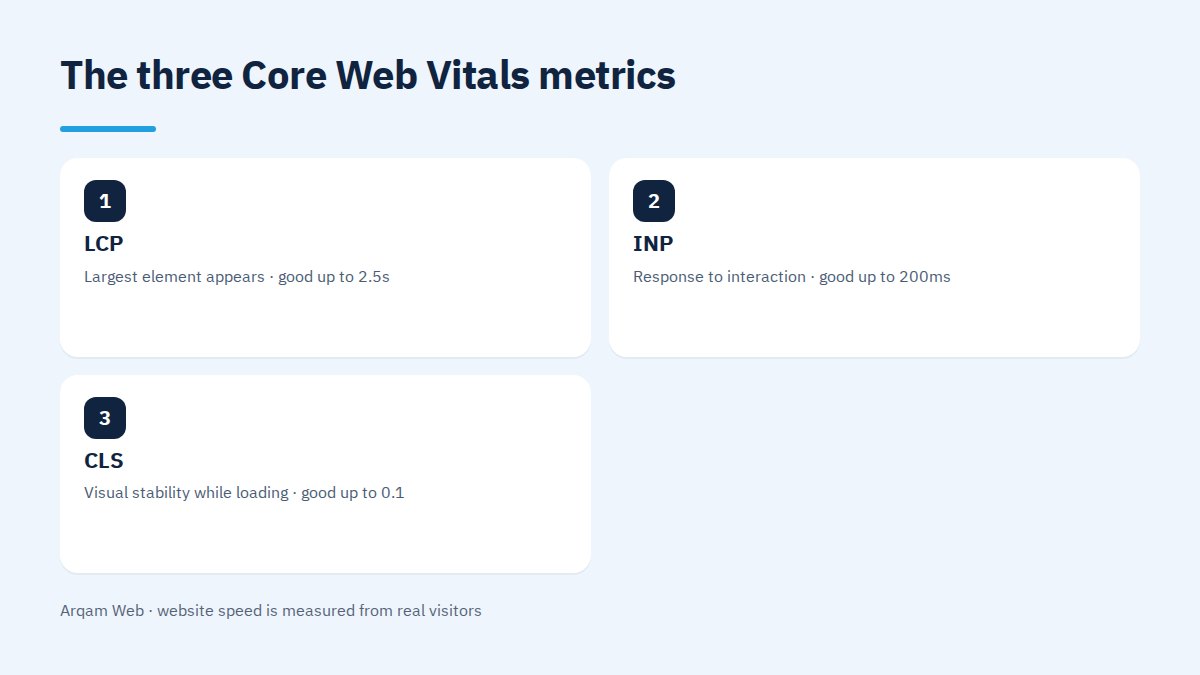
Website speed in Google is measured by three metrics called Core Web Vitals: LCP for how fast the largest element appears, INP for how fast the page responds to a tap, and CLS for how much content jumps while loading. Each has a threshold, and clearing all three means a good experience.
What are the three Core Web Vitals?
| Metric | What it measures | Good | Needs work |
|---|---|---|---|
| LCP | Time until the largest visible element appears, usually the hero image or heading | Up to 2.5 seconds | Over 4 seconds is poor |
| INP | How quickly the page responds to interactions | Up to 200 milliseconds | Over 500 is poor |
| CLS | How much elements shift during load | Up to 0.1 | Over 0.25 is poor |
These are measured from real visitors on their own devices and networks, not from a lab test alone. That is why a quick test can look fine while field data says otherwise.
Why does website speed matter commercially, not just technically?
- Visitors leave before they see your offer. On mobile data in Egypt and the Gulf, two extra seconds is enough to lose a share of them.
- Advertising gets more expensive. If you pay to bring someone in and they leave before the page loads, you paid for nothing.
- Search prefers the better experience between two pages of comparable content quality.
- A store loses directly. Every slow step in the purchase path reduces how many finish.
What actually slows a site down?
The order below is what we see on most sites we audit, from largest effect to smallest:
- Uncompressed images. A three megabyte hero image ruins LCP on its own.
- Slow hosting. A high server response time delays everything after it.
- Too many plugins and third party scripts. Every tracker and chat widget adds weight.
- Fonts. Loading four weights across two families postpones the text appearing.
- No caching. Rebuilding the page from the database on every visit is repeated work for nothing.
- Elements with no set dimensions. An image or advert without width and height pushes content down and raises CLS.
How do you fix website speed in the right order?
Do not start with the hardest item. The order that buys the most improvement for the least effort:
- Compress images, convert to WebP, set dimensions in the markup, and defer anything below the fold.
- Turn on caching at page level, then browser caching for static files.
- Delete what you do not use. Every pointless plugin should be removed, not merely deactivated.
- Cut fonts to two weights at most and serve them locally instead of over an external request.
- Review the hosting. If server response stays high after all of the above, the plan itself is the problem.
- Defer non essential scripts until after content appears, especially analytics and chat.
Re-measure after each step. Doing all six at once leaves you unable to tell which one worked.
How do you measure website speed yourself?
Three free tools are enough: PageSpeed Insights for the three metrics with field data where available, the Core Web Vitals report inside Search Console for a site wide view, and a manual test by opening the site on your own phone on mobile data rather than wifi.
The manual test is not the lesser one. A good score alongside a slow feeling means something the test does not measure is bothering your visitor.
Website speed on mobile versus desktop
The two numbers always differ, and the site is not the only reason. A mid range phone with a weaker processor on a variable network loads the same page two or three times slower. Our rule is that the mobile number is the real one and the desktop number is reassurance.
Three decisions improve website speed on phones specifically: serving images at sizes matched to the screen width, deferring everything below the first screen, and cutting the JavaScript that runs before content appears.
Do you need a score of 100?
No. The score is an indicator, not a target, and what matters is that the three metrics sit inside the good range. Chasing the last five points usually costs more time than it returns, while fixing one heavy image can move you from red to green in minutes.
Read website components to see which parts add weight, and the web design and development page for what we handle on this front.
Frequently asked questions
What counts as acceptable website speed?
The practical standard is that the main content appears within two and a half seconds on an average mobile network, with interaction response under two hundred milliseconds and visual stability under 0.1. Those are the three Core Web Vitals thresholds.
Is website speed a Google ranking factor?
Yes, but not the strongest one. Content quality and matching search intent come first. Speed shows its weight when two pages are close in content, and when slowness changes visitor behaviour itself.
Why does the test score well while the site feels slow?
Because a lab test runs the page in ideal conditions, while your visitor is on a weaker phone and a slower network. Trust field data in Search Console and your own test on mobile data.
Can WordPress really be made fast?
Yes. Slowness on WordPress comes from a heavy theme, too many plugins, uncompressed images and weak hosting, all of which are fixable. A disciplined WordPress site competes with any custom build on the three metrics.
How long does a speed improvement take?
Most of the gain usually arrives within a few days from compressing images, enabling caching and removing surplus plugins. Rebuilding a heavy theme or migrating hosting is a longer project decided after measurement.
Have your site speed checked
Send your site address and you will get a reading of the three metrics with an ordered list of what to fix first and why, with no obligation.
Request a quote · Message us on WhatsApp · Call us
Arqam Web
44 Central Axis, Al Saraya Mall, Lower Ground, Entrance 2, Sheikh Zayed, Giza, Egypt
Phone and WhatsApp: +20 111 872 1404 · Email: info@arqamweb.com
The official reference for the metrics and their thresholds is the Core Web Vitals page on web.dev.