

A full website or landing page? A landing page is enough when you have one offer, one message and traffic from a source you control. A full site becomes necessary once you sell several services or expect organic search traffic. What decides it is how many messages you need to land, not your budget.
A full website or landing page: what is actually different?
A full site is a set of connected pages: a home page, a page per service, an about page, a blog and a contact page. Each has its own job and its own search phrase.
A landing page is one standalone page, usually with no menu, built around a single offer and one button. Its traffic source is known before it is built: an ad, an email, a link under a video. The difference is not page count, but that you know what the visitor saw before arriving.
A full website or landing page: the comparison that decides it
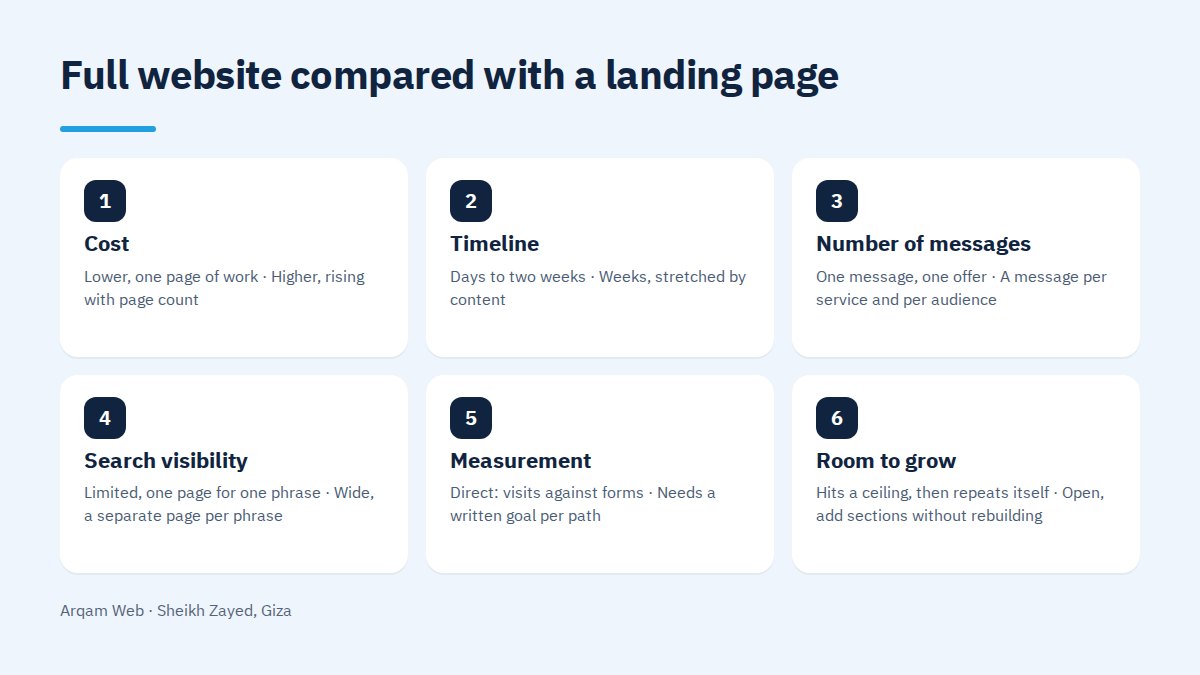
| Item | Landing page | Full website |
|---|---|---|
| Cost | Lower, one page of work | Higher, rising with page count |
| Timeline | Days to two weeks | Weeks, stretched by content |
| Number of messages | One message, one offer | A message per service and per audience |
| Search visibility | Limited, one page for one phrase | Wide, a separate page per phrase |
| Measurement | Direct: visits against forms | Needs a written goal per path |
| Room to grow | Hits a ceiling, then repeats itself | Open, add sections without rebuilding |
| Best suited to | A campaign, one product, an event | Several services, a store, trust based selling |
A full website or landing page is settled in most cases by one row: the number of messages. One message over ten pages loses force, and ten messages on one page lose clarity. Read your website goal first, because format follows goal.
When is a landing page enough?
- A single ad campaign with a defined offer and run, where every visit comes from a source you set up yourself.
- One product or service sold with one explanation and no variants.
- Testing an idea before you invest. If nobody asks, you learned that in two weeks, not after a full build.
- An event with a date, which stops mattering once the date passes.
- A seasonal offer that runs a few weeks, then closes or gets replaced.
All five share three conditions: the source is known, the goal is single, the lifespan is short. When those hold, a landing page is the correct spend.
When does a landing page fall short?
- Several services. Each needs a page that ranks for its own phrase, and stacking them weakens all.
- Relying on organic search. One page cannot target dozens of phrases or build depth.
- A blog you keep adding to, which needs categories, an archive and links between articles.
- A store with categories, product pages, a cart and checkout.
- Trust based selling such as law or contracting, where the buyer reads about the team first.
Here the question stops being a full website or landing page. It turns into how many pages the site needs and in what order to build them.
Why do ads that point at your home page underperform?
The most common fault we find on opening an ad account: months of budget with every click going to the home page. A home page is built for unknown intent: a full menu, links to every service, a company paragraph. Someone who clicked an ad for one service does not see it in front of them, so they hunt or leave.
Cost per enquiry rises because a smaller share finishes. Measurement turns vague because the page takes mixed traffic. And the ad promise contradicts the first thing on screen. One dedicated page per offer fixes all three.
What makes a landing page convert?
- A headline repeating the ad promise word for word, so the visitor knows they are in the right place.
- A real photo or video of the work, not a stock image seen on ten other sites.
- One offer and one button, repeated in one wording instead of competing wordings.
- A short form. Every extra field cuts the number who finish, so ask only what you need to make contact.
- Proof that can be checked: a link to a delivered project, or a named client comment.
- Objections answered on the page: the timeline, what the price covers, what happens next.
- Speed on a mobile network, since a heavy page burns ad budget before anyone reads the offer.
The same applies to service pages inside a full site, covered on the web design and development page.
How do you start with a landing page and grow without losing it?
- Register the domain in your own name and host the page on it, never on a builder subdomain.
- Build on the platform you intend to grow on, so growing means adding pages, not moving everything.
- Set up measurement on day one: analytics in your name, Search Console connected, a written definition of an enquiry.
- Keep the copy and images somewhere you own. They are the project’s most valuable output.
- On expanding, make the page an internal service page and keep its address, or redirect it permanently so the visits and links it earned survive.
Follow those five and expansion is an addition. Skip them, build on a closed tool with an address you do not own, and a website or landing page choice turns into paying twice.
A full website or landing page: deciding in ten minutes
Write three lines on paper. Where visits will come from over the next six months. How many offers you need to explain. Do you expect organic search traffic. If traffic is paid, the offer is single and search is not in the plan, a landing page is enough. Otherwise a full site costs less over time than separate pages rebuilt each time. Read types of websites to place your case.
Frequently asked questions
A full website or landing page for a company starting out?
If the plan is paid ads for one offer, start with a landing page on your own domain and delay the site. If you have more than one service, or you expect search traffic, building the site now costs less than a page today and a site six months from now.
Do landing pages show up in search results?
They can, if the page is indexed and written around one clear phrase, but the ceiling is low. One page does not compete with a site holding a page per service and dozens of linked articles. Treat it as an ad destination, not an organic plan.
How much cheaper is a landing page than a full site?
Clearly cheaper, because the work covers one page and one form. The gap narrows once you need custom design, measurement setup and two languages. The items that actually move the number, and how each one is priced, are listed on the pricing page.
Can a landing page be added inside an existing site?
Yes, and that is what we recommend for anyone who already has a site. It is built on your own domain with its own template and no menu, and the campaign points straight at it. It inherits the site speed and measurement setup rather than rebuilding both.
How many landing pages do I need?
One page per distinct offer, not one per ad. Three services with three different messages need three pages. Ad variants pushing the same offer can all land on the same page, as long as the traffic source is tracked separately.
We will tell you which format fits before you spend
Send your business, your goal and where you expect traffic from, and you will get a straight answer on the website or landing page question for your case, even when the cheaper option wins.
Request a quote · Message us on WhatsApp · Call us
Arqam Web
44 Central Axis, Al Saraya Mall, Lower Ground, Entrance 2, Sheikh Zayed, Giza, Egypt
Phone and WhatsApp: +20 111 872 1404 · Email: info@arqamweb.com