

This Boya Store case study explains how a paint store was built for a buyer who chooses by colour before name. The store runs on WooCommerce with five product categories and seven international brand sections, in Arabic and English, with a dashboard the client team uses to load products themselves.
What did the client in this Boya Store case study ask for?
The brief was clear and difficult at once: a store built out of colour rather than a conventional grid of product cards, without breaking an established brand identity. Two further conditions came with it: the structure had to hold a catalogue that keeps growing, and the team had to load products themselves without coming back to us each time.
That last condition decides whether any store still works two months after launch. A store its owner cannot update stays frozen at handover day.
Why is paint a special case in ecommerce?
- The buyer decides with their eyes. The colour name means nothing, and the visual swatch is effectively the product.
- One product carries a whole family of shades, so browsing has to start from colour rather than from a name.
- The supplier brand matters. Many buyers search by the international brand name directly.
- The catalogue keeps growing with every new colour range, so the structure has to expand without a rebuild.
The project stages in this Boya Store case study
| Stage | What happened |
|---|---|
| Requirements and platform selection | Reviewing existing product data and category structure before choosing the technology |
| Design and approval | An initial direction, then feedback rounds through to sign off |
| Build and dashboard | Building the store and a product management system for the client staff |
| Quality review | A full walkthrough in the primary language against the agreed specification |
| Localisation and launch | Translating pages, loading products, setting the structure, handing over to the team |
Note that the platform was chosen after reviewing the data, not before. That order is what prevents picking a technology the catalogue does not fit.
What exactly was built?
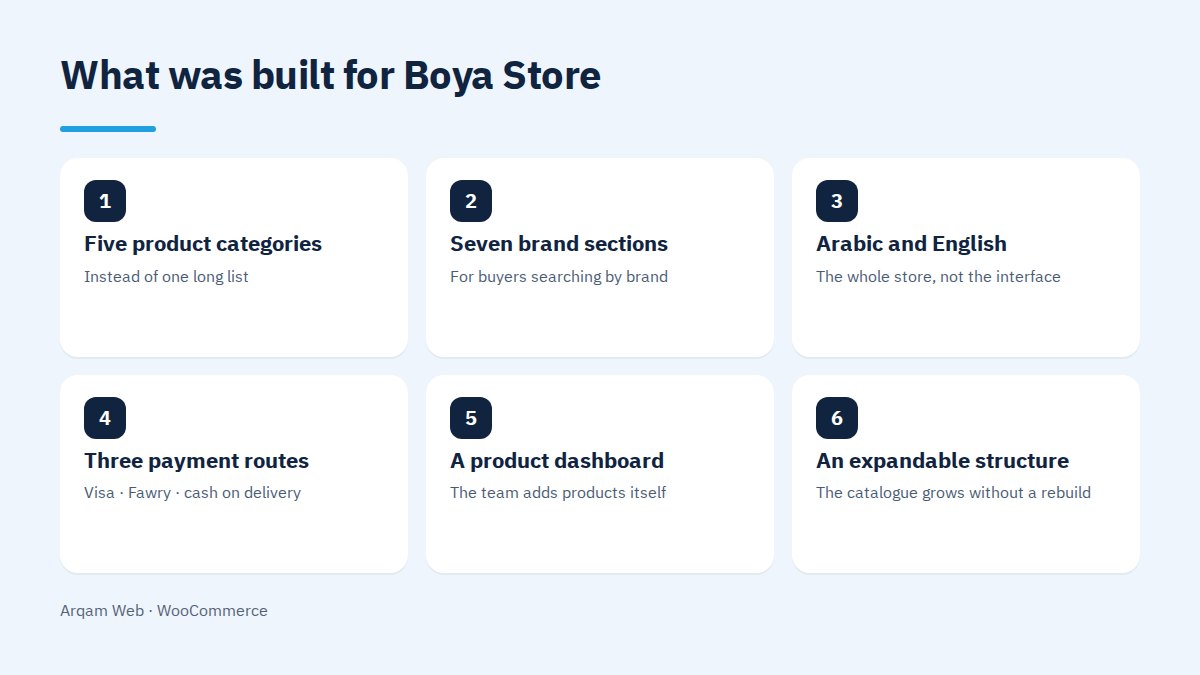
- Five product categories organising the catalogue instead of one long list.
- Seven international brand sections so anyone searching by brand name lands directly.
- Arabic and English versions of the whole store, not only the interface.
- Three payment routes: Visa, Fawry and cash on delivery.
- A product management dashboard the team uses with no technical help.
- An expandable structure that absorbs catalogue additions without a rebuild.
Every figure here is one you can count yourself on the project page or in the store. We do not publish performance numbers we cannot evidence.
The most important design decision
The tension between “a store built out of colour” and “an identity we will not break” was settled by separating the two roles: the identity governs the fixed elements, the logo, typography, buttons and footer, while colour governs the display areas where the product lives. The store still reads as the company and the browsing stays visual, as the client wanted.
This illustrates a rule we repeat: standing out does not mean ignoring the identity, it means deciding where the identity rules and where it makes room.
Two browsing axes instead of one
Most stores give the buyer a single route: categories. Here the buyer arrived two entirely different ways, so two routes were built: five categories for anyone who knows the product type they want, and seven international brand sections for anyone searching by brand name directly.
The practical lesson of this Boya Store case study is that a second browsing axis is not a luxury. It is the difference between a visitor who finds what they want and one who leaves after two pages. Ask yourself whether your customers arrive one way or several.
What does this Boya Store case study offer your own store?
- Start from your product data, not from design. The category structure is a commercial decision.
- Add a second browsing axis if your customers search two ways, as colour and brand did here.
- Require a team managed dashboard in the specification, not after handover.
- Choose payment routes that fit your market, and cash on delivery is still necessary in Egypt.
- Build a structure that expands, because catalogues always grow faster than expected.
For a contrasting case, see The Digger Hub, where a shop of one hundred and twenty products across eight categories was built inside an existing site that had never been designed to sell.
Frequently asked questions
What is the summary of this Boya Store case study?
A paint store on WooCommerce with five product categories and seven international brand sections, in Arabic and English, paying by Visa, Fawry and cash on delivery, with a dashboard the client team uses to add products and a structure that absorbs catalogue growth.
Why WooCommerce rather than another platform?
Because the brief needed a growing catalogue, full control of the category structure, self management by the client team, and two full language versions. WooCommerce covers that with no per transaction fee and no ownership limits, and it was chosen after reviewing the product data rather than before.
How long did the project take?
It completed inside the agreed schedule. Timelines on store projects are driven by product data and photography readiness more than by design and development, which is why the data review sits in the first stage.
Can the client team add products themselves?
Yes, and that was a condition in the specification rather than a later addition. The store was handed over with a product management dashboard, and the team has been adding to the catalogue since launch.
Does this model suit a store in another field?
The principle transfers, the details do not. Every store is built around how its buyer chooses: by colour here, by technical specification in equipment stores, by size in clothing. Define the choosing behaviour first, then build browsing around it.
Build your store on the same method
Send your product file and how your customers pick a product, and you get a proposed category structure with a written itemised offer, following the same method as this Boya Store case study: data first, then technology, then design.
Request a quote · Message us on WhatsApp · Call us
Arqam Web
44 Central Axis, Al Saraya Mall, Lower Ground, Entrance 2, Sheikh Zayed, Giza, Egypt
Phone and WhatsApp: +20 111 872 1404 · Email: info@arqamweb.com