

Template or custom design? The practical rule: a template is enough when your site follows a familiar pattern and carries no special experience, and a custom design becomes necessary when the shape and order of the site are part of the advantage you sell. The difference is not beauty. It is flexibility, ownership and speed.
Template or custom design: what exactly is the difference?
A ready template is a pre built design you buy, fill with your content and adjust within the limits it allows. A custom design starts from a blank page: the page structure, the order of the sections and the elements are built around your own goal.
Between them sits a third space where most of the market actually works: a light base theme with a custom component system on top. You get speed of delivery with freedom on the pages that matter.
Template or custom design on practical lines
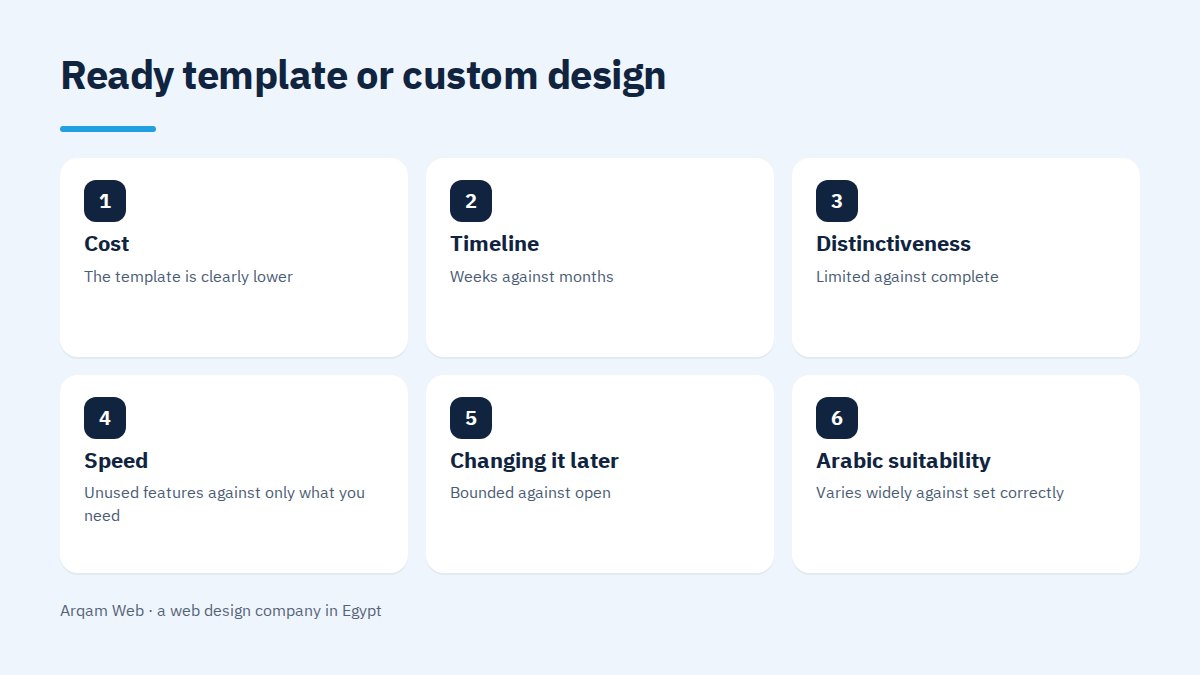
| Line | Ready template | Custom design |
|---|---|---|
| Cost | Clearly lower | Higher |
| Timeline | A few weeks | Longer, depending on layout count |
| Visual distinctiveness | Limited, and you may meet your twin | Complete |
| Speed | Often heavier from features you never use | Light, because it holds only what you need |
| Changing it later | Bounded by the template | Open |
| Third party dependency | Tied to the template author and their updates | None |
| Arabic suitability | Varies widely, and some handle direction poorly | Set correctly from the start |
When is a ready template enough?
- A simple brochure site for a company starting out that wants presence quickly.
- A limited budget and a tight deadline. A template reaches the market sooner, and that is a real gain.
- A conventional business resembling thousands of others with no special experience needed.
- Testing an idea. Before investing in design, confirm the market exists.
- A blog or content site where reading matters more than styling.
In those cases, spending the design budget on content and real photography returns more than a custom design would.
When does a template cost more than it saved?
- When you start fighting it. Every change needs a workaround, and temporary code piles up.
- When it weighs the page down. Multipurpose themes carry features you never use and load them on every visit.
- When you look like your competitor. A template popular in your field turns your site into a visual copy.
- When its author stops. A theme without updates becomes a deferred security hole.
- When you need a specific experience. A booking flow or a product configurator that does not exist ready made.
In practice, most clients who rebuild with us arrive from a template they fought for a year. That is why we raise template or custom design in the first session rather than at the end of the project.
How do you tell a site is built on a template?
Three signs a non specialist can see: stock photography in the hero and on the about page, sections arranged in an order you have met on many sites, and generic copy that fits no particular business. The strongest test is to hide the logo and see whether you can still tell whose site it is.
The middle path we usually build
A light base theme provides the structure, then a custom design covers the pages that sell: the home page, the service or product page, and the contact page. The rest is assembled from the same components. That balances cost against distinctiveness and puts the investment where the buying decision happens.
Read how to distinguish your site, since distinctiveness comes from content and real photography more than from the theme.
How do you pick a good template if you choose one?
Template or custom design does not end at the word “template”. Picking the template itself is a second decision that matters just as much:
- Test its demo speed on your phone over mobile data before buying.
- Read the last update date. A theme untouched for a year is a deferred risk.
- Try right to left in the demo rather than trusting the description.
- Count the plugins it forces on you. Every required plugin is extra weight and a new dependency.
- Look for sites in your field already using it so you do not mirror a direct competitor.
A light, maintained template with solid Arabic support gets close to a custom result at a lower cost.
What should not settle your choice?
Three common and invalid arguments: the template screenshots on its sales page, which are content staged for display rather than for your site; the price of the template itself, which is a tiny share of the total; and the number of advertised features, most of which you will never use while they slow your pages.
Frequently asked questions
Template or custom design for a small business site?
A template, in most cases, provided you pick a light one that handles Arabic well and spend the saved budget on real content and photography. Custom design becomes reasonable when the site itself is part of the advantage you sell.
Does a ready template hurt SEO?
Not in itself, but a heavy theme full of unused features slows the page, and speed is part of the user experience that affects results. Choose a light template and remove what you do not use.
Can a template site move to a custom design later?
Yes, and the content transfers. What gets rebuilt is the layouts and templates. That is why many businesses start on a template to validate the idea and rebuild once the need and the return are clear.
How many layouts are produced in a custom design?
Usually three to five key layouts rather than every page: the home page, a service or product page, an inner page and a contact page. The rest is assembled from the same components, and that is what keeps the cost controlled.
How do I check a template handles Arabic well?
Open its demo, switch it to right to left if possible, and inspect menus, buttons, forms and numerals on a phone. There are many templates, and good Arabic support is not guaranteed just because the description claims it.
Settle it in a short session
Describe your business and what you want the site to do, and we will tell you plainly which road is enough for your case, even when it is the cheaper one, because template or custom design is settled by the job the site does rather than by what the builder prefers. Check the pricing page before the session.
Request a quote · Message us on WhatsApp · Call us
Arqam Web
44 Central Axis, Al Saraya Mall, Lower Ground, Entrance 2, Sheikh Zayed, Giza, Egypt
Phone and WhatsApp: +20 111 872 1404 · Email: info@arqamweb.com