

A technical SEO checklist covers the work that lets a search engine reach your pages, read them and index them without obstruction: crawling, indexing, URL structure, canonical tags, sitemaps, structured data and language versions. Good writing on a technically broken site reaches nobody, which is why this list comes first.
What does technical SEO cover, and what does it not?
Drawing the boundary matters, because otherwise the wrong person gets blamed when rankings stall. Technical SEO prepares the site to be read. It does not write the content and it does not build reputation.
- Inside the scope: robots.txt, indexing directives, canonical tags, sitemaps, HTTP status codes for every URL, structured data, heading structure, language tags and mobile rendering.
- Outside it: whether the text answers the question, external links, brand strength and reviews.
- On the border: speed, which is technical in execution and a user experience matter in effect.
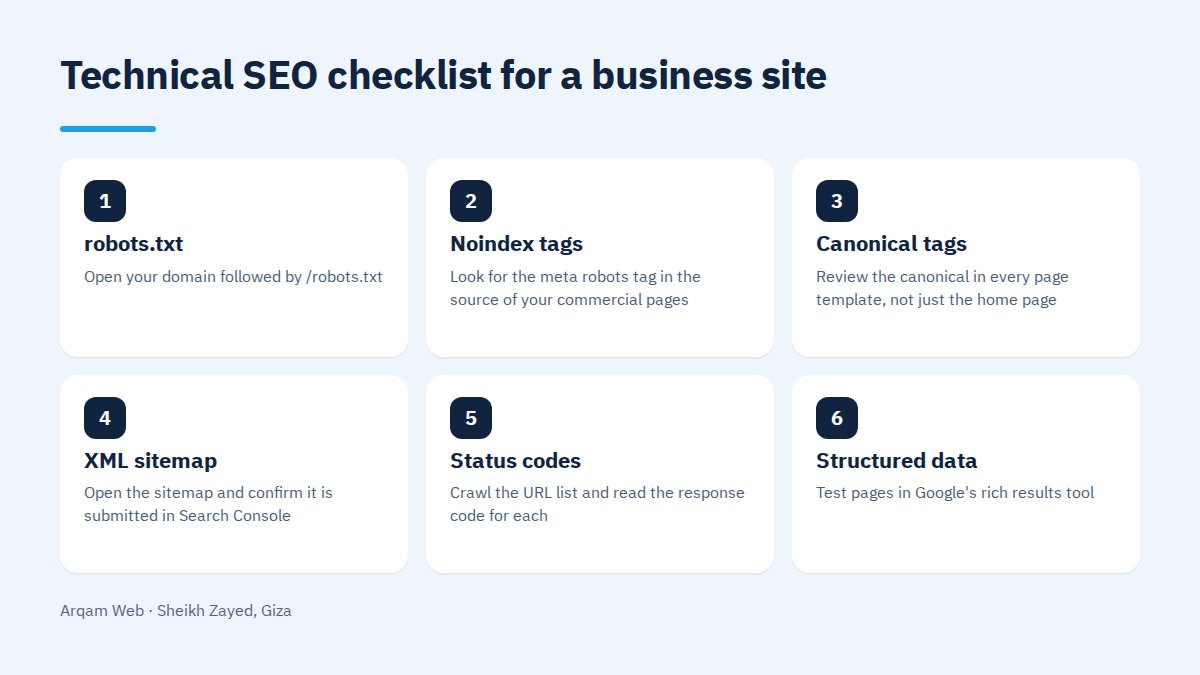
The technical SEO checklist in one table
| Item | How to check it | What to do when it is wrong |
|---|---|---|
| robots.txt | Open your domain followed by /robots.txt | Remove any disallow rule covering directories you want indexed |
| Noindex tags | Look for the meta robots tag in the source of your commercial pages | Take it off money pages, keep it on thank you and internal search pages |
| Canonical tags | Review the canonical in every page template, not just the home page | Point duplicate versions at one chosen URL |
| XML sitemap | Open the sitemap and confirm it is submitted in Search Console | Strip dead URLs and resubmit |
| Status codes | Crawl the URL list and read the response code for each | Redirect worthwhile 404s permanently to the nearest real page |
| Structured data | Test pages in Google’s rich results tool | Fill missing required fields and delete anything the page does not show |
| Headings | One H1 per page with a sensible order below it | Rebuild the outline without repeating H1 |
| Language tags | Check that hreflang pairs point both ways and at themselves | Complete the mapping in both directions |
Can the search engine actually see your pages?
Nothing else in technical SEO matters until the crawler arrives and gets a readable page back. The order we check in:
- Run a site: query on your domain for a rough sense of how much is indexed.
- Open the Pages report in Search Console and read the exclusion reasons one by one.
- Inspect an important URL and look at the rendered page as the crawler received it, not as your browser draws it.
- Read robots.txt for an old disallow line a previous developer left behind.
- Confirm the content exists in the HTML rather than appearing only after JavaScript runs.
Most of the sites that reach us with a complaint of not appearing in Google fail on one of those five points. The content strategy is rarely the first problem.
Sitemaps and structured data on a large site
A ten page site survives one sitemap and minimal markup. A large library of pages turns technical SEO into an organising problem. On the Forsan Pools project, a pool service company in Riyadh, we built 183 pool service pages, split the sitemaps into posts, pages, categories and video, and configured structured data covering Organization, WebSite, WebPage and Article. The site runs in Arabic with a full right to left layout, and the work was delivered remotely from our office in Sheikh Zayed, Giza.
The part worth copying is the sequence. On that build the search structure was decided before the design rather than retrofitted after it. Splitting sitemaps adds nothing when the structure underneath them was guessed.
What breaks on a site in two languages?
Language versions are where we find the largest share of technical SEO faults. The recurring pattern is a second language added with incomplete hreflang mapping, so the two versions compete with each other in search results instead of supporting each other.
On the Egyptian marble supplier project, an Egyptian marble exporter selling to buyers worldwide, we built 61 stone pages, one page per stone, on a site working in English and Arabic and aimed at international buyers who search for specific marble types by name. The rule we followed there: one page per entity, structure decided before design, and a catalogue the client can extend without us.
The faults we see most often
- A staging site fully indexed and competing with the live site on identical text.
- A URL restructure shipped without redirects, so pages that used to earn visits simply vanish.
- Every internal page canonicalised to the home page, which tells the engine the rest of the site is not worth keeping.
- Structured data declaring things the page does not display, which Google treats as a violation rather than an optimisation.
- A stale sitemap listing URLs deleted months ago.
- Infinite filter combinations eating crawl budget on pages nobody searches for.
A wider list of what damages a site sits in web design mistakes.
In what order should you work through the technical SEO checklist?
Fix what blocks visibility outright first: crawl blocks, wrong noindex tags, broken links in the main menu. Then handle what confuses understanding: duplicate versions, canonical tags, language mapping. Presentation items come last, which means structured data and sitemap organisation. A full audit belongs at handover, followed by a short monthly look at the reports, then another full audit after any rebuild or hosting migration. What we handle on this side is described on the web design and development page.
Frequently asked questions
What is the difference between technical SEO and content SEO?
The first makes a page reachable, readable and indexable. The second makes it worth ranking. Technical work logically comes first, since the best writing on a blocked page is never read. On its own, though, technical work will not rank a page that answers no question.
Do I need a developer to work through this list?
Plenty of items are handled from the dashboard or an SEO plugin with no code: sitemaps, indexing directives, headings and meta descriptions. Canonical tags, hreflang and structured data on custom templates usually need a developer who knows the theme, so the tag ends up in the right place.
How often should you run the technical SEO checklist?
A full pass at launch, a monthly look at the Pages report in Search Console, then a full pass again after any large change: a hosting move, a redesign or a change to the URL structure. Large changes are exactly when previously clean items break without any notification.
Does structured data improve rankings?
Not directly. Its job is to help the engine understand what kind of page it is looking at, and to make richer result presentations possible, such as questions or review stars. The practical gain shows up in click through rate more than in position, which is reason enough to implement it carefully.
What should I prepare before changing my URL structure?
Export the current URL list with its traffic, write the redirect map before publishing rather than after, and send each old URL to its nearest equivalent with a permanent redirect instead of to the home page. Then watch 404 reports for a fortnight and fix whatever surfaces.
Ask for a technical SEO audit of your site
Send your site address and you will get this checklist applied to your own pages: the item, its current state, what needs doing and who should do it.
The official reference for crawling and indexing is Google’s crawling and indexing documentation.
Request a quote · Message us on WhatsApp · Call us
Arqam Web
44 Central Axis, Al Saraya Mall, Lower Ground, Entrance 2, Sheikh Zayed, Giza, Egypt
Phone and WhatsApp: +20 111 872 1404 · Email: info@arqamweb.com