

Native app vs Flutter is a budget and team question before it is a technical one. A native build means one codebase per platform, Swift for iOS and Kotlin for Android. Flutter means one Dart codebase compiled for both. Three things settle it: what the app does on the device, who maintains it, and how many platforms you need now.
Native app vs Flutter: what actually differs?
A native app is written with the platform’s own tools and calls its components and APIs directly. Flutter draws its own interface and compiles to code that runs on the device. It is not a web page inside a shell, which is what the older hybrid tools were, and most of the old complaints about hybrid apps were aimed at those embedded browser approaches.
The practical consequence is simple. On the native route the interface is written twice and maintained twice. On the shared route it is written once, and the team drops into platform code only for a feature no ready plugin covers.
The comparison on lines a business owner cares about
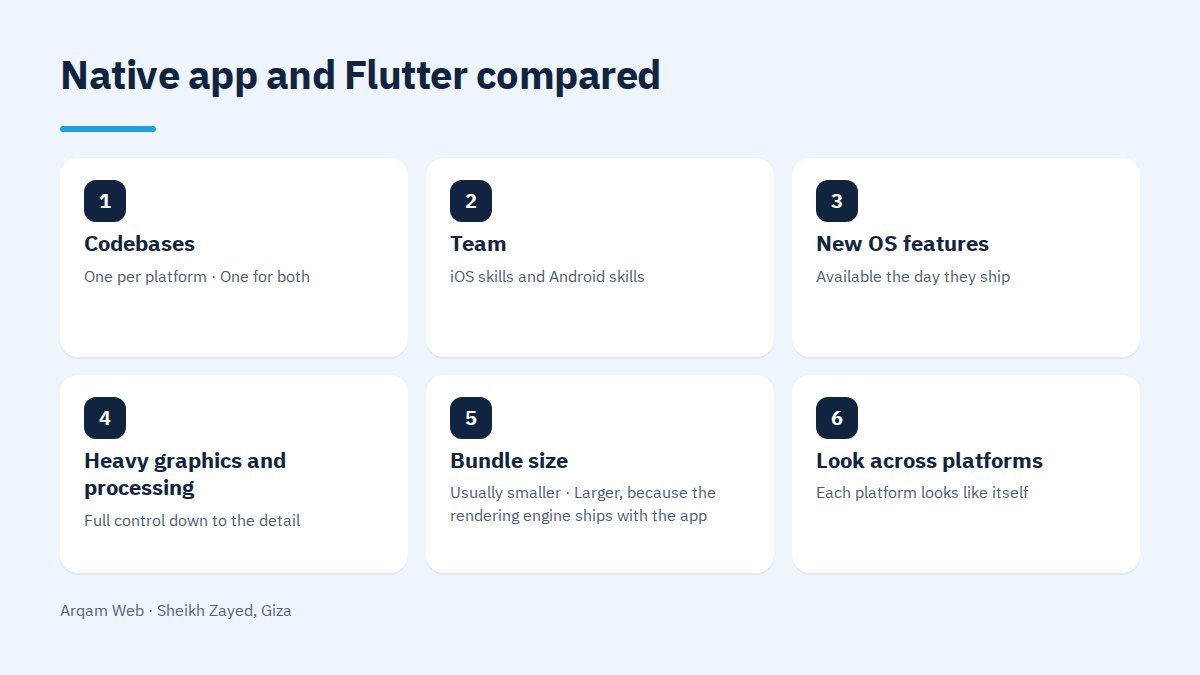
The native app vs Flutter decision is settled on the lines that turn up in the invoice and in year two, not in an engineering argument:
| Line | Native | Flutter |
|---|---|---|
| Codebases | One per platform | One for both |
| Team | iOS skills and Android skills | Dart and Flutter skills, plus native help when needed |
| New OS features | Available the day they ship | Waits on framework or plugin support, or a bridge you write |
| Heavy graphics and processing | Full control down to the detail | Fine for most screens, limits show in the hard cases |
| Bundle size | Usually smaller | Larger, because the rendering engine ships with the app |
| Look across platforms | Each platform looks like itself | One look on both unless you split details by hand |
When is a native build the right call?
- The app is the product and you have an in house team that will work on it for years, rather than a project handed over and maintained per change.
- Heavy work on the device: advanced camera use, augmented reality, video processing, or a constant Bluetooth link to medical or industrial hardware.
- You depend on OS features the week they arrive and cannot wait for support to land in another framework.
- System extensions are part of the service: a home screen widget, a watch app, or a screen inside the car.
In those cases native app vs Flutter stops being the question. What remains is how to build native well and which platform goes first.
When is one shared codebase enough?
Most company apps in Egypt and the Gulf are made of sign in, lists, search, booking, a cart, payment, notifications and a profile. None of that needs platform level control, and Flutter gives you both systems from one source with one team.
The native app vs Flutter answer also tips to the shared route when the budget stretches to one platform natively but you need both from launch. Half your audience does not wait its turn in your roadmap.
What changes in maintenance after two years?
Maintenance is the line where native app vs Flutter is really decided. On the native route every interface change is built twice and tested twice, and each OS release means a review on two fronts. On the shared route the change is made once, but you carry another dependency: upgrades to the framework itself and to the plugins you rely on.
Either way the app needs an annual maintenance budget. An app built without one usually breaks for part of its users after a single OS release, and by then the original team has moved on.
Do the app stores accept Flutter apps?
Yes. Store review looks at what the app does, not at the tool it was built with. Rejections come from privacy, content and payment policy, and from permissions the app requests without a clear reason. The framework’s own documentation is at the official Flutter site.
What matters in review is a real and accurate privacy policy, justified permissions, and an app that does not crash on the devices a reviewer picks up.
Native app vs Flutter: five questions that settle it
- Is the app your product or a channel to your service? A product carries native cost. A channel usually does not.
- Do you need both platforms now? If yes on one budget, the shared route is closer.
- What is the heaviest thing the app does on the device? If the answer is advanced camera work or video processing, look again at native.
- Who maintains it a year from now? An in house native team, or one company keeping one codebase alive.
- What happens if support for a new OS feature is late? If that delay stops your business, native is the safer bet.
Before any of that, make sure you need an app at all. Read your website goal and types of websites, because plenty of cases are served by a site that works properly on a phone.
What the choice does not change
Five things the native app vs Flutter choice does not touch:
- The server and the APIs. Your database and business logic sit outside the app and do not care what the interface is written in.
- Design quality. An ugly native app stays ugly, and a considered Flutter app looks excellent.
- Store rules, privacy policy and digital payment terms.
- The need to measure. With no event tracking and no completion rates you will not know where users stop, on either route.
- Content cost, the photography and the words inside the screens.
Frequently asked questions
Is a Flutter app slower than a native one?
On ordinary screens of lists, forms and images a user notices nothing, because the framework compiles to code that runs on the device. The gap appears in heavy cases such as video processing and complex graphics, and there the native route gives finer control over performance.
Do I still need iOS and Android developers with Flutter?
Not for building screens, but you need native knowledge at specific points: per platform project settings, notifications, permissions, publishing to both stores, and any feature that needs a bridge into platform code. A competent team covers those without two full teams.
Can a Flutter app be rebuilt natively later?
The interface gets rewritten, but the server, the APIs, the database and the content stay as they are, and that is usually the larger part of the work. This is why many projects start on the shared route and rebuild one platform natively once there is a clear reason.
Which route ships the first version sooner?
The shared route reaches both systems faster, since the interface is built once. If you launch on one platform only, the gap narrows sharply and native app vs Flutter comes back to the team you can hire and what the app has to do on the device.
Do I need an app at all, or is a mobile friendly site enough?
An app earns its cost when users come back regularly or when it needs device features. If the goal is that a new customer finds you and orders once or twice a year, a site that works well on a phone does that for less and with nothing to install.
Let us settle the route before you spend
Tell us what the app has to do and who will use it, and you will get one clear recommendation on native app vs Flutter with what follows from it. For what we build, see the web design and development page and the pricing page.
Request a quote · Message us on WhatsApp · Call us
Arqam Web
44 Central Axis, Al Saraya Mall, Lower Ground, Entrance 2, Sheikh Zayed, Giza, Egypt
Phone and WhatsApp: +20 111 872 1404 · Email: info@arqamweb.com