

The honest answer to how to pick keywords without paid tools is that the best sources were never behind a paywall: Google’s own search box, the queries report in Search Console, and the words customers use when they message you. Paid tools add estimated volume figures. They do not tell you intent, and intent decides the page.
A keyword is a buying moment, not a phrase
Sort every phrase by what the person wanted at that second. Asking what a thing is calls for an explanation. Asking which option is better calls for a comparison. Typing a price, a company or a city name means they want it done.
Those three states belong on three different pages, and mixing them is the fault behind most pages that rank for nothing.
How to pick keywords from six free sources
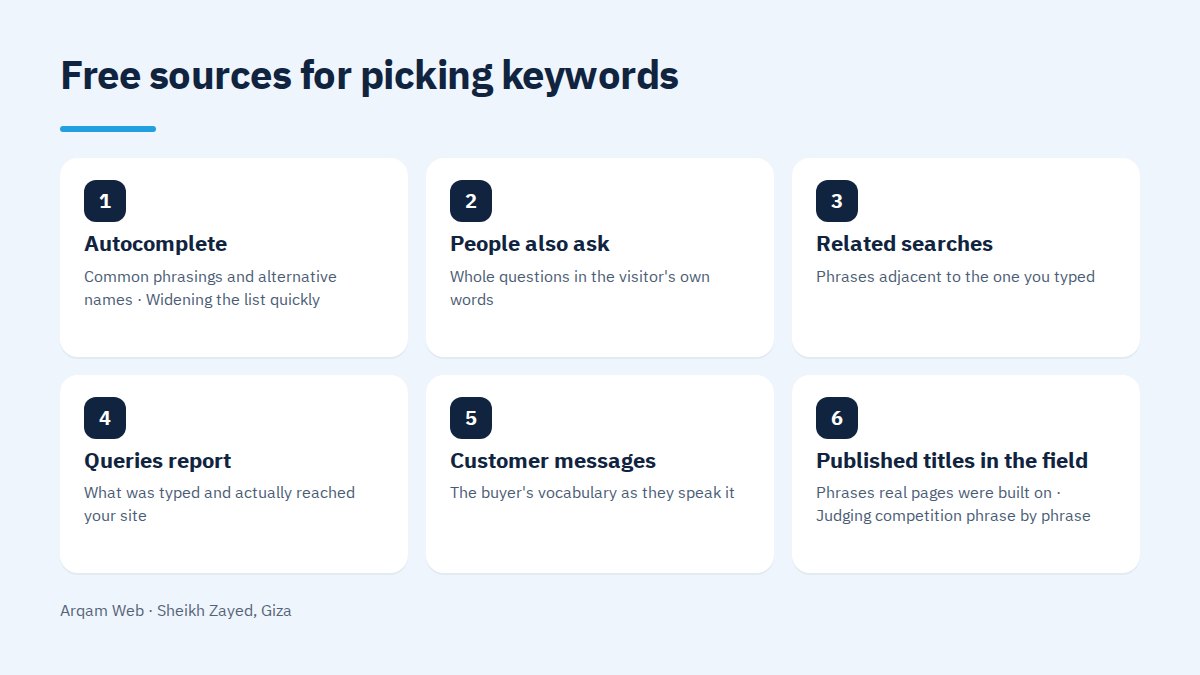
These produce more material than a whole site needs:
- Google autocomplete. Type your service, add one letter after it, then repeat with price, company and your city.
- The “People also ask” block. Expanding one question opens deeper ones, all of them typed by somebody.
- Related searches at the foot of the page, closest to the wording your market really uses.
- The queries report in Google Search Console, if your site gets impressions. It reports what was typed, not what you assumed.
- Your own message history. Read the last fifty enquiries and note the words people used.
- Published page titles in your field. A site search shows which phrases real pages were built around.
The fifth is the least used and the most valuable, because a customer writes in their own language, not your industry’s.
Free sources and what each one is good for
| Source | What it gives you | The decision it helps with |
|---|---|---|
| Autocomplete | Common phrasings and alternative names | Widening the list quickly |
| People also ask | Whole questions in the visitor’s own words | Section headings and FAQ entries |
| Related searches | Phrases adjacent to the one you typed | Finding an intent you had not considered |
| Queries report | What was typed and actually reached your site | Improving a page you already own |
| Customer messages | The buyer’s vocabulary as they speak it | Writing the title and opening paragraph |
| Published titles in the field | Phrases real pages were built on | Judging competition phrase by phrase |
How do you shortlist without a volume number?
Most of how to pick keywords is deciding what to throw away. Work through the raw list in this order:
- Delete what you do not sell. Any phrase with no matching service behind it goes immediately.
- Merge the duplicates. Two phrasings of the same request are one intent and one page.
- Label the intent as understanding, comparison or action, beside each phrase.
- Open the results page for each shortlisted phrase and read what type of page Google chooses. If every result is an article, that phrase will not carry a service page.
- Judge the competition with your eyes, from the names on page one and the depth of their pages.
- Sort by distance from the purchase. Whatever the ready buyer types gets built first.
This is the step that turns how to pick keywords into a decision instead of a guess, because Google is showing what searchers already chose to click.
Is search volume the wrong first question?
It is rarely the right one. Volume counts opportunities without valuing them, and ten people a month who want a paid service beat a thousand who want a free fact.
Volume figures are estimates by construction, and they get noisier in Arabic because of spelling variants. Use volume to break a tie between two phrases of similar intent, never as the only reason to build a page.
One phrase, one page: mapping the list
Our rule is one primary phrase per page, one page per intent. Two similar pages compete for the same search and both lose.
On the Forsan Pools project, a pool service company in Riyadh, the page map was settled before a screen was drawn: which pages exist, and how a city page relates to a service page. That produced 183 pool service pages, with Riyadh alone carrying 136. The work was delivered remotely from our office in Sheikh Zayed, Giza.
On the Masar Law project, a law firm in Riyadh, each area of the firm’s work has its own page across fourteen practice areas, so a visitor lands on the one matching their problem. That is why how to pick keywords is a structure question and not only a wording one.
How to pick keywords for a page you already have
Most sites need remapping more than new pages. Open the queries report, filter to one page, and read which searches it already earns impressions for. Three outcomes, each with its own fix.
Impressions for the phrase you wrote it for: sharpen the title and first paragraph, leave the rest. Impressions for a different intent: rename the page to match what it actually answers. Nothing at all: the phrase probably belongs to a page type Google is not choosing here.
Check the same report a month after every edit, and check your website goal so each page still serves a commercial decision. The official detail on the report sits in Search Console help.
Mistakes we see most often
- Writing in industry language instead of customer language. Your internal term may be something nobody types.
- Forcing two intents into one page, which satisfies neither searcher.
- Ignoring the results page, then wondering why a long article produced no enquiries.
- Treating spelling variants as noise in Arabic, where each written form shows up separately in the queries report.
- Starting from a tool rather than from the site, when the pages you own are where the fastest gain sits.
Frequently asked questions
Can I learn how to pick keywords with no paid subscription at all?
For most small and mid sized sites, yes. The free sources give you the phrases and the intent behind each one, and that is what the decision rests on. A paid tool earns its keep when you manage hundreds of pages, not ten service pages.
How many primary phrases does a small company site need?
One per commercial page you want found: one for each service, one for the home page, and one for each city you genuinely serve. Everything else is a secondary phrase mentioned inside the copy, so the number follows from your service list rather than a target set in advance.
What is the difference between a broad phrase and a long one?
A broad phrase gets more searches with less clarity about what the searcher wants. A longer one gets fewer searches and states the need plainly. Long phrases are winnable sooner because fewer pages fight for them, and they build the ground you compete from later.
Should the same phrase appear in more than one spelling?
Put the most common form in the title and the opening, then let other forms appear naturally in the body where people use them. Never write a repeated paragraph per variant. After a few weeks the queries report shows which forms earn impressions, and you edit from that.
What do I do when page one is all large international sites?
Pick a narrower phrase you can win: add the city, the type of business, or the use case. A tight specialist page outranks a broad global page on a specific search, and it becomes the base you compete from later on the wider phrase.
Ask for a review of your keyword map
Send your site address and your service list, and you will get a proposed map: which phrase belongs to which page, which pages to merge or drop, and a second opinion on how to pick keywords for pages you already publish. More on the web design and development page, with packages on the pricing page.
Request a quote · Message us on WhatsApp · Call us
Arqam Web
44 Central Axis, Al Saraya Mall, Lower Ground, Entrance 2, Sheikh Zayed, Giza, Egypt
Phone and WhatsApp: +20 111 872 1404 · Email: info@arqamweb.com