

Website or mobile app? Build the website first in almost every case. A website reaches people who do not know you yet, because a link opens instantly and search can find it. An app serves people who already decided to come back. Frequency of use decides this, not budget size.
Website or mobile app: the comparison that matters
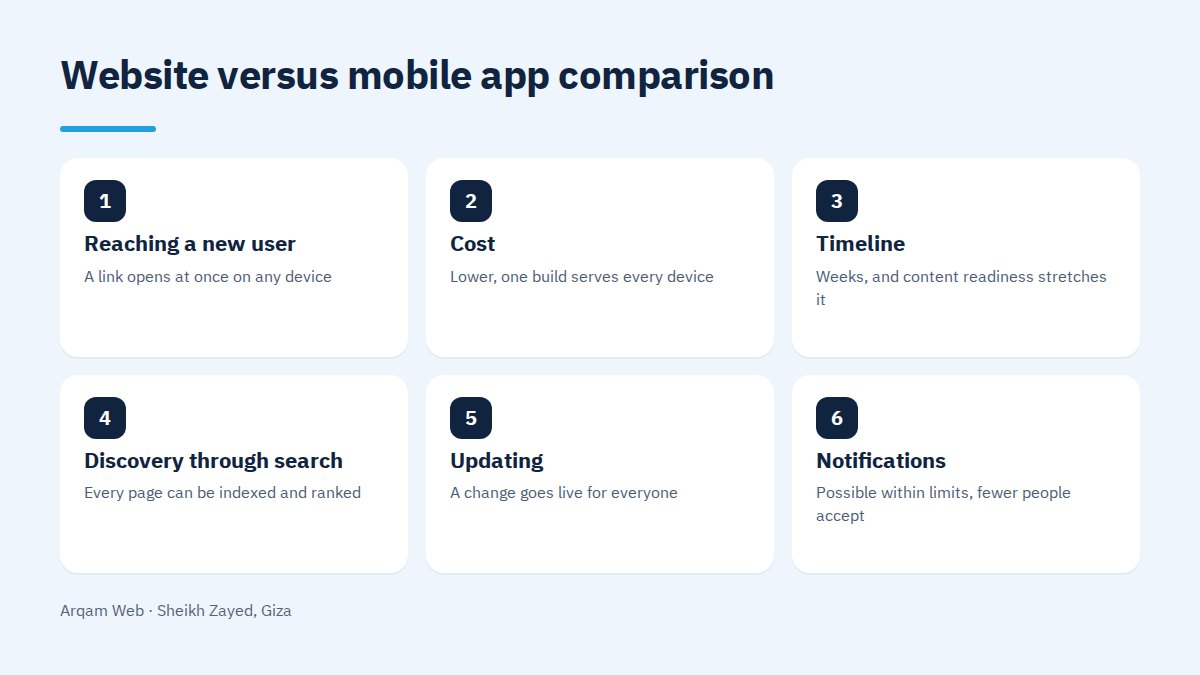
| Factor | Website | Mobile app |
|---|---|---|
| Reaching a new user | A link opens at once on any device | Needs a decision to install, plus phone space |
| Cost | Lower, one build serves every device | Higher, and it climbs across two platforms |
| Timeline | Weeks, and content readiness stretches it | Longer, with store review added on top |
| Discovery through search | Every page can be indexed and ranked | Limited, store search has its own rules |
| Updating | A change goes live for everyone | A release passes review, then waits for users to update |
| Notifications | Possible within limits, fewer people accept | A strong direct channel, a nuisance if misused |
| Working offline | Limited, simple cases only | Fully possible, with data stored on the device |
| App store dependence | None, the channel is yours | Store policy governs release and payment |
Five rows favour the website, two favour the app. The last is the constraint people forget: build on someone else’s store and you accept their terms.
Which one brings new users and which one keeps them?
A website is a discovery tool. Someone who has never heard of you types a question, lands on a page of yours, and asks for a quote minutes later.
An app is a retention tool. Nobody installs one without already deciding to return, and after the install you hold an icon on their home screen and an open notification channel. An app does not fix a shortage of customers. It raises the value of existing ones.
So the website or mobile app question starts with a diagnosis. If people do not know you exist, the website answers it. If those who know you never return, an app deserves a look. Settle your website goal first.
When is an app the right call?
- Repeat purchase. A restaurant or pharmacy bought from weekly, where a saved cart and address save real steps.
- Loyalty or a wallet. Points, balance and vouchers need one fixed place, opened at the counter.
- A daily or weekly task. Logging attendance, tracking workouts, managing shipments daily.
- Camera or location at the core. Scanning a code, or following a driver on a map mid-job.
- Notifications as part of the service. An appointment alert or a changing order status, not a marketing blast.
Each case shares one trait: repetition. Without it the icon stays unopened until the phone runs short of space.
When does an app waste money?
- A new business with no customer base. Nobody is there to invite, so the budget builds an empty channel.
- A service used once a year. A renewal or seasonal booking earns no permanent space on a phone.
- A tight budget. Most of it on the app leaves a weak site, costing you your only discovery channel.
- An app that copies the website. Same content, nothing added, your site plus an install step.
- A decision driven by a competitor. Their app exists, which says nothing about whether anyone opens it.
Read types of websites before you settle the website or mobile app question. Many app requests we receive are answered by a disciplined store or a well built services site.
Why a download costs more than a visit
The path to an app user is longer. A visitor sees an advert or a search result, taps, and reads your page: two steps ending in an enquiry or an exit. The website or mobile app order follows from what comes next.
An app user sees the advert, moves to a store listing, decides to install, waits, opens the app, and is usually asked to create an account before seeing any value. Each of those six steps loses people, so one active app user costs far more than one site visit, even at a similar click price. The website funds discovery, and the app benefits from the audience it built.
Can a progressive web app replace both?
A progressive web app is a site built so it can be added to the home screen. It opens like an app with no browser bar, part of it works offline, and updates go live the moment you publish, with no store listing and no review.
It suits a shop bought from monthly, an internal dashboard, or a repeat booking service. The limits are clear: notification support differs between operating systems and versions, so verify it first; deep use of device hardware belongs in a real app; and nobody finds it in a store search. For many businesses this shape does the job the app was requested for.
How do a site and an app share one backend?
Building two separate tracks ends with content updated twice and two account systems that disagree. The sound approach is one source of data both front ends read, one customer account, and one written definition of an order. Today’s website work is then not wasted if you add an app next year, as our web design and development page sets out.
Website or mobile app: the order we recommend
- A fast, mobile ready website with a page per service or category and a clear enquiry path.
- Measurement you trust, showing who returns, how often, and where people stop.
- Fix what already leaks before adding a channel. A path that stalls on the site stalls in the app too.
- A progressive web app once a returning segment appears and wants a faster experience.
- A native app when repetition is proven by your own numbers, or you need a capability only an app provides.
The sequence protects the budget because each step rests on evidence from the one before. What each track includes is on the pricing page.
Frequently asked questions
Website or mobile app for a new online store?
Start with the store on the web. A new store needs traffic from search and ads, and an app brings none of it. Once you know which customers buy more than once, an app becomes a service for that group rather than an open experiment.
Do apps appear in Google results the way websites do?
Not in the same way. Site pages are indexed and can surface for any phrase a person types, while an app has a store listing and an internal search with its own rules. An app alone gives up that wider channel and leaves you dependent on paid ads.
Do I still need a website if I have an app?
Yes. An app gives nobody a place to check you out before installing, never shows up in search results, and does not work on a desktop. The minimum is a site that explains the service, answers buying questions and offers direct contact.
Why do users delete an app after a week?
The usual reasons are a sign-up wall before any value appears, too many marketing notifications, slow opening, and no clear reason to return. An app that saves the user no real step over the website is the first candidate for deletion once storage runs short.
Can a website be converted into an app with one click?
Tools exist that wrap a site inside an app shell, and the result is usually worse than the site itself, with stores free to reject it for adding too little. The serious alternative is a proper progressive web app, or one built for a single job.
Let us settle the route before you spend
Send a description of your business and what you want the user to do, and you will get a written recommendation: website or mobile app or the middle option, and what can wait for a second phase.
Request a quote · Message us on WhatsApp · Call us
Arqam Web
44 Central Axis, Al Saraya Mall, Lower Ground, Entrance 2, Sheikh Zayed, Giza, Egypt
Phone and WhatsApp: +20 111 872 1404 · Email: info@arqamweb.com