

Choosing an SEO company comes down to two questions: what gets delivered each month, and whose name is on the accounts? A serious proposal states the number of content pages, who writes them, the technical scope and the report format. A promise of first position is the first sign it is not serious.
Which promises give the pitch away on the first call?
| The promise | Why it cannot hold | What a serious proposal says instead |
|---|---|---|
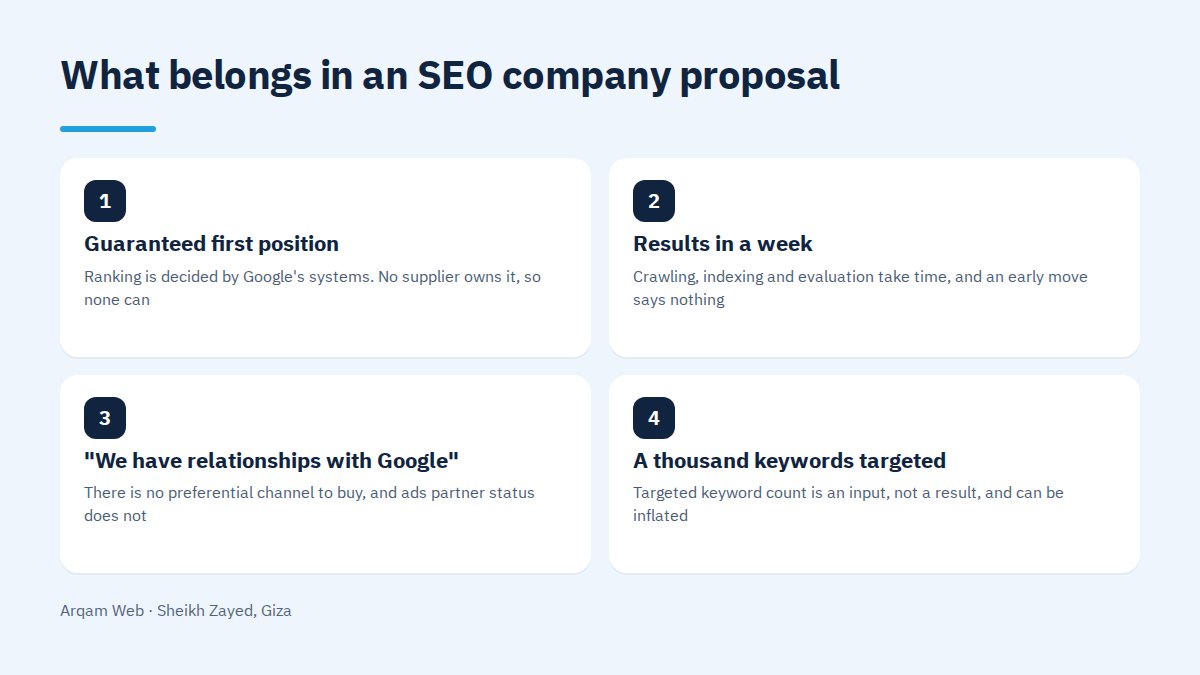
| Guaranteed first position | Ranking is decided by Google’s systems. No supplier owns it, so none can sell it | We work on named pages and report their impressions and clicks monthly |
| Results in a week | Crawling, indexing and evaluation take time, and an early move says nothing about stability | A phased plan with written deliverables and indicators per phase |
| “We have relationships with Google” | There is no preferential channel to buy, and ads partner status does not touch organic search | We work from the published documentation and cite it |
| A thousand keywords targeted | Targeted keyword count is an input, not a result, and can be inflated without limit | Pages published, pages indexed, and enquiries received |
The first row deserves saying plainly: position in search results is decided by Google alone, and no SEO company can guarantee it. Google warns about guaranteed-ranking promises in its own SEO starter guide. Anyone guaranteeing a spot is selling what they do not own.
Where does choosing an SEO company actually start?
It starts in the proposal. A good one can be executed and audited without a later argument. The minimum that belongs in writing:
- How many content pages per month, of what kind, how long, and who approves them before publication.
- Who writes them. A writer who knows your field, a translator, or a generation tool with human review? The answer changes quality and price.
- What the technical side covers: page speed, indexing and coverage errors, internal linking, structured data, duplicate pages and canonical tags, sitemaps.
- The report format and frequency, which metrics it carries, and who answers your questions.
- Account ownership: Search Console, GA4, hosting and the site admin, all in the client’s name.
- What the proposal excludes. A scope with no stated edges turns every extra request into a dispute.
Who should own the Search Console and GA4 accounts?
You should. The account is created under the email of the company that owns the site, and the agency is then granted user access. This is the clause that decides most of choosing an SEO company. If the account sits in the supplier’s name, years of history can leave with them on the last day of the contract, and the next supplier starts from nothing.
The same rule covers the domain, the hosting and the ad accounts. When the relationship ends you revoke access and keep the whole record. A supplier who objects has told you something useful about how they work.
Questions that reveal the level before choosing an SEO company
- What are the first three things you would fix on my site, and how do you know? A good answer comes from looking at the site, not a generic checklist.
- Show me a real report for another client with the name removed. Its shape tells you the standard of the work.
- How do you build links, and from where? Hesitation here is answer enough.
- What do you need from me each month? A programme that needs nothing from you is probably not touching your product or market.
- What happens if the indicators have not moved after six months? Hear the full answer.
Red flags when choosing an SEO company
- Bought links, blog networks, or a ready-made package of a thousand backlinks. The risk sits on your domain.
- Bulk generated content with no review. The tool is not the problem. The missing review is.
- Refusing you access to Search Console, or stalling with repeated excuses.
- A report built on metrics that mean nothing: keywords targeted, links built, posts published, a ranking from an unnamed location with no screenshot.
- A contract with no scope, or a scope loose enough to cover anything.
- Pressure to sign today against a discount that expires in hours.
How do you measure at three months and at six?
Choosing an SEO company does not end at signature. Fix what you will measure before the work starts, and take a snapshot of Search Console and GA4 on day one. At three months, do not ask about positions. Ask whether the agreed fixes shipped, how many pages were published and how many are indexed, whether impressions rose on your service queries, and whether coverage errors fell.
At six months the questions get heavier. Are clicks up from queries that do not carry your brand name? How many pages now earn clicks that earned none before? How many enquiries arrived from organic search? Enquiries are the measure a business owner cares about, and everything before them is a signal on the way.
When should you end the contract?
Choosing an SEO company is a reversible decision. Three months is enough to judge delivery, and six months with no movement in impressions or clicks is a serious signal. End it when last month’s report reappears with only the date changed, when access to your accounts is withheld, when you find bought links, or when nobody can say how many pages went live.
Arrange the exit before you need it: revoke access, export the Search Console reports, keep the content files and a site backup. A tidy exit lets the next supplier start where the last stopped.
What makes an SEO company worth its fee?
The last test in choosing an SEO company is simpler than it looks. A good supplier explains why this page comes before that one, ties every task to a commercial outcome, and says “we do not know yet” when that is the truth. You can see the thinking in how to distinguish your site and how to benefit from your site, examples of our work in our project pages, and our price ranges on the pricing page.
Frequently asked questions
Can any company guarantee the first position on Google?
No. Ranking is decided by Google’s systems across many factors that keep changing, and no company controls it directly. The only reasonable guarantee covers deliverables: pages produced, fixes shipped, reports on time. Anyone guaranteeing a position is selling what they do not own.
How long does SEO take to show results?
First indicators usually appear in the second or third month as rising impressions and better indexing. Effect on enquiries more often takes four to six months, and longer in competitive markets or on a site starting from a poor technical state.
Does AI generated content damage a site?
What damages a site is unhelpful content, whatever tool wrote it. Text generated and published untouched tends to carry padding, errors and unverified claims. Used properly it is a first draft, reviewed by somebody who knows the field and adds real knowledge.
What metrics belong in the monthly report?
Impressions and clicks from Search Console split by query and page, pages published and pages indexed, the state of coverage errors, technical fixes shipped, and enquiries from organic search. Plus what was done this month and what is planned for next.
Do I need a long contract?
A medium term with a clear review at three months and a right to exit on reasonable notice works best. SEO compounds, so one month is too short to judge. A full year with no review point leaves you weak if the supplier turns out wrong.
We will read your proposal before you sign
Send the proposal you received and your site address, and we will come back with straight notes on scope, report format and account ownership, with no obligation.
Request a quote · Message us on WhatsApp · Call us
Arqam Web
44 Central Axis, Al Saraya Mall, Lower Ground, Entrance 2, Sheikh Zayed, Giza, Egypt
Phone and WhatsApp: +20 111 872 1404 · Email: info@arqamweb.com