

Writing for AI and humans is not two jobs. It is one piece of text with three settings adjusted: where the answer sits, how long a paragraph runs, and whether a sentence survives on its own. A reader scans the page for an answer, and a model lifts a paragraph out and shows it somewhere else.
How does a reader who scans differ from a machine that extracts?
A reader never reads every word. Their eye drops to the headings, the bold phrases and the first line of each paragraph, then stops at whatever looks like their question. A model does the same but harsher: it takes one block and shows it away from your page.
Both behaviours punish the same defect: a sentence leaning on the one before it collapses when lifted. The visitor who landed mid page from search never read your introduction, which is why writing for AI and humans is one edit, not two.
What makes a paragraph quotable?
Put a complete answer in the first sentence of the paragraph, then add the detail and the exceptions after it. This is the cheapest edit on any page, because it asks for no new content and only moves what you wrote.
Before: “Several factors affect how long a website project takes, and we will go through them below.”
After: “A brochure site’s timeline is set by content readiness, page count and the number of review rounds.”
The second sentence can be published as an answer exactly as written, while the first promises an answer later. Nothing new was added: the information moved to the front.
How does writing for AI and humans change your subheadings?
The subheading is what matches the question, so write it in the words your client says. Nobody types “integrated content solutions.” They type “how often should I update a blog post.” A marketing label looks tidy and matches nothing.
Quick test: read your subheadings alone, with no body text under them. If they read as questions a real buyer asks, the structure is sound. If they read as slogans, you built a table of contents for yourself. A plain descriptive heading is fine, as long as it says what follows.
Table, list or plain prose: which shape, and when?
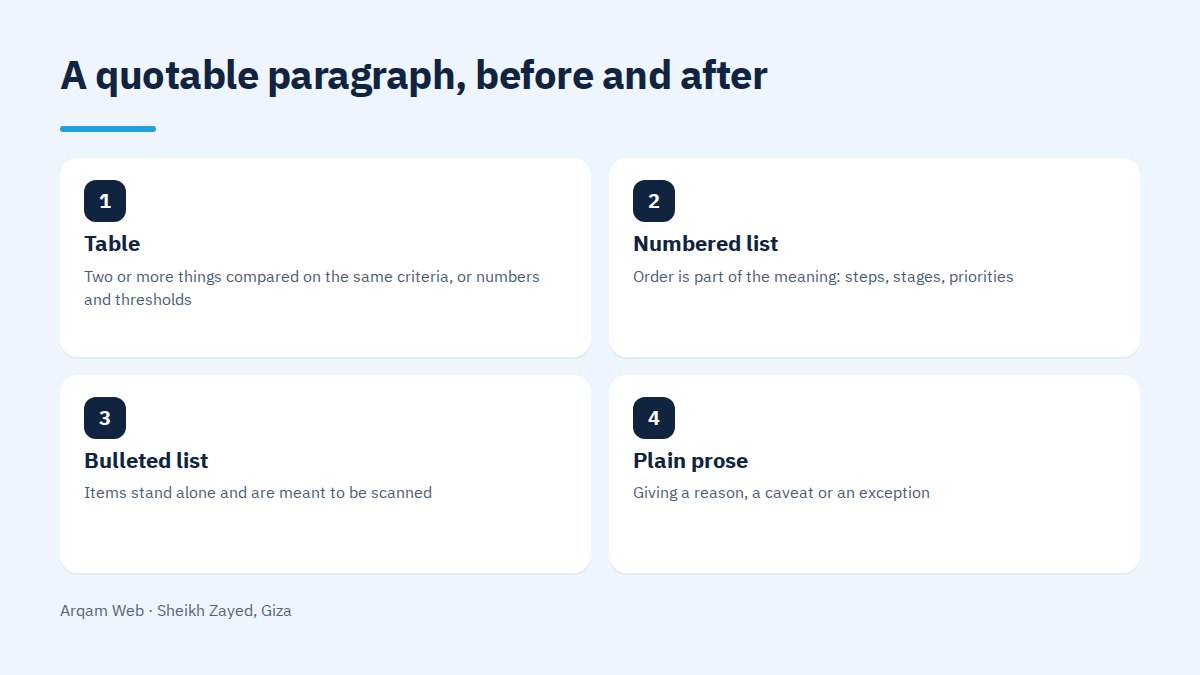
| Shape | Use it when | Avoid it when |
|---|---|---|
| Table | Two or more things compared on the same criteria, or numbers and thresholds | Explaining one idea with a cause and an effect |
| Numbered list | Order is part of the meaning: steps, stages, priorities | Items are equal and unordered |
| Bulleted list | Items stand alone and are meant to be scanned | The point needs a built argument |
| Plain prose | Giving a reason, a caveat or an exception | The content is really data points |
The common mistake is turning everything into bullets. A page made of fragments loses its argument.
How long should a paragraph and a sentence be?
Two to four lines for a paragraph, and around twenty words for a sentence. A long paragraph does not get extracted: taking all of it is expensive and taking half destroys the meaning. A long sentence carries three ideas, so it answers none cleanly.
Perfect uniformity is its own tell. Text where every paragraph runs exactly three lines reads as machine output, which is the worst thing writing for AI and humans produces when it is treated as a template. Vary the lengths.
How do you write the definition sentence?
A definition sentence is “X is a Y that does Z,” with no superlatives and no run up. It is the most quoted shape in an article, because so many questions start with “what is.” Put it at the top of its section.
Before: “Landing pages have become one of the most important tools in modern digital marketing.”
After: “A landing page is a single page with one goal: turning a visitor from an ad campaign into an enquiry or an order.”
Why put the date and the source inside the sentence?
A claim with no date is treated as expired. The word “currently” tells nobody anything, while “as of September 2026” sets the shelf life of the sentence.
Name the source in the same sentence, not in a footnote. “According to Google’s documentation on page experience signals” beats “according to studies,” and an unsourced number weakens the paragraph.
What is an implicit reference, and why does it break a quote?
An implicit reference is any phrase pointing at other text on the page without naming it. Fine in a book read in order, fatal on a page quoted in fragments:
- “As mentioned above” becomes: “as in the criteria for choosing a content shape.”
- “In the table above” becomes: “in the comparison of the four content shapes.”
- “This issue” and “this point” become the name of the thing: “paragraph length,” “the definition sentence.”
- “We will cover that later” gets deleted, or replaced with the answer in place.
Stranded pronouns belong here too. A paragraph opening with “which is what makes it faster” cannot be quoted, because “it” lives outside it. Name the thing.
A pre-publish checklist for writing for AI and humans
- Read the first sentence of every paragraph alone. If it needs the previous one, rewrite it.
- Read the subheadings in sequence. They should sound like client questions.
- Answer the title’s question in the first sixty words.
- Search for “above” and “the previous” and replace them with a name.
- Count the lines in your longest paragraph. Over five, split it.
- Add a date to every changeable fact and a named source to every number.
- Turn any prose comparison into a table and any sequence into a numbered list.
- Read it aloud. What trips your tongue gets neither quoted nor read.
A quarter of an hour per article is enough for that list, and running it on your web design and development page matters more than running it on your blog. Read how to distinguish your site and how to benefit from your site next.
Frequently asked questions
Does writing for AI and humans hurt the human reader?
No, it serves the reader first. Someone scanning the page wants a fast answer, and a paragraph opening with a complete one helps them before it helps any model. The harm comes from overdoing it: repeating the key phrase for its own sake, or chopping text into identical sentences.
What is the first edit to make on an old article?
Rewrite the opening paragraph as a standalone answer to the title’s question in about fifty words, then turn the subheadings into real questions phrased the way buyers ask them. Both edits take minutes, need no code change, and matter more than technical work on the page.
Is repeating the key phrase part of writing for AI and humans?
Useful repetition comes from the subject, not from a counter. Use the phrase where it belongs: in the first answer, in two subheadings, in one question, and in the closing section. Stuffing shows up the moment you read the page aloud, and it spoils a paragraph that would have been quoted.
How long should the article be?
Length is a result, not a target. An article is finished when it answers every sub question coming out of its main one, so eight real sub questions produce a medium length piece. Adding words to hit a number creates paragraphs with no information, and those get ignored first.
Should every page have a frequently asked questions section?
Every page where a real question keeps coming up, yes. A useful section collects the questions you hear on calls and in messages, answered in forty to seventy words each, in wording that stands alone. A section built just to exist repeats the body and adds nothing.
Have your pages edited
Send a page or an article and you get the same text back with each paragraph rebuilt to stand alone, plus notes on the subheadings and definition sentences. For scope, see the pricing page. Writing for AI and humans is editorial work before it is technical.
Request a quote · Message us on WhatsApp · Call us
Arqam Web
44 Central Axis, Al Saraya Mall, Lower Ground, Entrance 2, Sheikh Zayed, Giza, Egypt
Phone and WhatsApp: +20 111 872 1404 · Email: info@arqamweb.com