

The Egyptian Marble Supplier case study covers a marble exporter selling to buyers worldwide, and one decision that shaped everything after it: every stone got its own page, because that is how the buyers search. Sixty-one stones were entered one at a time into a catalogue the client can keep extending.
Where did the Egyptian Marble Supplier case study start?
It started with the problem as the project page states it: a trade where the buyer searches by the name of a stone. A site listing its whole range on one page gives search nothing to land on, and an answer engine nothing to quote.
The first phase was not design. It was reading the sites already selling into this trade.
Why does a marble buyer search by the name of the stone?
Because the buyer knows the material before he knows the supplier. An architect wants a named stone in a given thickness and finish. An importer wants a replacement for a stone his supplier has run out of. Either way the query is about the material, not the company.
That inverts the usual priority order on an export site. The home page is not the real entrance. The product page is. The decision behind the Egyptian Marble Supplier case study follows: one page per stone.
How was the catalogue ordered: colour first, then form?
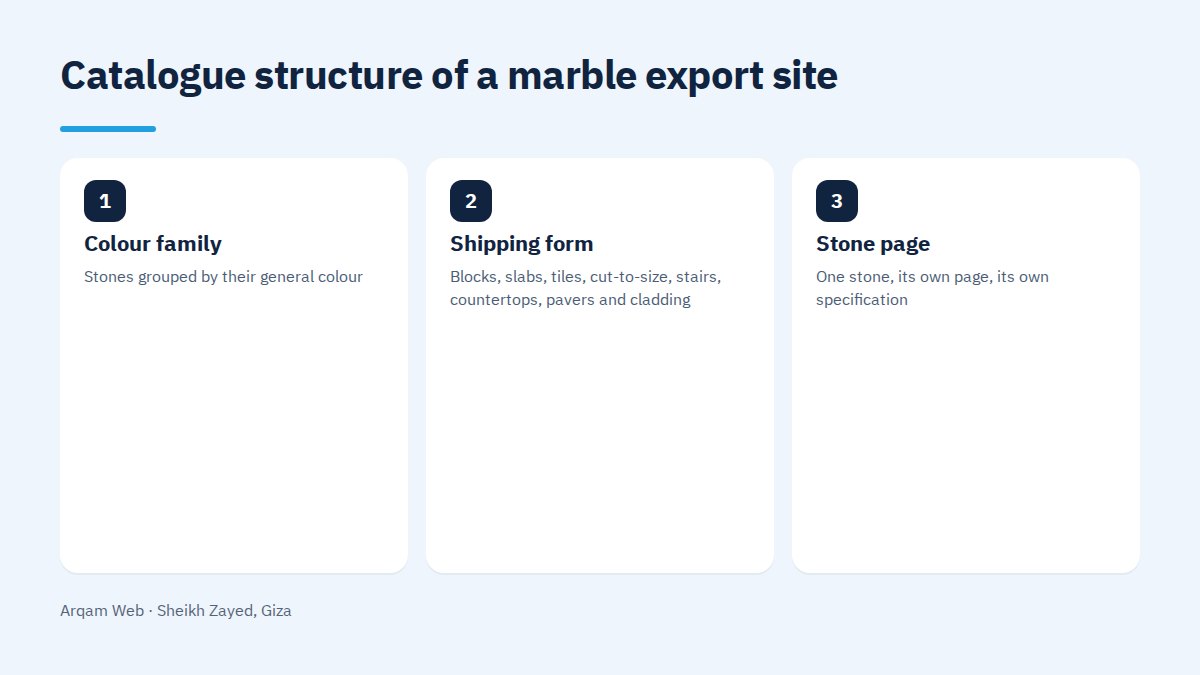
The published structure works on two levels, and the eight shipping forms are named on the project page, so anyone can count them.
| Level | What it holds | Why the buyer cares |
|---|---|---|
| Colour family | Stones grouped by their general colour | Most buyers start from a colour that suits the project |
| Shipping form | Blocks, slabs, tiles, cut-to-size, stairs, countertops, pavers and cladding | Each form has its own weight, packing and price |
| Stone page | One stone, its own page, its own specification | This is the page a search result lands on |
That order follows how the question is asked, not how the stock is held. A supplier thinks in quarries, a buyer in colour and finish.
What does an overseas buyer need before sending an enquiry?
What follows is general practice in export sites, not a description of this project. A product page that produces real enquiries answers the buyer before he types the question:
- The technical specification. Trade name, quarry, material type, and any real laboratory reading you hold.
- Dimensions and thicknesses. Slab and tile sizes, standard thicknesses, and the limits of cut-to-size work you accept.
- Finishes. Polished, honed, flamed, bush hammered, with a photograph of each, since colour shifts with finish.
- Packing. Crate or bundle type, how much one holds, and how the stone travels protected.
- Shipping. Port of loading, what fits in a container, and full container against consolidated freight.
- Minimum order. A figure in square metres or containers saves a long exchange of messages.
- Sample requests. A short form with a stated policy on who pays for sample freight.
Certification and import rules differ by country, and the above is general content guidance rather than export or shipping advice.
The five phases, as published
The project page publishes five phases, and they are the part of the Egyptian Marble Supplier case study worth copying:
- Competitor study. Reading the sites already trading in this market before any decision.
- Structure before design. The search requirement decided the shape of the site, hence the split by colour family and shipping form.
- Design and build. The site was designed and built on that agreed structure, with a custom content type for stones.
- Loading the catalogue. In the page’s words, sixty-one stones, entered one at a time.
- Search work, continuing. Base optimisation is done and the work has not stopped.
What was actually built
The deliverables as the project page names them, the part of the Egyptian Marble Supplier case study worth borrowing:
- A page for every stone rather than one consolidated list.
- Sorted by colour, then by form across the two levels above.
- A material guide explaining the stone itself to a buyer who does not know it.
- Factory and export for the operational side.
- Applications and finishes tying each stone to where it is used.
- A catalogue the client can extend without a developer.
The last item decides how long the site stays useful. A catalogue needing a developer for every addition freezes within months. Read the Egyptian Marble Supplier project page for the deliverables in their published wording.
What the published result says
The page is plain about it: sixty-one stone pages sit under nine main sections, covering the material guide as well as the factory and export side. The catalogue was loaded in full, base optimisation is done, and the work continues. There are no published rankings yet, and none are invented here.
Both numbers can be counted on the project page. That is the difference between a case study and a brochure, and why the Egyptian Marble Supplier case study stops where the evidence stops.
What the Egyptian Marble Supplier case study means for your own export site
- Start from how the buyer searches rather than a layout you like. The product name is the query.
- One page per real product. A single list crowds different search intents onto a page that serves none.
- Order on two levels at most: a grouping the buyer starts from, and a form that sets price.
- Write the full specification before spending on motion and oversized photography.
- Put additions in the owner’s hands. A custom content type costs less than a monthly change request.
- Accept that search work continues. Base optimisation is only a starting line.
Compare formats in types of websites to decide whether your case is an export catalogue or a retail store, and see our published work for other live cases. What we handle here sits on the web design and development page.
Frequently asked questions
What does the Egyptian Marble Supplier case study prove?
That catalogue structure is a commercial decision rather than a technical one. One page per stone, ordered by colour family then shipping form, in a catalogue the client extends himself. What is published is sixty-one stone pages under nine sections, with base optimisation complete and search work continuing.
Why one page per stone instead of a single catalogue page?
Because the buyer searches by the name of the stone. One page holding every stone gives search a single result for dozens of queries, and gives an answer engine only generic text to quote. A dedicated page carries a full specification, so it answers one specific question well.
How many stones does the catalogue hold?
Sixty-one, entered one at a time, sitting under nine main sections that include the material guide and the factory and export side. Both figures are published on the project page and can be counted there. No other figure appears here, because the page publishes none.
Does an export site need a shopping cart and online payment?
In most building material export cases it does not. The deal opens with a request for a quotation or a sample, and price moves with quantity, shipping form and destination port. A clear catalogue and a short enquiry form matter more than a gateway built for retail.
What should I prepare before an export site is built?
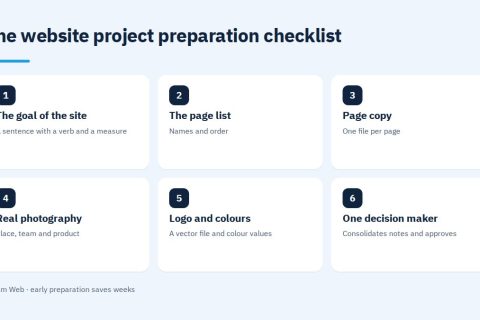
Your product list under its trade names, a written specification for each item, one clean photograph per finish, the shipping forms you actually sell, and your minimum order. How ready that material is decides the timeline more than design does, and missing content is why projects slip.
Have your export catalogue structured the same way
If the Egyptian Marble Supplier case study reads close to your situation, the first step is short. Send your product list, the shipping forms you sell and the markets you target, and you will get a proposed structure with page counts and ordering levels before any talk of design.
Request a quote · Message us on WhatsApp · Call us
Arqam Web
44 Central Axis, Al Saraya Mall, Lower Ground, Entrance 2, Sheikh Zayed, Giza, Egypt
Phone and WhatsApp: +20 111 872 1404 · Email: info@arqamweb.com