

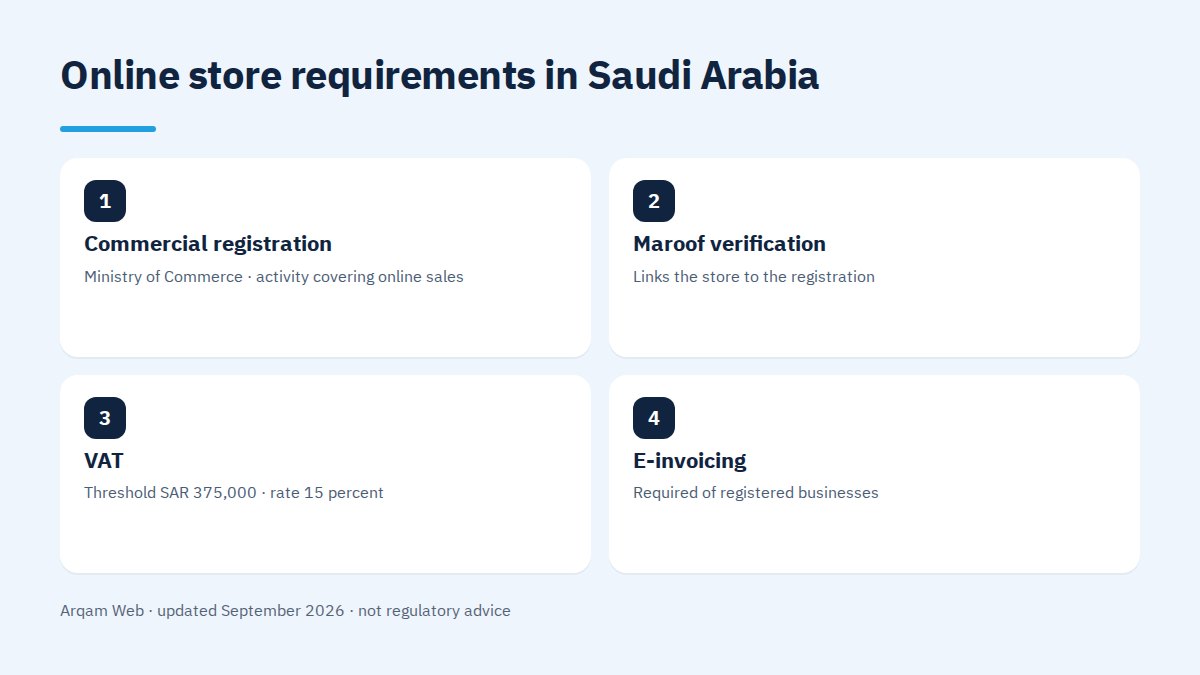
Online store requirements in Saudi Arabia come down to four things: a commercial registration that names e-commerce as the activity, verification of the store on the Maroof platform, VAT registration once taxable revenue reaches SAR 375,000 a year at a rate of 15 percent, and compliance with the e-commerce law on disclosure, returns and e-invoicing.
This is general guidance updated in September 2026 and not regulatory advice. Check with the relevant authority or your adviser before acting.
Why should the paperwork run in parallel with the build?
Payment gateways in Saudi Arabia ask for business documents before activating an account, and couriers do the same. Building the store first and starting the paperwork afterwards leaves you stalled for weeks at the final step, with a finished store that cannot collect money.
Online store requirements in Saudi Arabia: the four items in detail
| Item | Authority | Note |
|---|---|---|
| Commercial registration | Ministry of Commerce via the Saudi Business Center | The activity must cover selling online |
| Maroof verification | The Maroof platform under the Ministry of Commerce | Links the store to the registration and shows buyers a trust signal |
| VAT | Zakat, Tax and Customs Authority | Mandatory at SAR 375,000 · rate 15 percent |
| E-invoicing | Zakat, Tax and Customs Authority | Required of VAT registered businesses |
What does the e-commerce law require on your pages?
- Disclosure of store details and owner identity clearly, not on a buried page.
- A clear returns and exchange policy that does not reduce consumer rights.
- Accurate product description and price inclusive of tax before the payment step.
- Protection of customer data and no use beyond the stated purpose.
- Truthful advertising with no misleading claims about products or offers.
These are design items before they are legal ones: each is a page or an element that belongs in the specification from the start. That is what makes the online store requirements in Saudi Arabia a build question rather than a paperwork question alone.
Shipping and payment: what does a Saudi buyer expect?
The default expectation is paying online and knowing the delivery date before paying. Three elements make the difference:
- Mada and Apple Pay alongside cards, and their absence costs you orders.
- A delivery window per city rather than a vague “within a few days”.
- Shipment tracking with a link sent automatically after the order.
These are not regulatory items but they are part of market expectation, and neglecting them loses orders even when every document is in order.
How do the Saudi and Egyptian markets differ here?
| Item | Saudi Arabia | Egypt |
|---|---|---|
| VAT rate | 15 percent | 14 percent |
| Registration threshold | SAR 375,000 | EGP 500,000 |
| Government store verification | Maroof | No direct equivalent |
| Expected payment methods | Mada, Apple Pay and cards | Cards, Fawry and cash on delivery |
The most consequential practical difference is that Saudi buyers expect to pay online by default, while cash on delivery is still central in Egypt. That changes the design of the checkout step itself. Compare with how much a website costs in Egypt.
What does this mean for the build?
- An about page carrying the entity details, the commercial registration number and the Maroof badge.
- Separate policy pages: returns and exchange, shipping, privacy, terms.
- Prices displayed inclusive of tax with shipping stated before payment.
- A compliant invoice with a sequential number and a QR code for registered sellers.
- A reporting dashboard giving total sales so you can watch the registration threshold approach.
Common mistakes with online store requirements in Saudi Arabia
- A commercial registration that does not cover online selling, which stalls verification and payment setup.
- Skipping Maroof even though Saudi buyers look for it as a trust signal.
- Showing prices without tax and adding it at the last step, which raises cart abandonment.
- A copied returns policy that does not match how your business actually works, which causes disputes.
- Not tracking total sales until the registration threshold has already been crossed.
A suggested order for clearing the requirements
Start with the commercial registration under an activity that covers online selling, then open the bank account, then apply for the payment gateway, then verify the store on Maroof once it has a live address, and in parallel build the store and prepare product data, photography and policy pages.
Frequently asked questions
What are the online store requirements in Saudi Arabia?
A commercial registration covering e-commerce activity, verification on the Maroof platform, VAT registration once taxable revenue reaches SAR 375,000 a year at 15 percent, and compliance with the e-commerce law on disclosure, returns and e-invoicing.
What is Maroof and why does it matter?
It is a Ministry of Commerce platform that verifies online stores and links them to their commercial registrations. Saudi buyers often check whether a store appears there before buying, so verification is a practical trust signal rather than a formality.
When do I register for VAT?
Once taxable revenue reaches SAR 375,000 over twelve months, at a rate of 15 percent. Voluntary registration is available at half that threshold. Watch the figure monthly in your store reports.
Can a non Saudi open an online store?
It depends on residency status, investment licensing and the registered activity, and it differs between a resident and a foreign investor. Review this with the relevant authority or a regulatory adviser before starting, because the answer changes with your situation.
Do I need my own site or is a hosted platform enough?
Hosted platforms are faster at the start but limit design and structure and carry ongoing fees. A site you own gives full freedom over categories, content and SEO. The decision depends on catalogue size and your growth plans.
Build a store that is compliant from the start
We build stores with policy pages, invoices and reporting from day one, with tax inclusive prices and shipping stated before payment, so the online store requirements in Saudi Arabia are covered in the design rather than bolted on under pressure. Send your product count and shipping method.
Request a quote · Message us on WhatsApp · Call us
Arqam Web
44 Central Axis, Al Saraya Mall, Lower Ground, Entrance 2, Sheikh Zayed, Giza, Egypt
Phone and WhatsApp: +20 111 872 1404 · Email: info@arqamweb.com
Official sources: the Zakat, Tax and Customs Authority and the Maroof platform.