

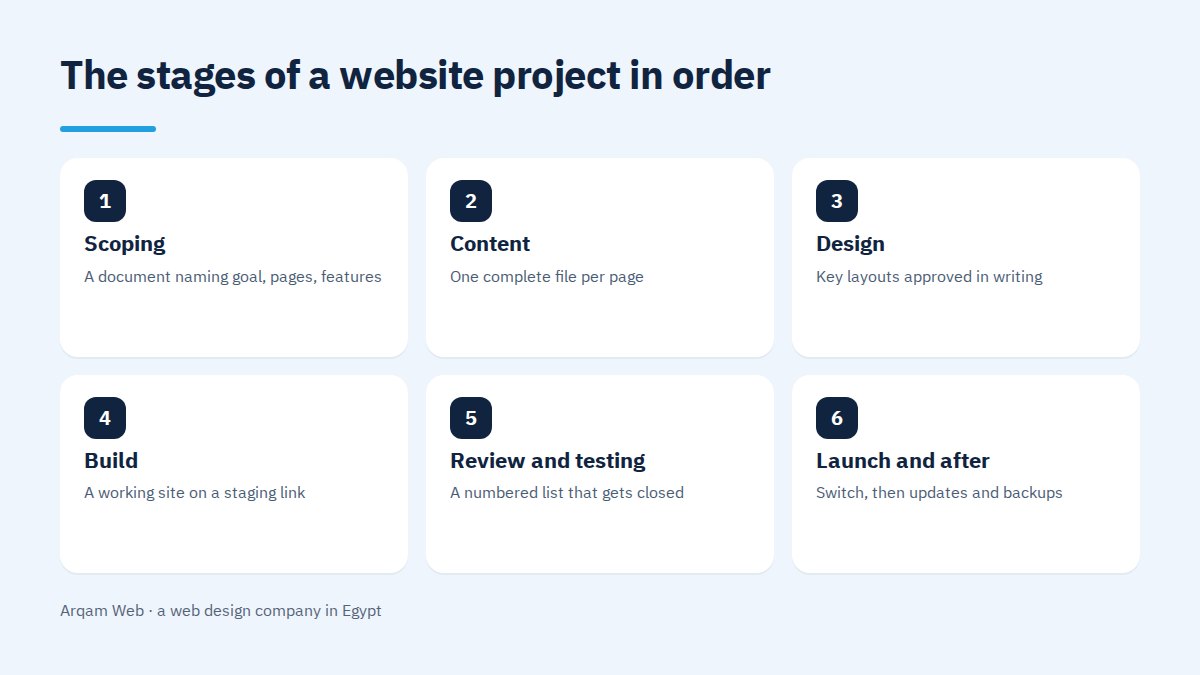
The stages of a website project are seven: scoping, content, design, build, review, launch and life after launch. The order is not decorative. Each stage closes before the next opens, and reopening a closed stage is the single biggest cause of delay on website projects.
The stages of a website project and who owns each one
| Stage | Output | Owner | Closes when |
|---|---|---|---|
| 1. Scoping | A document naming goal, pages and features | Client and agency together | The document is signed off in writing |
| 2. Content | Copy, images, logo, data | Usually the client | Every page has a complete file |
| 3. Design | Key page layouts | The agency | Design approved with no open notes |
| 4. Build | A working site on a staging link | The agency | Every agreed feature works |
| 5. Review and testing | A closed list of notes | Both | Every note is closed or explicitly deferred |
| 6. Launch | The site on the real domain | The agency | Speed, links and forms are checked |
| 7. After launch | Updates, backups, measurement | As agreed | Ongoing |
Stage one of a website project: scoping
This is the cheapest of the stages of a website project and the most consequential. You leave it with a written document naming your website goal and the action you want from a visitor, the pages by name, the special features such as booking, payment or two languages, who writes the content, and the timeline with delivery points.
Anything left out here gets discussed later at a higher price. Every other stage of a website project rests on this document.
Stage two: content before design
Most delay on website projects comes from copy and photography that were never prepared, not from stuck development. Designing on placeholder text produces layouts that cannot hold the real words, so the design gets done twice.
A practical rule: one file per page holding the heading, the body, the images, the buttons and where each button goes. An incomplete file means a late page.
Stage three of a website project: design
Usually three to five key layouts are designed rather than every page: the home page, a service or product page, an inner page and a contact page. The rest is assembled from the same components.
Review the design on a phone before a large screen, because most visitors in Egypt and the Gulf arrive on mobile. Approve in writing, since a verbal yes tends to reopen the stage two weeks later.
Stage four of a website project: build
Here the design becomes a working site on a staging link: templates, the dashboard, forms, payment or booking if present, and the Arabic and English versions on a bilingual site. This is the longest stage in most projects and the one that needs the least from you.
Stage five: review and testing
Review with a list, not an impression. The minimum:
- Every form actually sends and the notification email arrives.
- Every link works and there are no 404 pages.
- Pages open acceptably fast on mobile data rather than on office wifi.
- Arabic text runs in the correct direction with punctuation in place.
- Images are compressed and carry alt text.
- A thank you page exists after submission and can be measured.
Collect your notes in one numbered list rather than scattered messages. A list gets closed item by item. Scattered messages never close.
Stage six of a website project: launch
Before the domain switches: a backup, an SSL certificate, redirects for old URLs if a previous site existed, the site added to Search Console and GA4, and a sitemap submitted. After the switch, open at least ten pages yourself and check them.
Skipping redirects for old URLs is the most common launch mistake, and it throws away rankings built over years.
Stage seven of a website project: after launch
A site nobody updates becomes a security liability and a slow page within months. Agree in writing on who updates the platform and plugins, where backups live and how often, who adds new content, and who reads the traffic report each month.
Read how to benefit from your site as well, because launch is the start of the work rather than the end.
Where do the stages of a website project actually slip?
- Content that is not ready. The leading cause by a wide margin.
- Too many decision makers. Three reviewers with no single authority produce contradictory notes.
- Out of scope requests during build. Every addition reopens a closed stage.
- Third party data. A payment gateway or a courier account can take weeks.
Three of the four sit with the client, and that is good news: you really can shorten the timeline.
How do you track the stages of a website project without micromanaging?
Good tracking is not a daily question about percentage complete. It is three fixed points:
- A short meeting whenever a stage closes instead of a daily update with no substance.
- A staging link open to you from the start of the build so you can see progress yourself.
- One point of authority on your side who gathers your team notes and sends them as one list.
With those three, the stages of a website project pass without surprises in the final week, which is normally when every deferred note reappears at once.
How do a brochure site and a store differ across these stages?
The stages are the same and the weight moves. A brochure site loads the content stage: service copy and photographs of work. A store loads two extra fronts inside the build: product data with images, and payment and shipping integrations that depend on third parties whose timelines you do not control.
Frequently asked questions
How many stages does a website project have?
Seven: scoping, content, design, build, review and testing, launch, and life after launch. Some agencies merge review into build, but keeping them apart is what makes notes closable.
How long does a business website take?
Content readiness drives the timeline more than design size does. A brochure site with copy ready moves through the stages quickly, while a store waiting on product data, photography and a payment gateway takes longer. Ask for a schedule with intermediate milestones rather than one total figure.
Can design start before the content is ready?
The overall direction can start, but final pages cannot. Designing on placeholder text produces spaces the real words do not fit, so the work is redone. The middle path is to start with the page whose content already exists.
What if I want a change after approving the design?
It gets done, with cost and time attached, because it reopens a closed stage. That is why approval is written and any later change is logged as an additional request with a new agreed schedule.
What do I receive at the end of the project?
The site on the real domain, credentials for the dashboard, hosting and domain in your name, a backup, a short guide to adding content, and the written agreement covering life after launch.
Start with a scoping session
Send the goal of your site and a rough page count, and you leave the first session with a document naming the stages of a website project as they apply to you, with durations and delivery points, even if you decide not to continue with us. See the web design and development page for what we build.
Request a quote · Message us on WhatsApp · Call us
Arqam Web
44 Central Axis, Al Saraya Mall, Lower Ground, Entrance 2, Sheikh Zayed, Giza, Egypt
Phone and WhatsApp: +20 111 872 1404 · Email: info@arqamweb.com