

How to choose a web design company: ask for three things before anyone mentions a price. Live work you can open yourself, a contract naming who owns the domain, hosting and code after handover, and a timeline broken into stages with payments tied to them. A company that dodges one of those three has a problem no discount fixes.
The questions below follow the order of a real conversation with a supplier, from the first call to the signed contract. Each one has a right answer, and an answer that reveals the supplier has never thought about it.
What does “web design company” actually mean?
A web design company plans, designs, builds and launches your site, then hands you an asset you own. That sounds obvious, and it is the line that separates two very different business models.
The first kind builds your site and gives you the keys. The second builds it on their own account and rents it to you monthly, and two years later you find you cannot move it, edit it, or export what is inside it. That difference never shows up in the quote. It shows up in the ownership clause.
How to choose a web design company from its work rather than its pitch
Ask for links to live sites, not screenshots in a slide deck. A screenshot is made in a design tool and proves nobody built anything.
Open every link on your phone first. Most visitors in Egypt and the Gulf arrive on a phone, and a site that looks sharp on a laptop and falls apart on a handset was never tested.
Then ask about one specific project: what the client asked for, what changed along the way, and how long it took. A supplier who did the work answers with boring detail. A supplier who bought the screenshots answers in generalities.
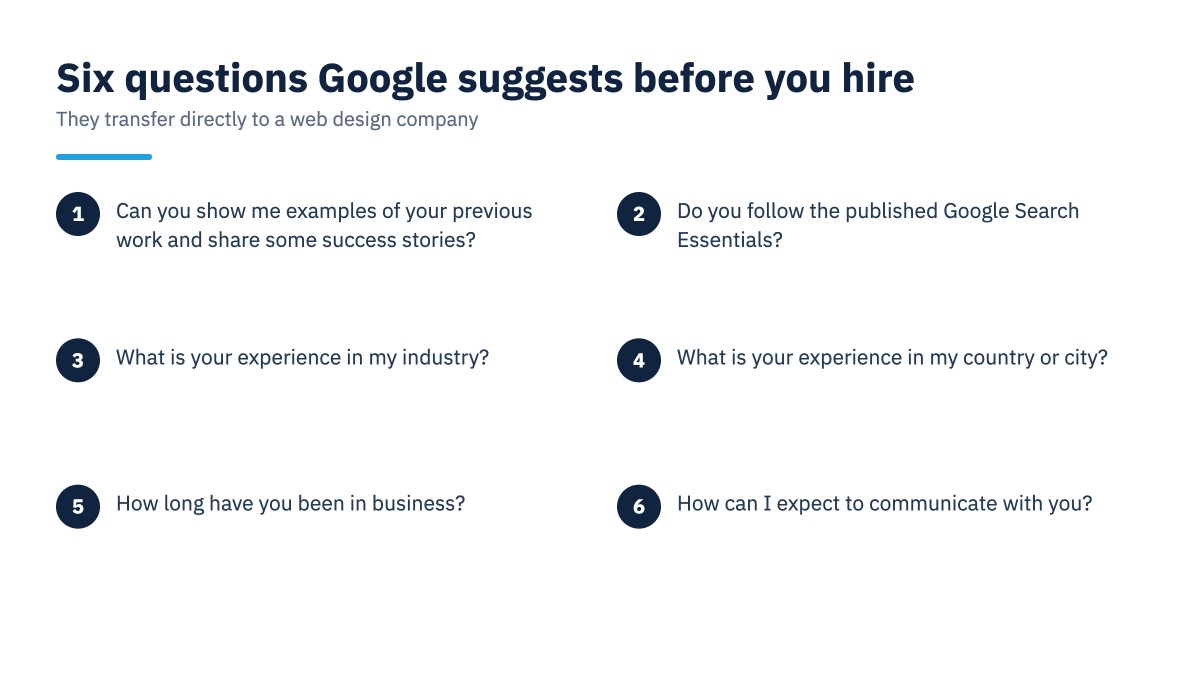
Google’s own documentation recommends the same approach when hiring any search provider, and the questions it suggests transfer directly to a web design company:
| Google’s suggested question | What the answer reveals |
|---|---|
| Can you show me examples of your previous work and share some success stories? | Whether real, verifiable work exists |
| Do you follow the Google Search Essentials? | Knowledge of published rules rather than folklore |
| What’s your experience in my industry? | Understanding of who your buyers are |
| What’s your experience in my country or city? | Familiarity with local payment gateways and buying habits |
| How long have you been in business? | Whether they will still be there after handover |
| How can I expect to communicate with you? | A process, rather than dependence on one person |
Who owns the domain, the hosting and the code after handover?
This question prevents the single largest loss available to you, and it belongs in the first meeting rather than the last.
The domain should be registered in your name or your company’s, with you holding the registrar login. Hosting the same. Code and design files should transfer to you on final payment, written into the contract in plain words.
Ask one direct question: “If I decide in a year to move this site to another supplier, what do I receive from you?” The right answer is a list: a full copy of the database and files, the logins, and a stated number of days. Hesitation here is itself the answer.
Which platform will your site be built on, and why?
No platform is correct for every project, but there is a correct answer about why this one was chosen. Ask for the reasoning.
WordPress leads by a wide margin. W3Techs data on 27 September 2026 puts it at 58.7% of sites whose content management system is known, which is 40.2% of all websites. That reach means finding someone to maintain your site later is easy, and it also means bad plugins are as available as good ones.
A custom-coded site gives tighter control and a lighter page, costs more, and needs a developer for any structural change. If your project is a store, ask about the payment gateway and the shipping company before anything else, because those two decide half the build.
We cover the differences between site types in more depth in Types of Websites and How to Choose the Right One for Your Business.
How do you judge site speed before you accept delivery?
Speed is not an impression. It has published numbers anyone can measure.
Google defines three page experience metrics, and the “good” value for each is stated on web.dev: Largest Contentful Paint at 2.5 seconds or less, Interaction to Next Paint at 200 milliseconds or less, and Cumulative Layout Shift at 0.1 or less. All three are assessed at the 75th percentile of page views rather than at the average, so a fast median hides nothing.
Ask the supplier to commit to those values on mobile after handover, in writing. Then measure them yourself on any live link from their portfolio before you sign, because what they built last month is the honest predictor of what they will build for you.
Does the quote include content, or are you writing it?
This is the first cause of delayed projects, and the item most often left vague on purpose.
Ask it specifically. Who writes the page copy? Who supplies product photography? How many products are entered within the price? And who translates, if the site runs in two languages?
A bilingual site is not one site. It is twice the pages and twice the copy, with separate technical setup for each language. A quote with “bilingual site” on a single line and no detail underneath turns into an expensive conversation two weeks in.
Why do two quotes with the same description carry different prices?
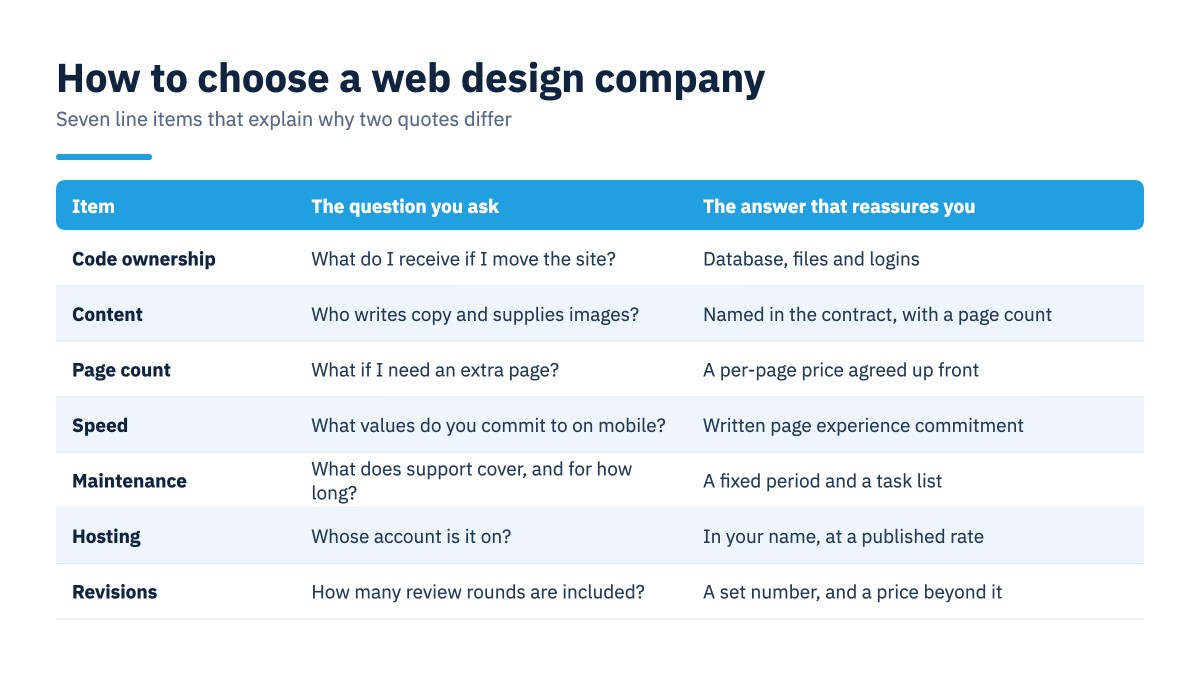
The gap is almost always in what the cheaper quote leaves out. The table below lists the items to ask about by name in every quote you receive.
| Item | The question you ask | The answer that reassures you |
|---|---|---|
| Code ownership | What do I receive if I move the site later? | Database, files and logins, within a stated number of days |
| Content | Who writes the copy and supplies the images? | Named in the contract, with a page count |
| Page count | What happens if I need an extra page? | A per-page price agreed before work starts |
| Speed | What values do you commit to on mobile? | A written commitment to the page experience metrics |
| Maintenance | What does post-launch support cover, and for how long? | A fixed period and a list of tasks, not a vague promise |
| Hosting | Whose account is it on, and what does it cost yearly? | In your name, at a published renewable rate |
| Revisions | How many review rounds are included? | A specific number, and a price for anything beyond it |
Fill that table in for two quotes and the mystery usually disappears. The cheaper quote was not cheaper. It was less.
How to choose a web design company for a store rather than a brochure site
An online store is a different purchase, and the questions change with it.
Ask which payment gateway they have shipped before, by name, and in which country. A gateway that is straightforward in the United Arab Emirates can need different paperwork in Egypt or Saudi Arabia, and a supplier who has never integrated the one you need will learn on your budget.
Ask how many products are entered within the quoted price, who writes the product descriptions, and what happens to the price at product two hundred. Ask which shipping company the store will talk to, and whether order status updates are automatic or typed by a person.
Then ask what happens on the day a customer says they paid and the order never appeared. The answer tells you whether anyone will be reachable after launch.
Which promises should end the conversation?
Some phrases mean the supplier either does not know, or knows and is betting that you do not. Part of knowing how to choose a web design company is knowing when to end the call.
Google’s documentation states plainly that no one can guarantee a #1 ranking, and warns against providers who guarantee rankings, claim a “special relationship” with Google, or advertise a “priority submit” of your site to the search engine. The guarantee itself is the warning sign, whatever price sits next to it.
Add a promise of a complete store in three days from someone who never asked how many products you sell, a quote that does not mention hosting at all, and a refusal to share a single live link because “clients don’t allow it”. Live sites are public by definition.
How do you read the timeline and the payment schedule?
A useful timeline lists stages, not a total duration. Page structure, design, build, content entry, testing, launch.
Each stage should end in something you see and approve in writing. That protects you from a surprise at handover, and protects the supplier from revisions that never end.
Tie payments to stages rather than dates. A payment tied to a date falls due even when the work slipped. A payment tied to a delivered stage puts you both on the same side.
Ask what causes delays most often in their projects. An honest supplier will tell you it is waiting for content from the client, because it is, and will suggest you prepare copy and images before the project starts.
What should you prepare before the first meeting?
Preparation is the cheapest part of how to choose a web design company. Three things cut weeks off a project: a list of the pages you want, three sites you like with a reason for each, and one sentence describing what you want a visitor to do when they arrive.
That last sentence changes the whole quote. A site built to collect quote requests is not built like a site meant to sell products, and neither is built like a site meant to prove a company is credible to a government buyer.
How to choose a web design company: where to start
Start by separating what you need now from what can wait for a second phase. Then request two or three quotes and fill in the item table above for each one before you compare anything.
Arqam Web is a web design and development company based in Sheikh Zayed, Giza, working with clients across Egypt and the Gulf. Package details and what each one includes are on the pricing page, and the cost items are broken down in How Much Does a Website Cost in Egypt.
Read Google’s own standard on the Google Search Essentials page, which has three parts: technical requirements, spam policies, and key best practices. Ask any supplier whether they follow them.
Frequently asked questions about how to choose a web design company
What is the first question to ask a web design company?
Ask about ownership: who holds the domain, the hosting and the code after handover. That single question exposes the supplier’s entire business model in a minute, and tells you whether you are buying an asset or renting one. Insist the answer appears in the contract rather than in a meeting.
Does a higher price mean better web design?
Not by itself. A higher price usually means more items inside the quote: written content, extra pages, a longer maintenance period, or a performance commitment. Compare quotes by their line items rather than their totals, and much of the price gap tends to disappear once everything is itemised.
How do I verify a company’s portfolio is real?
Ask for links to live sites rather than images, and open them on your phone. Then ask about one project in detail: what the client wanted, what changed during the build, and how long it took. People who did the work answer with specifics. People who did not answer in generalities.
Do I need a company or will one freelancer do?
It depends on the size of the project and what happens after launch. A freelancer suits a small site on a limited budget, while a company gives you continuity and a team that does not stop when one person is unavailable. If the site is a direct source of revenue, continuity is a requirement rather than a luxury.
How long does a small business website take to build?
The duration depends on content readiness far more than on development. A small brochure site whose copy and images are ready before work starts finishes in days. The same project with content still being written can stretch for weeks, and the delay usually sits on the client’s side.
What if I do not like the design after handover?
Staged delivery is what prevents that. Tie each stage to something you see and approve in writing before the next one begins, and agree in advance how many review rounds are included and what further rounds cost. Settling this before work starts is far cheaper than negotiating it afterwards.