

The Home of Tax case study starts from a constraint many professional firms share: a tax and audit firm in Sharjah cannot publish its client work, because confidentiality is the product. The site becomes the only thing a prospect can inspect, so it was built on two decisions: a page per service, and the registration number before any claim.
What problem does the Home of Tax case study begin with?
The published problem statement is blunt. A tax consultancy cannot show its work, a prospect comparing firms judges what they can see, and this firm had no photography to build a site around. No proof to display, no material to design with.
That inverts the usual order of work. On a site for a factory you start from completed projects and their photographs. Here there was nothing to display, so the structure and the verifiable facts carried the whole argument.
Why does a prospect judge a professional firm by its website alone?
Professional advice is invisible before purchase. Nobody samples an audit before signing the way they inspect a product in a shop. What is left is what each firm publishes about itself, and what a reader can check independently.
So phase two of the Home of Tax case study was reading competing tax and audit firm sites and recording what that market treats as the minimum for looking credible. The reading came before the design.
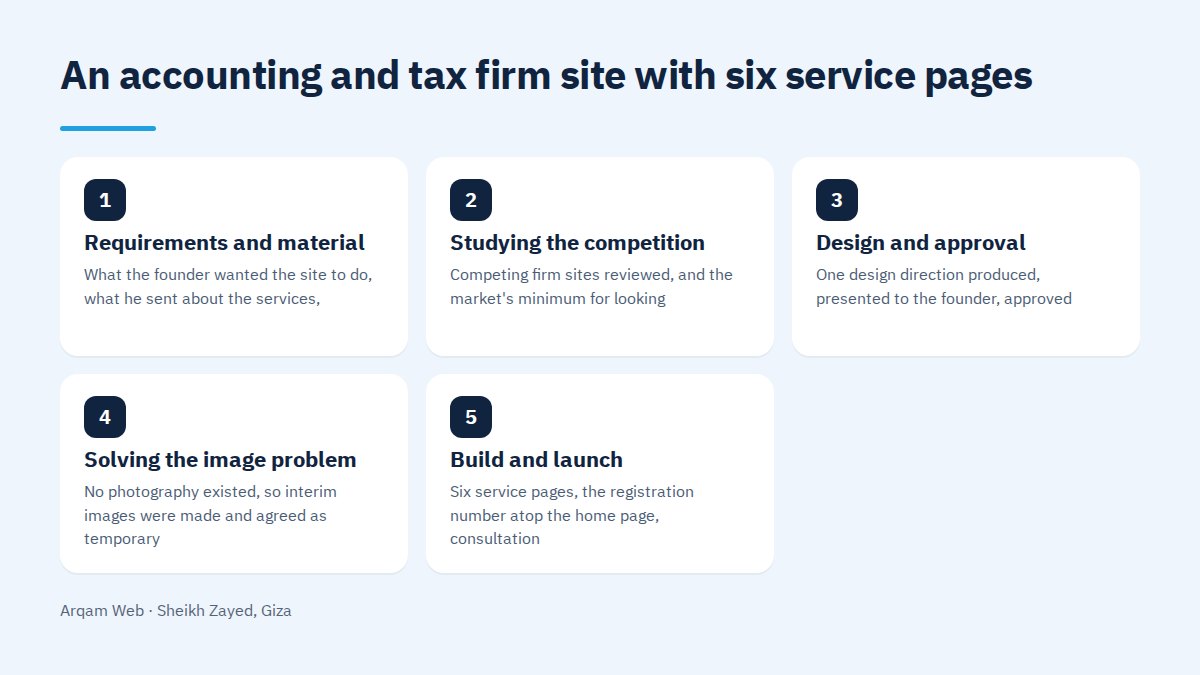
The five phases in the Home of Tax case study
| Phase | What happened in it |
|---|---|
| Requirements and material | What the founder wanted the site to do, what he sent about the services, and which clients the firm was after |
| Studying the competition | Competing firm sites reviewed, and the market’s minimum for looking credible recorded |
| Design and approval | One design direction produced, presented to the founder, approved |
| Solving the image problem | No photography existed, so interim images were made and agreed as temporary |
| Build and launch | Six service pages, the registration number atop the home page, consultation path, careers, blog, legal set, launch |
Note where the competitor study sits. When a firm has nothing to show, the market’s floor stops being research and becomes a build requirement.
What was actually built in the Home of Tax case study?
- Six services on six pages: corporate tax, VAT, excise tax, audit and assurance, accounting and bookkeeping, training programmes.
- Credentials in the first screen. The firm’s TAAN registration number sits atop the home page, not in a footer.
- A consultation path on its own page, for the visitor who has finished reading and wants to talk, kept apart from general contact.
- A careers page, because an advisory firm sells its people, and a site with no way in for the people it wants to hire works against itself.
- A blog, for a field where the rules change and the firm’s value is knowing before its clients do.
- A legal set of four documents: disclaimer, terms of service, privacy policy and cookie policy.
That list is the published outcome, and every item can be checked on the Home of Tax project page. There is no traffic figure and no search position beside it, because the page publishes neither. It publishes instead a review the founder recorded himself, on camera, after delivery. Evidence, not us describing our own work.
Why six pages for six services instead of one services page?
The published reasoning is direct: a business searching for corporate tax help is not searching for a consultancy in general. One services page folds six questions into a single body of text, answers none fully, and gives an answer engine no passage worth quoting.
The practical difference matters more than the technical one. An owner worried about a registration deadline wants a page naming their situation: what the engagement covers, which documents are needed, what happens next.
Why does the registration number come before the claims?
Putting the TAAN number at the top of the home page was deliberate. Any firm can describe itself as expert, and the descriptions are similar enough that they no longer separate one firm from another. A registration number a prospect can verify does.
The principle carries to any regulated profession: a licence, a professional body number, an accreditation with its issuing authority. Anything here about registration or tax is general information, not tax or legal advice, and requirements differ by country and activity.
What turns a visitor into a qualified enquiry?
General practice, not a description of this build. A qualified enquiry comes from someone who knows what they want and fits the work you take:
- A page per service, named the way clients name it. The question arrives as a service, not a firm.
- Verifiable proof somewhere visible: a registration, licence or membership number, not a self awarded adjective.
- A consultation route separate from the contact page, so a decided reader has one step to take.
- Stated limits on who you serve. Naming the business size or sector you work with removes enquiries that never convert.
- What happens next: the first step, the documents required, and who replies.
- A complete legal set. On a site selling regulated advice these pages get read, and their absence shows.
The fourth point is the most neglected, and that problem sits on the page, not in the market. Settle what the site is for first.
How did the Home of Tax case study handle the missing photography?
The firm had no image library, so interim images were created and the design was finished, agreed openly as placeholders to be replaced. A project that waits for perfect assets does not launch, and a page pretending placeholders are permanent ages badly.
The client is in Sharjah and the work was done remotely from our office in Sheikh Zayed, Giza. We have no office in the UAE. For other builds see our work, and our scope sits on the website design and development page.
Frequently asked questions
What is the short version of the Home of Tax case study?
A tax and audit firm in Sharjah that cannot publish client work got a site with six service pages, its TAAN registration number atop the home page, a separate consultation path, careers, a blog and a legal set of four documents. The founder then recorded his own review on camera.
Which six services got their own pages?
Corporate tax, VAT, excise tax, audit and assurance, accounting and bookkeeping, and training programmes. The count is verifiable on the project page. They were separated because someone searching for corporate tax help is not searching for a consultancy in general, and one combined page answers partly.
Why publish no traffic or ranking figures for this project?
Because the project page publishes none, and the Home of Tax case study adds no number we cannot prove. What is published is what was built, item by item, all countable, plus the founder’s recorded review. A filmed review beats a sentence claiming the client was pleased.
Does this model suit a law firm or a clinic?
The principle transfers, the details do not. Any profession that cannot display client work needs the same substitutes: a page per service, a verifiable registration, a clear consultation route, a complete legal set. Service names and issuing authorities change while the structure stays put.
What should a firm prepare before the build starts?
Your service list as clients name it rather than as regulation names it, your registration numbers with issuing bodies, the steps and documents per service in writing, the limits of who you serve, and your legal page text. That material sets the timeline more than design does.
Build your firm’s site on the same method
Send your service list, your registration numbers and a description of the clients you want. You get back a proposed page structure and a written view of what your site can prove, on the method behind the Home of Tax case study: market, structure, design.
Request a quote · Message us on WhatsApp · Call us
Arqam Web
44 Central Axis, Al Saraya Mall, Lower Ground, Entrance 2, Sheikh Zayed, Giza, Egypt
Phone and WhatsApp: +20 111 872 1404 · Email: info@arqamweb.com