

FAQ schema is a block of JSON-LD that labels a question and its answer on a page so a machine can tell them apart. Google stopped showing the FAQ rich result on 7 May 2026 and then removed its documentation, so the markup no longer changes how a page looks in search results.
What FAQ schema actually contains
The markup is not visible content. It describes text that already exists in the page body, in a format built for parsers. Four pieces make a complete block:
FAQPagedeclares the page type: a page carrying questions the publisher wrote and answered.mainEntityis the array holding those questions, in the order a reader meets them.Questionwraps each one, with the question text inname, word for word as the visitor reads it.acceptedAnswercarries anAnswer, and inside it atextproperty holding the full answer, not a trimmed version.
Nothing else is required: no minimum question count in the vocabulary, no third mandatory property inside a question. That simplicity is why FAQ schema spread further than almost any other type, and why so much of it went in without anyone reading the guidelines.
What changed in May 2026
A page carrying this markup could qualify for an expandable set of questions under the title in Google results. It took more vertical space than a plain listing, which is why the type became popular. That display ended on 7 May 2026. Google then removed the feature page from its documentation, and FAQ schema no longer appears in the gallery of supported types.
So the commercial argument for adding it is gone. A proposal pricing FAQ schema today as a way to take more room in Google results is selling a display that no longer exists.
Is the markup still worth keeping?
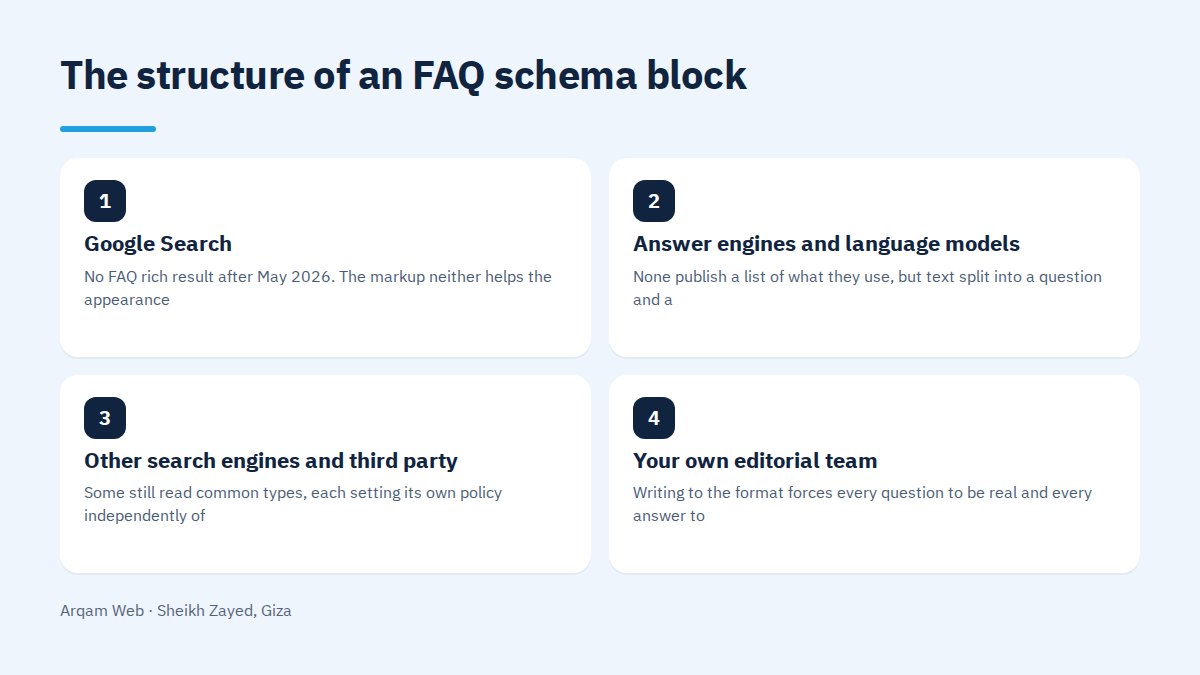
More than one kind of software reads structured data, each on its own terms:
| Who reads the markup | What it does with it now |
|---|---|
| Google Search | No FAQ rich result after May 2026. The markup neither helps the appearance nor causes harm |
| Answer engines and language models | None publish a list of what they use, but text split into a question and a self contained answer is easier for any parser than a running paragraph |
| Other search engines and third party tools | Some still read common types, each setting its own policy independently of Google |
| Your own editorial team | Writing to the format forces every question to be real and every answer to stand alone. That is an editing benefit before a technical one |
The honest summary is that FAQ schema moved from paid work with a visible return to a discipline in how a page is built. Anyone who added it for the look in results has lost their reason. Anyone already writing genuine questions with clear answers has lost nothing.
FAQPage or QAPage: which one describes your page?
These two get mixed up constantly, and the difference is not cosmetic. It comes down to who writes the answer.
FAQPagefits a page where the publisher wrote both sides: a service page, a terms page, or a question section in an article.QAPagefits a page built around one user’s question, answered by other users, the way a forum thread works.- The second type is still supported in Google’s gallery under Q&A, provided the answers genuinely come from users rather than the site owner.
Putting QAPage on a question section a company wrote itself misdescribes the page. Mistakes like that survive for years, because nothing ever reports them.
Six ways FAQ schema goes wrong
In the sites we audit, FAQ schema rarely fails on syntax. It fails on a mismatch between the markup and the page:
- Markup for text nobody can see. Questions in the code that never appear in the body. The oldest violation in the guidelines, and the easiest to catch.
- One block on every page. A template injects the same questions site wide, so a hundred pages claim identical content.
- Questions that are not questions. A marketing line with a question mark bolted on, answered by a paragraph about the company.
- Half an answer. Part of the reply in the markup, part on the page, or an answer that is only a link.
- A deleted section with live markup. Common after a redesign: the code still describes a block that was taken off the page.
- Keywords packed into the question text. The question should read the way a customer says it, not the way you want it indexed.
How do you validate it now?
The Rich Results Test only checks features Google still supports, so it will not report on a type that has left the gallery. Run the schema.org validator to confirm the structure and the property names, then open the page source, read the JSON-LD block and match every question against the body text. Manual reading beats any tool here, because the usual defect is a mismatch, not malformed code.
Also worth reading: web design mistakes, since most structured data problems start with generic code injected through a theme.
What deserves the time instead
Content before markup. A page answering eight questions a customer actually asks serves the reader and the crawler whether or not a line of JSON-LD exists. Valid code on a page with no real questions returns nothing.
On the Forsan Pools project, a pool service company in Riyadh, the home page carries eight FAQ answers in the same scroll as the services, the coverage and the prices. The project page also records that the structured data was configured during the build, for Organization, WebSite, WebPage and Article. The question section earned its place regardless of which markup type sat behind it, which is the right order.
If you are planning a page from scratch, website components shows where a question section belongs, and the web design and development page covers what we handle here.
Frequently asked questions
Should I strip FAQ schema out now that the rich result has gone?
Not if it matches what the page shows. Leaving it costs nothing measurable in crawl budget and carries no risk. Markup describing questions that are not in the body is a different case: remove that today, because it misdescribes the page rather than sitting there harmlessly.
Can leaving the markup trigger a penalty?
Carrying a type that no longer has a display is not a violation. The violation is structured data describing content a visitor cannot see, which was against the guidelines before May 2026 and still is. The rule never changed: markup describes the page.
How many questions should one page carry?
As many as customers genuinely ask, and no target number. Five real questions beat fifteen where half were invented to fill space. Pull them from WhatsApp threads, sales calls and your inbox, then write up only the ones that keep coming back.
Can the same block sit on every page of the site?
Technically yes, practically no. Each page describes itself, and the questions on a service page are not the questions on a contact page. A template level block makes a hundred pages assert the same content, a common finding when one plugin runs the whole site.
Does this need a developer or will a plugin do?
A plugin is enough for a small site, provided you configure it page by page rather than globally. Sites with several templates and generated sections are better served by building the block inside the template, where it stays tied to the text and survives edits.
Want your structured data reviewed?
Send your site address and we will open the source of your main pages, tell you which blocks match the page and which do not, then put the fixes in order.
The official list of what Google supports today is the structured data gallery.
Request a quote · Message us on WhatsApp · Call us
Arqam Web
44 Central Axis, Al Saraya Mall, Lower Ground, Entrance 2, Sheikh Zayed, Giza, Egypt
Phone and WhatsApp: +20 111 872 1404 · Email: info@arqamweb.com