

Egyptian Marble Supplier Case Study:
Sixty-One Stones, Sixty-One Pages
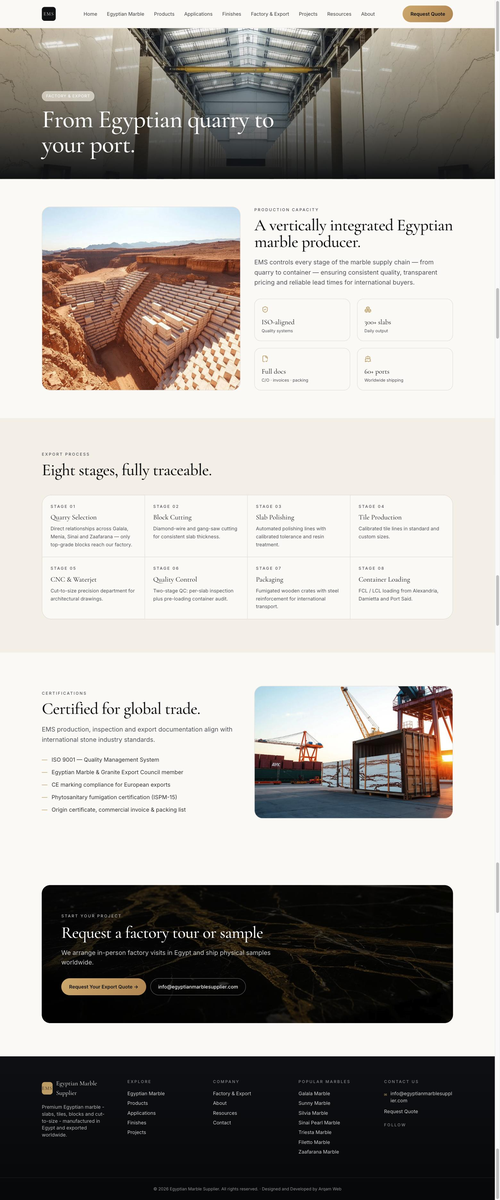
An Egyptian marble exporter selling to buyers worldwide. Every stone got its own page, because that is how the buyers search.
Visit Website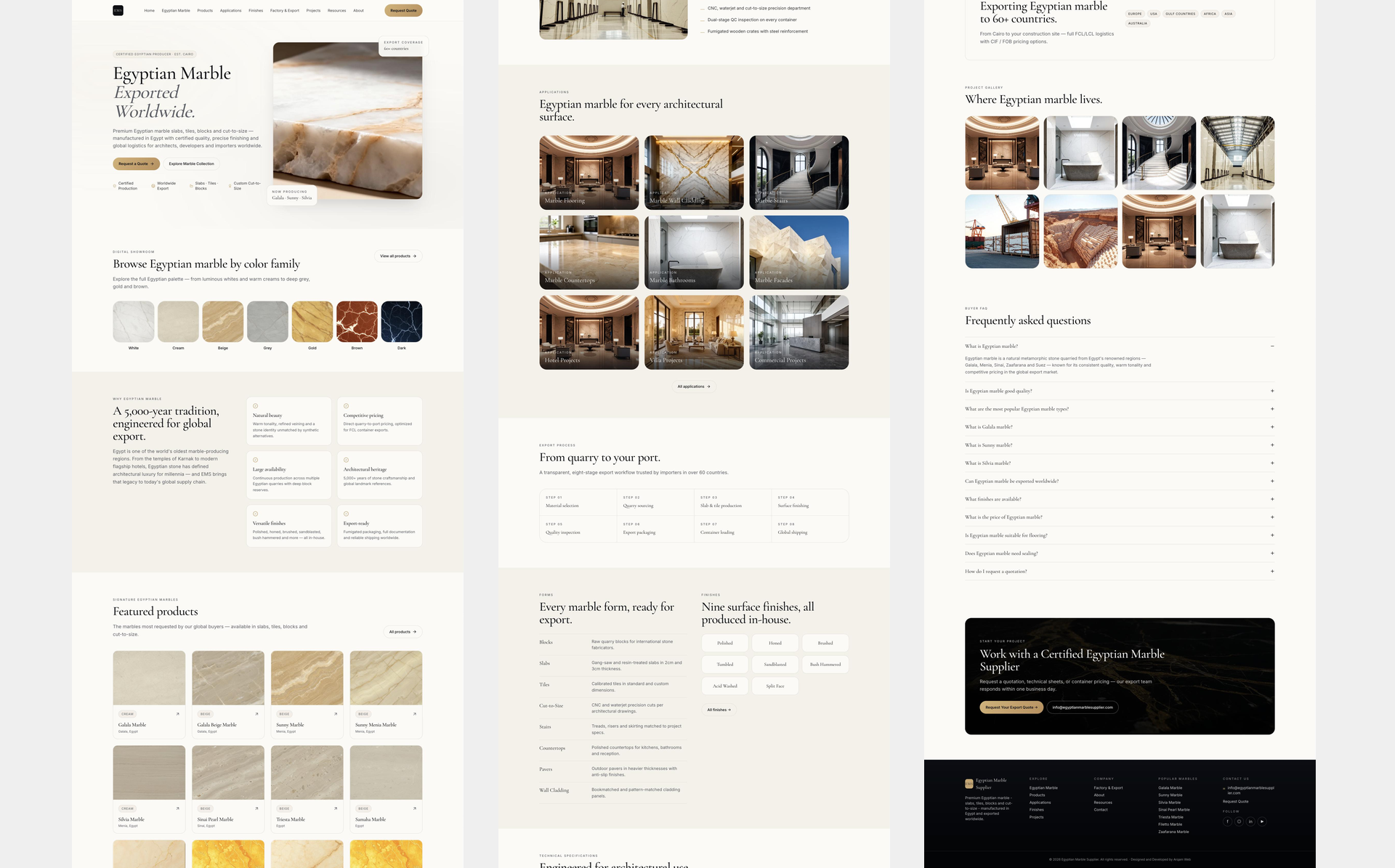
Visual Showcase
Crafted with precision, down to the pixel
Overview
How we transformed this business

The Problem
A trade where the buyer searches by the name of a stone. A site that lists its whole range on one page gives search nothing to land on, and gives an answer engine nothing to quote.

Our Approach
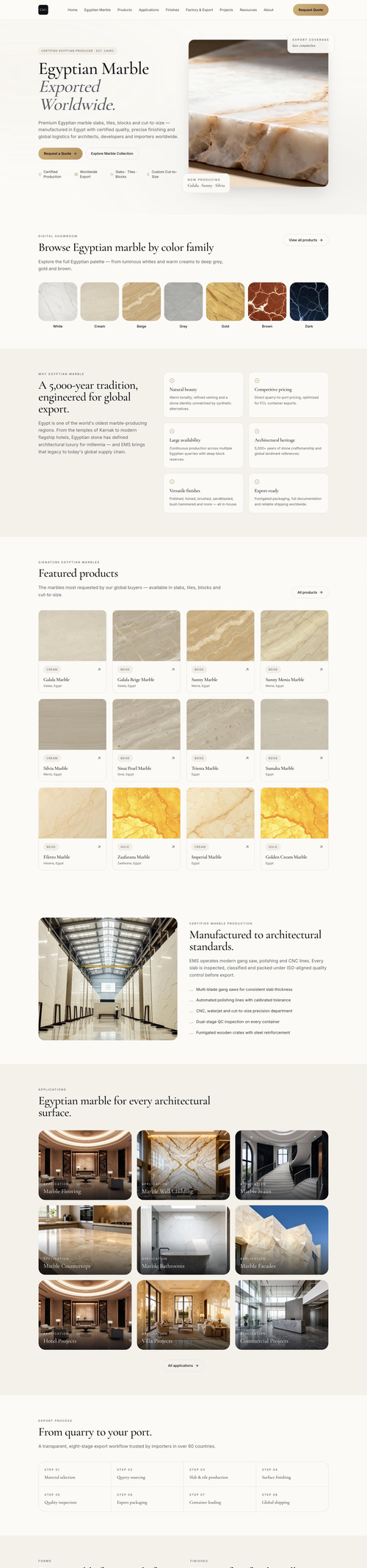
We studied the competitors before deciding the structure, then built a catalogue where every stone is its own page, sorted by colour family and by the form it ships in. The search and answer-engine structure went into the build rather than on top of it afterwards.

The Outcome
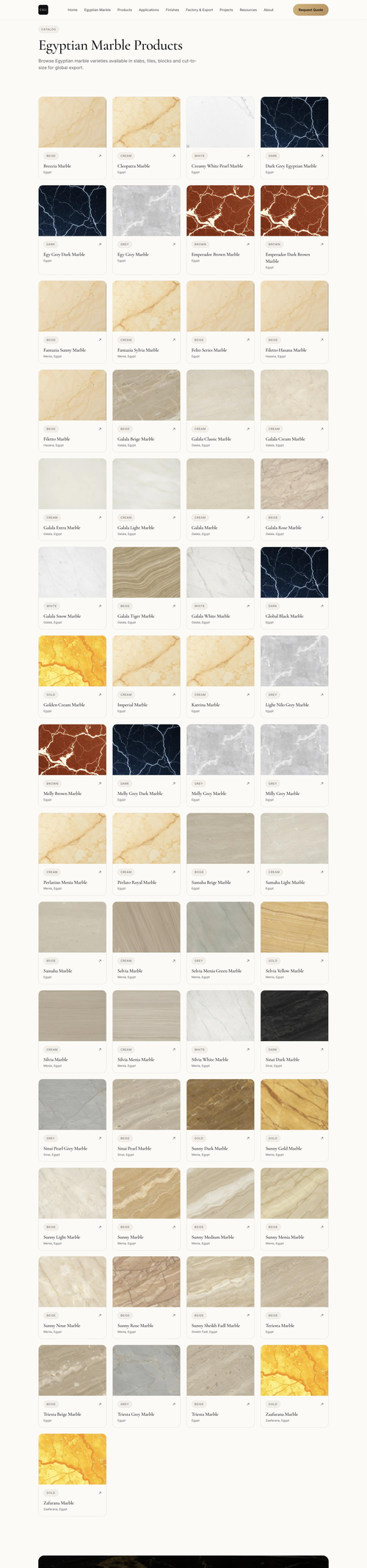
Sixty-one stone pages live under nine sections, from the material guide through to the factory and export side. The catalogue was loaded in full, the base optimisation is done, and the work is continuing.
Project Story
From vision to launch — every step, intentional
- Went through the competitors' sites and recorded how each one handled its range
- Noted where they were strong and where the structure let them down
- Used that to set an initial view of the design and the shape of the site
- Agreed the direction before the build started
- Planned the catalogue as one page per stone rather than one page for the range
- Sorted the stones by colour family, which is how a buyer narrows a choice
- Separated the forms the material ships in: blocks, slabs, tiles, cut-to-size, stairs, countertops, pavers and cladding
- Built the page structure so search engines and answer engines can read what each page is about
- Designed the interface on the agreed structure
- Built the catalogue as its own content type, so the team can add a stone without touching the layout
- Built the supporting sections: the material guide, applications, finishes, factory and export, projects and resources
- Tested the pages before the content went in
- Entered every stone in the range with its own page
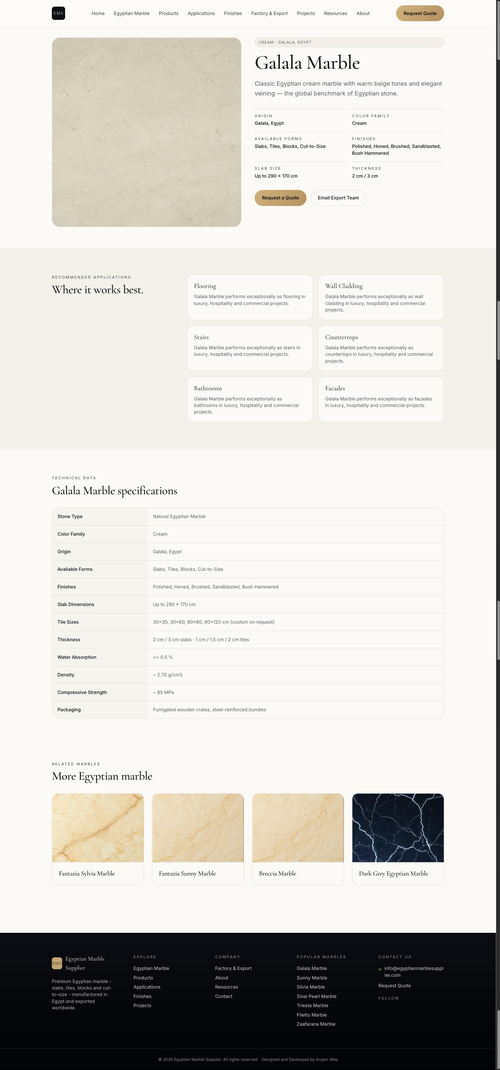
- Gave each one the detail a buyer looks for before asking for a quote
- Grouped them so a visitor can arrive by colour, by form, or by the name of a single stone
- Checked that each page stands on its own for someone landing on it straight from search
- Completed the base on-page work across the catalogue and the main sections
- The site is still being worked on
- No positions are published on this page
- When there are figures we can show, they will go here
What We Built
Performance & Delivery

A Page for Every Stone
Sixty-one marbles, each with a page of its own rather than a row in a list, because a buyer searching for a specific stone by name should land on that stone.

Sorted by Colour, Then by Form
White, cream, beige, grey, gold, brown and dark, crossed with the forms the material ships in, so a buyer can narrow from either direction.

A Material Guide
A section on Egyptian marble itself, for the visitor who is still deciding what to specify rather than what to order.

Factory and Export
The part of the site that answers what an overseas buyer asks before a first order: where it is made, how it is finished, how it ships.

Applications and Finishes
Two more ways into the catalogue, matching how specifiers think: by where the stone is going, and by how its surface is treated.

A Catalogue the Client Can Extend
The stones sit in their own content type, so adding one is entering a record rather than rebuilding a page.
Behind the Results
Why this project succeeded

The Structure Was the Optimisation
It was a build decision, not a later pass.
There is a version of this project where the site gets designed first and optimised afterwards. It produces a catalogue on one page, and a search consultant asking later for it to be split up. We planned it the other way round: one page per stone, grouped by colour and by form, with the page structure readable by search engines and by the answer engines that now sit above them. That is a decision you make before the design, or you make twice.

Reading the Competition First
We looked at what the trade was already doing, and where it was weak.
Before deciding anything we went through the sites already selling into this trade and recorded both what worked and where their structure let them down. That study is what produced the first view of the design and the shape of the site. It is cheaper to learn from a market than to test against it.

Sixty-One Entries, Not One Page
The catalogue was loaded in full, stone by stone.
After the build we entered the whole range: sixty-one stones, each with its own page and the detail a buyer wants before asking for a quote. A range page with sixty-one names on it takes an afternoon. Sixty-one pages take a great deal longer, and they are the reason someone searching for one stone by name arrives somewhere that answers them.

Still Working On It
The base optimisation is done. The project is not.
Search work on a catalogue this size does not finish at launch. The base is in place and we are still working on the site. No positions or traffic figures appear on this page, because we publish figures we can show and this is not yet the moment for them. When there is something to show, it goes here.
Sound Familiar?
What This Means For You
- Struggling with low traffic and zero visibility?
- Poor conversion rates despite good products?
- Slow, outdated website hurting your credibility?
- Competitors outranking you on every search?
Let's achieve similar results for your business.
Ready to Build a Website That Actually Makes You Money?
We build high-performance websites engineered for growth, revenue, and measurable business results.
Related projects.
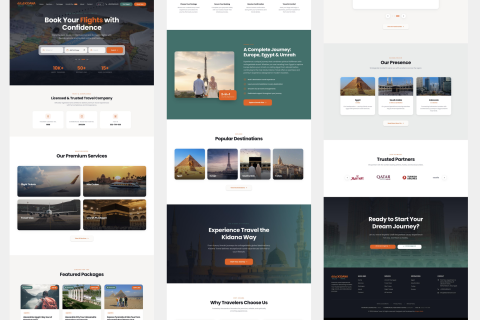
Kidana Travel Website
Custom Laravel Travel Platform with Online Booking
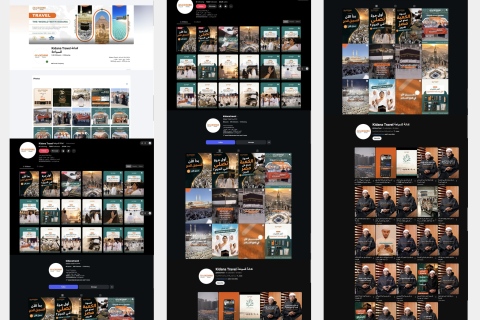
Kidana Travel Social Media
Social Media Marketing for Hajj and Umrah
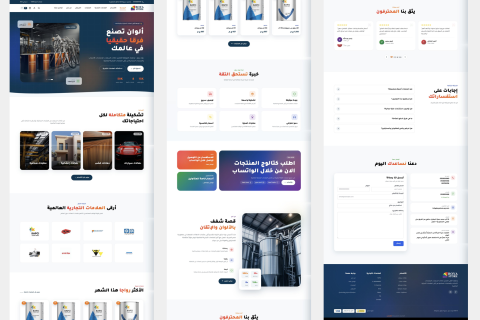
Boya Store Website
WooCommerce Store for a Multi-Brand Paint Retailer